


Listen to the article
Artist Faces Unexpected Opposition Over Palestinian Exhibition
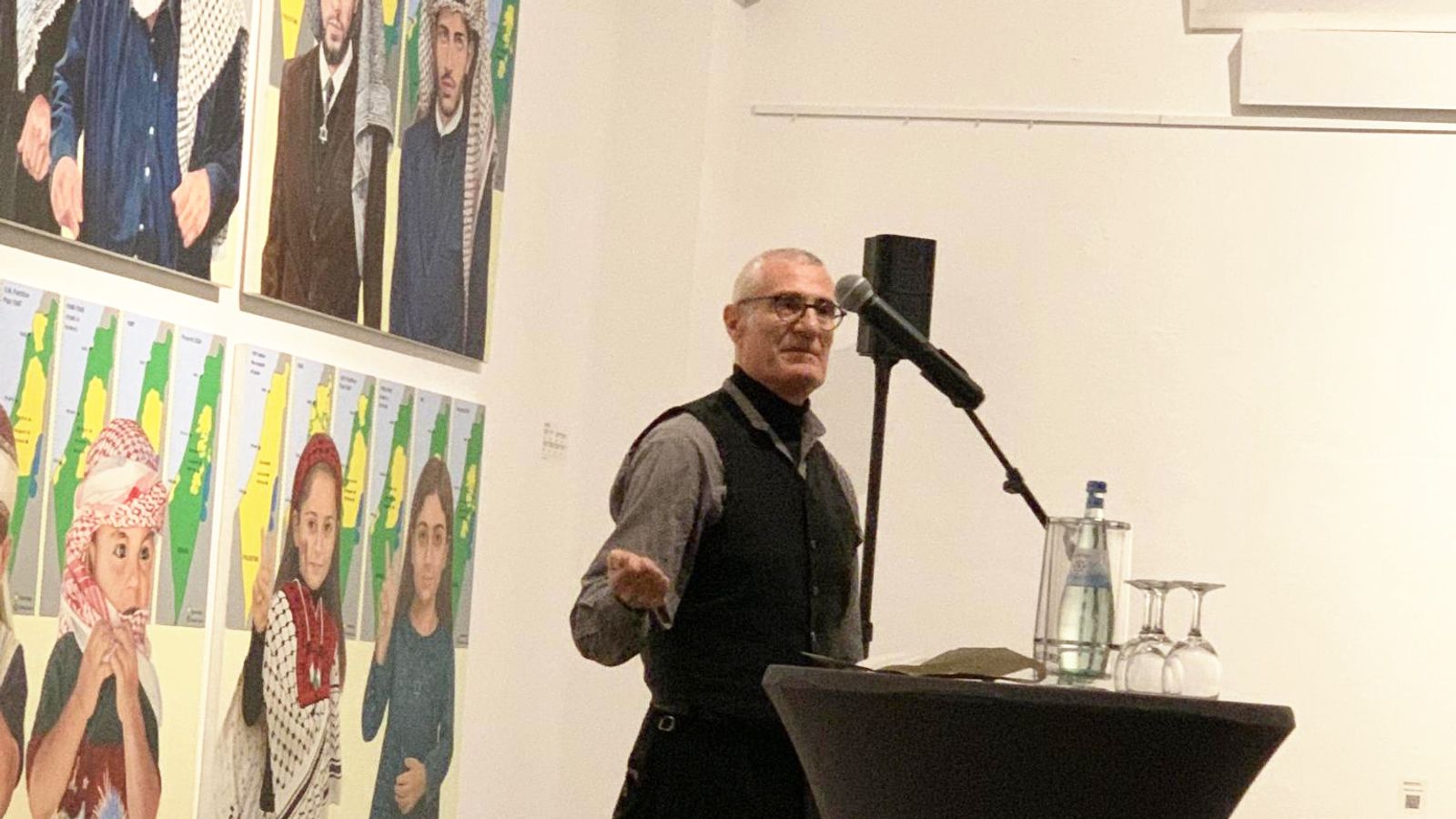
Berlin-based Italian artist Costantino Ciervo encountered significant resistance from an unexpected source during the opening of his latest exhibition, “COMUNE—The Paradox of Similarity in the Middle East Conflict,” at Potsdam’s Fluxus Museum in mid-November.
In a surprising turn of events, the museum’s own curator, Tamás Blénessy, used his introductory speech to express vehement opposition to the exhibition, which aims to encourage debate about the persecution of Palestinian people and highlight the common interests and roots of peoples in the Middle East.
“The curator’s statement expressed arguments which could have come from the mouth of Israeli President Benjamin Netanyahu,” Ciervo explained in an interview following the opening. “His remarks represented the most right-wing positions held by Zionists.”
According to Ciervo, Blénessy’s speech drew heavily from an essay by Zionist blogger Ilya Bezruchko, making controversial claims including the assertion that Palestinians as a people do not exist and that no occupation of Palestinian lands had taken place. The curator reportedly avoided using the term “Palestinian” throughout his speech, instead referring only to “Arabs” or “people other than Israelis.”
Ciervo, a self-proclaimed political artist and socialist whose work over four decades has consistently addressed the plight of exploited groups, including undocumented workers in Italy and migrants who died crossing the Mediterranean, promptly countered these claims in his response to the audience.
“I made the point that the concept of nation first arose along with the development of capitalism,” Ciervo said. “Peoples with traditions other than Jewish tradition had been living in the territory of the Middle East for thousands of years. The term Palestine was already used 2,000 years ago by the Romans, by the British when they administered the territory, and is also used by the United Nations.”
The exhibition itself uses AI-generated imagery to illustrate similarities between Jewish and Arab peoples, juxtaposing portraits to evoke an affiliation between individuals often portrayed as fundamentally different. Ciervo meticulously hand-painted these AI-generated patterns, demonstrating how new technologies can be used constructively in artistic production.
Central to the exhibition is the concept of a one-state solution for the Israeli-Palestinian conflict. “If two states are built side by side, then one state, Israel, would be much more powerful, receive more support and have more money, while the second state would remain underdeveloped,” Ciervo explained. “This inequality would invariably provoke violence.”
The artist illustrates this concept through a sewing machine installation that stitches the outline of Palestine from 1917, with the territory currently occupied by Israel in the middle. Background imagery shows the steady diminution of Palestinian land during the past 75 years.
Ciervo’s work continues a tradition of opposition to a religiously based Jewish state in the Middle East that includes prominent Jewish intellectuals like Albert Einstein and Hannah Arendt, who in 1948 warned of the dangers of such an approach.
In discussing his use of artificial intelligence, Ciervo highlighted both the technology’s potential and its current misuse. “AI is used every day to achieve Netanyahu’s plan for a Greater Israel,” he noted, referencing Israel’s Unit 8200, which employs facial recognition technology to identify and eliminate opponents. “This technology is being used to oppress and potentially eliminate an entire people.”
By contrast, Ciervo uses AI metaphorically, creating twin portraits that show Palestinians and Jewish people as siblings with more commonalities than differences. “The source of their differences is external, in particular, the priorities of major imperialist powers which seek to divide in order to maintain their rule,” he said.
Despite the controversy, the exhibition continues to draw attention for its thought-provoking approach to one of the world’s most persistent conflicts, showcasing how art can challenge dominant narratives and offer alternative perspectives on complex geopolitical issues.
Fact Checker
Verify the accuracy of this article using The Disinformation Commission analysis and real-time sources.

16 Comments
It’s disappointing to hear the curator apparently used their position to advance a partisan agenda rather than facilitate open and thoughtful discussion. Museums should be forums for the exchange of ideas, not platforms for political propaganda.
I agree, the curator’s actions seem highly inappropriate and undermine the purpose of the institution. Museums have a responsibility to uphold principles of impartiality and artistic freedom.
This is a concerning incident. Curators should remain impartial and facilitate open dialogue, not push their own biases. I hope the artist is able to continue exhibiting their work without interference.
I agree, the curator’s remarks seem highly partisan and inappropriate. Exhibitions should encourage thoughtful discussion, not shut it down.
It’s concerning to hear the curator apparently used their platform to voice such overtly partisan views. Museums should be spaces for nuanced exploration of issues, not venues for political grandstanding.
I agree, the curator’s actions seem inappropriate and undermine the integrity of the institution. Exhibitions should aim to inform, not inflame tensions.
This is a complex and sensitive issue. While I don’t know all the details, I believe museums have a responsibility to present diverse perspectives, not suppress them. Hopefully the exhibition can continue as intended.
That’s a fair point. Censorship or one-sided narratives in cultural institutions are concerning. A balanced approach that encourages dialogue is important.
The curator’s behavior seems highly unprofessional and antithetical to the mission of a museum. Artists should be able to express their views without interference from biased staff. I hope this incident leads to greater accountability.
I agree, the curator’s actions undermine the integrity of the institution. Museums must uphold principles of impartiality and artistic freedom.
This is a disappointing development. While people can have differing views on complex geopolitical issues, a museum curator should strive to be objective and facilitate respectful dialogue, not push their own agenda.
Well said. Curators have a responsibility to remain neutral and create an environment conducive to the open exchange of ideas, not propagate their personal biases.
It’s troubling to hear the curator made such politically-charged statements that appear to contradict the exhibition’s purpose. Museums should foster objective understanding, not promote divisive rhetoric.
You’re right, the curator’s actions undermine the museum’s role as a neutral platform for artistic expression and public discourse. This is an unfortunate development.
This is a troubling situation. Curators wield significant influence and must exercise great care to avoid injecting their own ideological leanings into the programming. Hopefully this incident leads to a reevaluation of policies and practices.
Well said. Maintaining objectivity and creating space for diverse perspectives is crucial for cultural institutions. This situation raises important questions about curatorial ethics and accountability.