


Listen to the article
Genocide Denier Milorad Dodik Receives Controversial Award at U.S. University
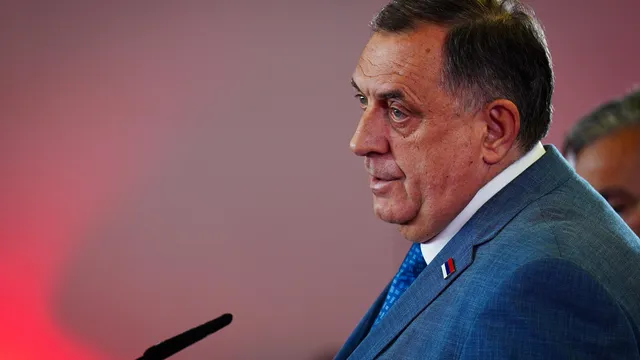
Former Republika Srpska president Milorad Dodik has sparked outrage after receiving a “Leadership and Standing Up for Democracy Award” at Judson University in Illinois, where he openly denied the Srebrenica genocide during his acceptance speech.
Speaking through an interpreter at the Christian university’s World Leaders Forum, Dodik dismissed the 1995 massacre of more than 8,000 Bosniak men and boys as “NATO propaganda” despite international courts classifying the atrocity as genocide.
“There was a crime against Muslims, against Serbs and against Croats as well. All the most prominent genocide scholars and academics say that genocide was not committed,” Dodik claimed, contradicting rulings by the International Criminal Tribunal for the former Yugoslavia and the International Court of Justice.
Dodik, who served as president of Republika Srpska, one of Bosnia and Herzegovina’s two main political entities, from 2022 until his removal from office earlier this year, has a documented history of shifting positions on the Srebrenica massacre. In 2007, he acknowledged the genocide based on Hague tribunal rulings but later reversed his stance, repeatedly calling it a “fraud,” “myth,” and “fabrication.”
Throughout his speech to a packed audience at the university’s Herrick Chapel, Dodik maintained a defiant tone, arguing that Serbian politicians and the Serbian army should not “bear the guilt” for what happened. “I never had hatred for anybody. I always loved my people and respected others,” he insisted.
The event drew significant opposition both before and during Dodik’s appearance. Mark Vargas, Judson graduate and chairman of the World Leaders Forum, acknowledged receiving “hundreds of coordinated messages from international activists” demanding the event’s cancellation. Despite heavy rain, dozens of protesters gathered outside the campus to express their outrage.
“We are genocide survivors. For Judson University to award someone who is a known genocide denier is a slap in all of our faces,” said Chicago resident Alma Hodzic, representing the sentiment of many Bosnian Americans who fled the conflict in the 1990s.
University leadership defended their decision to proceed with the event. Judson President Gene Crume acknowledged the controversy but maintained that canceling would “abandon the very principle of open inquiry that defines a university education.” He emphasized that the forum does not endorse speakers’ views but aims to create space for students to “confront complex global realities directly.”
Adding to the controversial nature of the event, Dodik appeared alongside former Illinois Governor Rod Blagojevich, who was convicted on corruption charges before receiving a pardon from then-President Donald Trump in early 2025. Blagojevich has since become a paid lobbyist representing Republika Srpska’s interests in the United States.
When presenting the award, Vargas framed Dodik’s stance as courageous, stating that “standing up for your people, your country and your freedom never comes easy, but it is a battle that all of us, no matter who we are, should never stop fighting.”
The Srebrenica genocide stands as the worst atrocity on European soil since World War II. In July 1995, Bosnian Serb forces under General Ratko Mladić overran what had been designated a UN “safe area,” systematically separating men and boys from women before executing them and burying them in mass graves. Both Mladić and Bosnian Serb political leader Radovan Karadžić have been convicted of genocide for their roles in orchestrating the massacre.
Dodik’s award comes amid increasing concerns about historical revisionism in the Balkans, where ethnic tensions continue to simmer nearly three decades after the Bosnian War ended. Human rights organizations have consistently warned that genocide denial not only dishonors victims but threatens the fragile peace in the region by inflaming nationalist sentiments.
Fact Checker
Verify the accuracy of this article using The Disinformation Commission analysis and real-time sources.

6 Comments
Genocide denial is a dangerous and harmful act that should be firmly condemned, not rewarded. This award decision seems highly misguided and raises doubts about the judgment of those involved.
Milorad Dodik’s dismissal of the Srebrenica genocide as NATO propaganda while receiving a democracy award is deeply disturbing. Denying well-established historical facts about mass atrocities undermines human rights and accountability.
This award decision raises serious concerns about the vetting process and the true values upheld by the award’s organizers. Genocide denial should disqualify any individual from receiving an accolade for democratic leadership.
It’s disheartening to see a political leader receive a prestigious award while openly rejecting the well-documented Srebrenica genocide. This raises serious questions about the credibility and standards of the award.
Receiving a democracy award while denying the Srebrenica genocide seems highly contradictory. How can an individual who rejects established historical facts about mass atrocities be considered a champion of democratic values?
Dismissing the Srebrenica genocide as NATO propaganda is deeply concerning, especially when the recipient of a democracy award. Downplaying such horrendous war crimes undermines accountability and justice.