


Listen to the article
The Myth of Carl Benz and the World’s First Automobile: Setting the Historical Record Straight
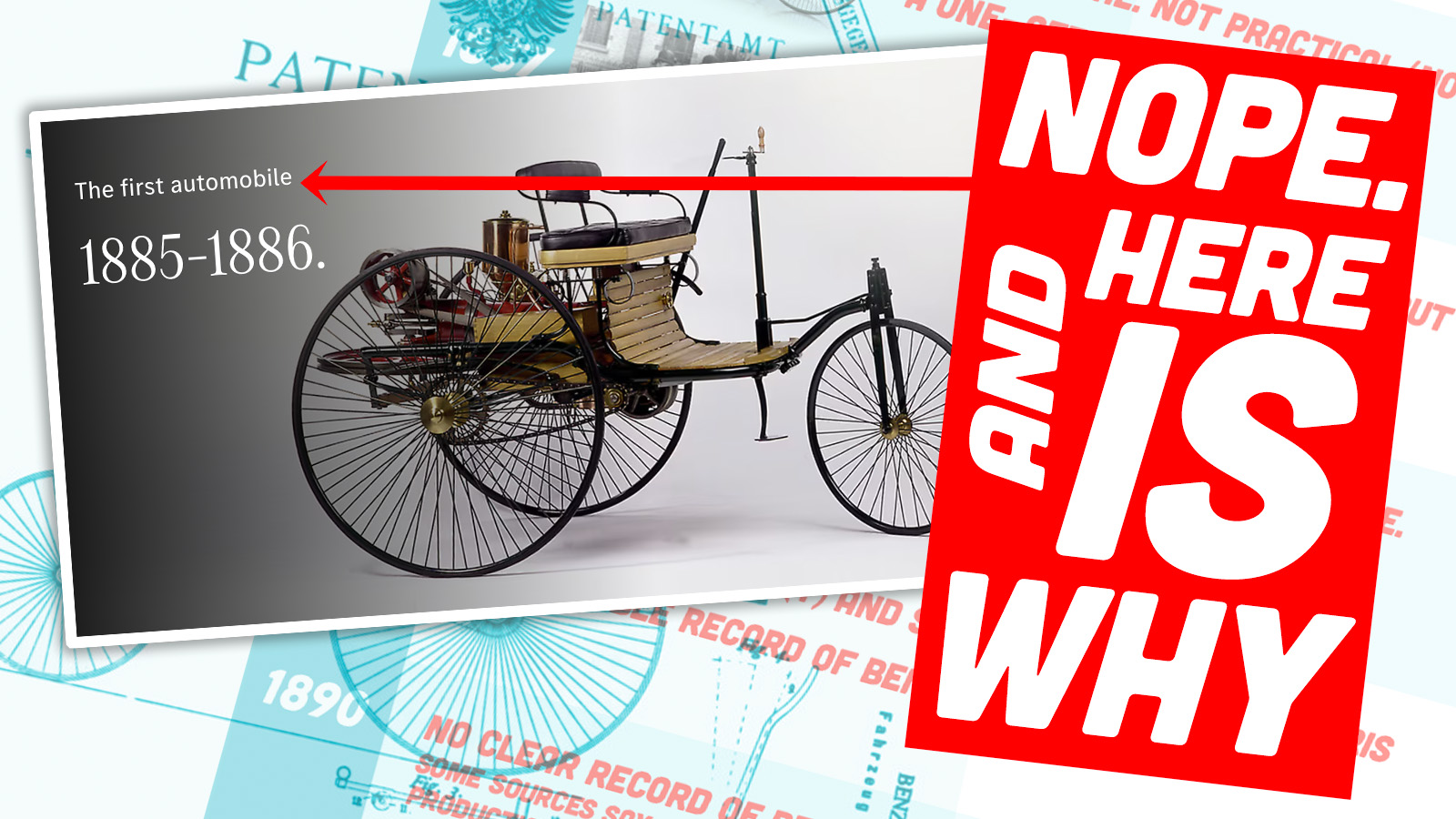
For decades, automotive enthusiasts and historians have accepted without question that Carl Benz invented the automobile in 1886 with his Patent-Motorwagen. Mercedes-Benz has proudly upheld this claim as part of its corporate heritage. However, a growing body of evidence suggests this widely accepted “truth” is fundamentally flawed and stems from questionable historical revisionism.
The 1886 Benz Patent-Motorwagen, despite its undeniable importance, was neither the first automobile nor the first production vehicle. It represented just one milestone in a century-long evolution of self-propelled vehicles that began with Nicholas-Joseph Cugnot’s steam drag in 1769.
Even when qualified as “the first gasoline-powered” or “first practical” automobile, the Benz narrative falls apart under scrutiny. The 1886 Patent-Motorwagen was an experimental machine that couldn’t tackle hills and had no fuel tank, relying solely on the 1.5 liters of petroleum distillate in its crude carburetor. This one-off prototype was far from a production-ready vehicle.
Between 1886 and 1888, Benz produced three distinctly different experimental vehicles, each addressing shortcomings of its predecessor. The vehicle Bertha Benz famously drove in 1888 was not the original 1886 model, though many recreations incorrectly depict it as such. The 1888 model still required roadside repairs and assistance on hills during Bertha’s journey.
Production figures further undermine the “first production car” narrative. Mercedes-Benz claims “about 25” Patent-Motorwagens were sold between 1886 and 1894, but this figure lacks verification. The earliest evidence suggests Benz might have begun taking orders around 1890, with sales agent Émile Roger reportedly selling “almost a dozen” by 1892 – hardly the clear-cut production success the historical narrative suggests.
By comparison, Peugeot built four Type 2 automobiles in 1890 and followed with 64 units of the Type 3 by 1894. Panhard et Levassor sold 90 vehicles by 1894. Both companies have documented sales figures that exceed Benz’s alleged production during the same period.
Perhaps most significantly, the Panhard et Levassor vehicles introduced in 1891 established what would become the standard automotive layout for nearly a century – engine in front, driving the rear wheels – known as the Système Panhard. This arrangement defined automotive design until the rise of front-wheel drive in the 1970s, making Panhard’s contribution arguably more foundational to “modern” automobile design than Benz’s three-wheeled vehicle with its horizontal flywheel and under-seat engine.
The troubling origin of Mercedes-Benz’s “inventor of the automobile” claim can be traced to Nazi Germany. In 1940, Daimler-Benz’s board wrote to the Reich Ministry for Public Enlightenment and Propaganda, resulting in an official directive that German encyclopedias should credit Daimler and Benz, rather than Siegfried Marcus, as “the creators of the modern automobile.”
Marcus, an Austrian Jew who had built internal combustion vehicles as early as 1870, had been widely recognized in pre-war reference works as a pioneer of automobile development. A documented noise complaint about Marcus’s “Benzinautomobil” from 1875 suggests he had functioning gasoline-powered vehicles before Benz. The Nazi regime’s systematic erasure of Marcus from automotive history, combined with Mercedes-Benz’s willingness to benefit from this revisionism, has perpetuated a flawed historical narrative for over 80 years.
This historical distortion does not diminish Carl Benz’s genuine contributions to automotive development. He was undoubtedly a brilliant engineer whose work significantly advanced automobile technology. However, his achievements should be placed in proper historical context rather than exalted through a narrative born of Nazi propaganda.
The time has come for Mercedes-Benz to acknowledge this uncomfortable truth and correct the historical record. Automobile development was a collaborative, multinational effort spanning more than a century, with numerous inventors making crucial contributions. The rich tapestry of automotive history deserves to be told accurately, free from the distortions of political manipulation and corporate mythology.
Fact Checker
Verify the accuracy of this article using The Disinformation Commission analysis and real-time sources.

9 Comments
I’m glad to see this critical examination of the automotive industry’s founding myths. Uncovering the truth behind these origin stories is important, even if it means dismantling cherished corporate legacies.
This is a thought-provoking piece that challenges the conventional wisdom around the automotive industry’s origins. Separating fact from propaganda is crucial, and I appreciate the author’s efforts to set the record straight.
Fascinating article about the complex origins of the automobile. I didn’t know the Mercedes-Benz narrative had been shaped by Nazi propaganda – that’s quite troubling. It’s important to critically examine historical claims and not simply accept them at face value.
Agreed, uncovering the truth behind these iconic brands is important. It’s a good reminder to be skeptical of corporate origin stories and do our own research.
The article raises some valid concerns about the Mercedes-Benz origin story and its Nazi ties. I’m curious to learn more about the alternative narratives and earlier pioneering work in self-propelled vehicles.
Same here. It would be fascinating to explore the lesser-known innovators and developments that predated the Benz Patent-Motorwagen. Shedding light on the full history is important.
This is an eye-opening look at how even foundational automotive history can be distorted by political agendas. I appreciate the deep dive into the actual origins of the automobile, beyond just the Benz narrative.
Yes, it’s crucial we understand the full historical context, not just the sanitized version promoted by manufacturers. Objectivity is key when examining these types of corporate legends.
Wow, I had no idea the Mercedes-Benz story was so deeply entangled with Nazi propaganda. It’s alarming to see how corporate narratives can be shaped by political agendas. This is a valuable lesson in historical skepticism.