


Listen to the article
Tennessee lawmakers have approved a contentious new congressional map that threatens to eliminate the state’s last Democratic-held congressional seat, sparking fierce protests and immediate legal challenges from civil rights groups.
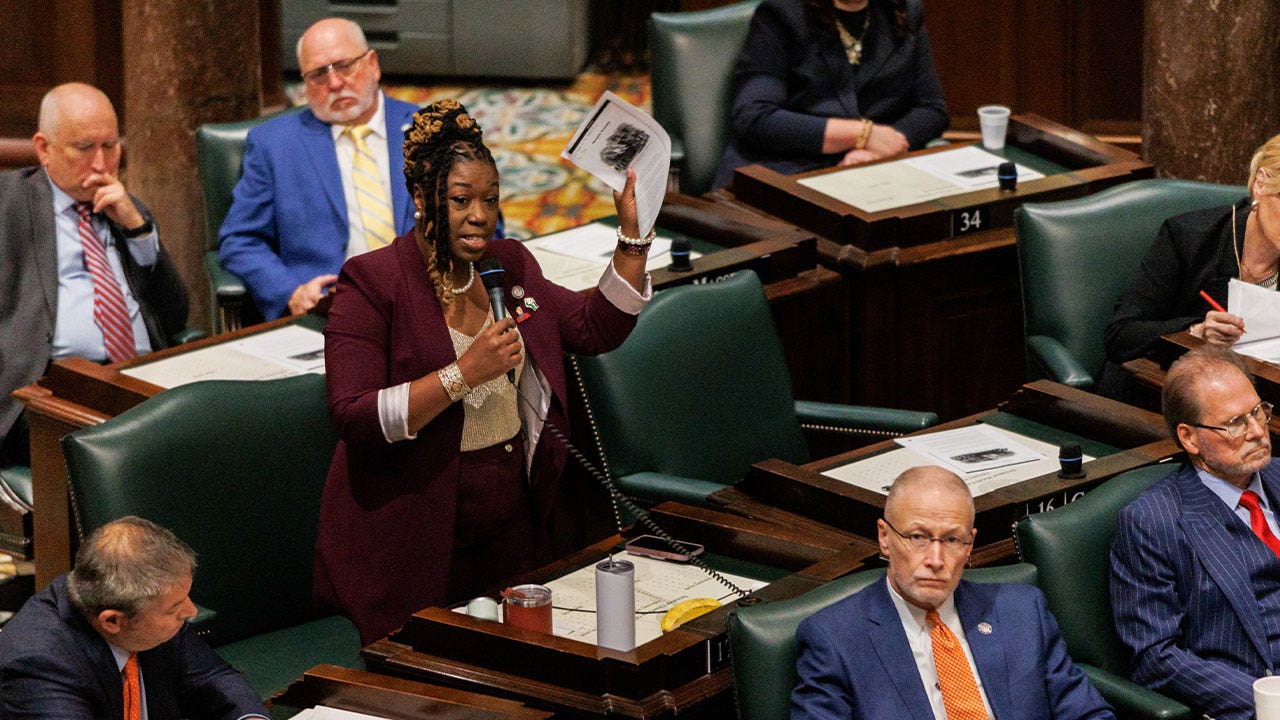
The Republican-controlled legislature passed the redistricting plan Thursday amid chaotic scenes, with Democratic lawmakers using air horns and linking arms in protest as the measure advanced to Governor Bill Lee’s desk for his expected signature.
The new map specifically targets Tennessee’s 9th Congressional District, the state’s only majority-Black district and final Democratic stronghold, centered in Memphis. The redesign would effectively create an all-Republican congressional delegation from Tennessee, shifting from the current 8-1 Republican advantage to a potential 9-0 sweep.
During the heated legislative session, tensions boiled over as Democratic lawmakers vocally opposed the measure. Tennessee State Troopers were called to maintain order in the galleries when protesters attempted to reach the chamber floor during the vote.
“You may have the votes to do this, but you don’t have the moral authority,” said State Senator London Lamar, a Democrat from Memphis, who characterized the redistricting as an “insult” to the Black community and warned Republican colleagues that their actions had “awakened a sleeping giant.”
State Senator Charlane Oliver, a Democrat from Nashville, rejected the notion that the map reflects Tennessee’s natural political leanings. “Tennessee is not a red state,” Oliver argued during floor debate. “Tennessee is a gerrymandered state. We are a suppressed state.”
The redistricting push gained momentum following support from U.S. Senator Marsha Blackburn, who is considered the frontrunner to replace Governor Lee. Blackburn publicly endorsed the effort on social media, writing: “I urge our state legislature to reconvene to redistrict another Republican seat in Memphis. It’s essential to cement @realDonaldTrump’s agenda and the Golden Age of America.”
Republican lawmakers have defended the new boundaries as reflecting Tennessee’s increasingly conservative political identity. The state has trended more Republican in recent election cycles, and supporters argue the map aligns with this shift.
The redistricting comes amid a nationwide trend of partisan map-drawing following the Supreme Court’s recent decision that gives state legislatures greater latitude in redrawing congressional districts. Several states with Republican-controlled legislatures have moved quickly to redraw maps that could help Republicans maintain or expand their majority in the U.S. House of Representatives.
Civil rights advocates have already launched legal challenges to Tennessee’s new map. The NAACP’s Tennessee chapter filed a lawsuit Thursday, arguing the redistricting plan illegally dilutes Black voting power and deliberately targets the state’s only majority-Black district in violation of the Voting Rights Act.
The outcome of Tennessee’s redistricting battle could have significant implications for the balance of power in Congress. Political analysts note that every seat will be crucial in the 2026 midterm elections, where control of the narrowly divided House of Representatives will be at stake.
The controversy highlights ongoing tensions around redistricting nationwide, with critics arguing partisan gerrymandering undermines democratic representation, while supporters maintain states have legitimate authority to draw districts reflecting their political majorities.
As Governor Lee considers the legislation, both supporters and opponents are preparing for what will likely be a protracted legal battle that could ultimately determine whether Tennessee’s congressional delegation remains politically diverse or becomes uniformly Republican for the first time in modern history.
Fact Checker
Verify the accuracy of this article using The Disinformation Commission analysis and real-time sources.

14 Comments
Eliminating the final Democratic seat in Tennessee’s congressional delegation is a significant blow to political diversity. I hope cooler heads prevail and a more balanced map can be drawn.
Redrawing district lines to disenfranchise minority voters is a troubling trend we’re seeing in many states. I hope the legal challenges to Tennessee’s new map are successful in preserving democratic principles.
While redistricting is a complex process, the new Tennessee map seems to prioritize partisan interests over fair representation. I encourage lawmakers to seek a more balanced and inclusive solution.
The protests and disruptions during the vote highlight the high stakes involved. Tennessee lawmakers should carefully consider the legal and ethical implications before finalizing this redistricting plan.
Agreed, the chaotic scenes underscore how divisive this issue has become. A more collaborative, inclusive approach would be better for Tennessee’s long-term political stability.
Redistricting should serve to accurately reflect the will of the people, not consolidate partisan power. It’s disappointing to see Tennessee take this approach amid protests from civil rights groups.
I agree, the redraw seems aimed at silencing the opposition rather than upholding democratic principles. This is a worrying trend we’re seeing in many states.
Redistricting is always a delicate and politically charged process. While I understand the desire for efficient governance, the new Tennessee map seems to tip the scales too far in one direction. A more balanced approach would be preferable.
Redistricting is a complex and often contentious process. While I understand the desire for efficient governance, the new Tennessee map appears to unfairly target minority representation. Transparent, bipartisan redistricting is crucial for a healthy democracy.
This situation illustrates the challenge of balancing practical redistricting needs with principles of fair representation. I hope Tennessee can find a solution that upholds democratic values.
Eliminating the last Democratic seat in Tennessee’s congressional delegation is a concerning development. Redistricting should aim to accurately reflect the will of all voters, not solidify one party’s control.
I agree, this appears to be a blatant attempt at gerrymandering. Upholding democratic principles should be the priority, not consolidating partisan power.
This is a concerning development for democratic representation in Tennessee. Redrawing district lines to disenfranchise minority voters is deeply troubling. I hope the legal challenges are successful in preserving fair elections.
It’s disheartening to see the protests and disruptions during the redistricting vote in Tennessee. Ensuring fair representation should be the goal, not creating an all-Republican congressional delegation.