


Listen to the article
X’s new account transparency tool has unexpectedly revealed that many influential “America First” social media accounts appear to be operating from outside the United States, sparking intense debate about foreign influence in American political conversations.
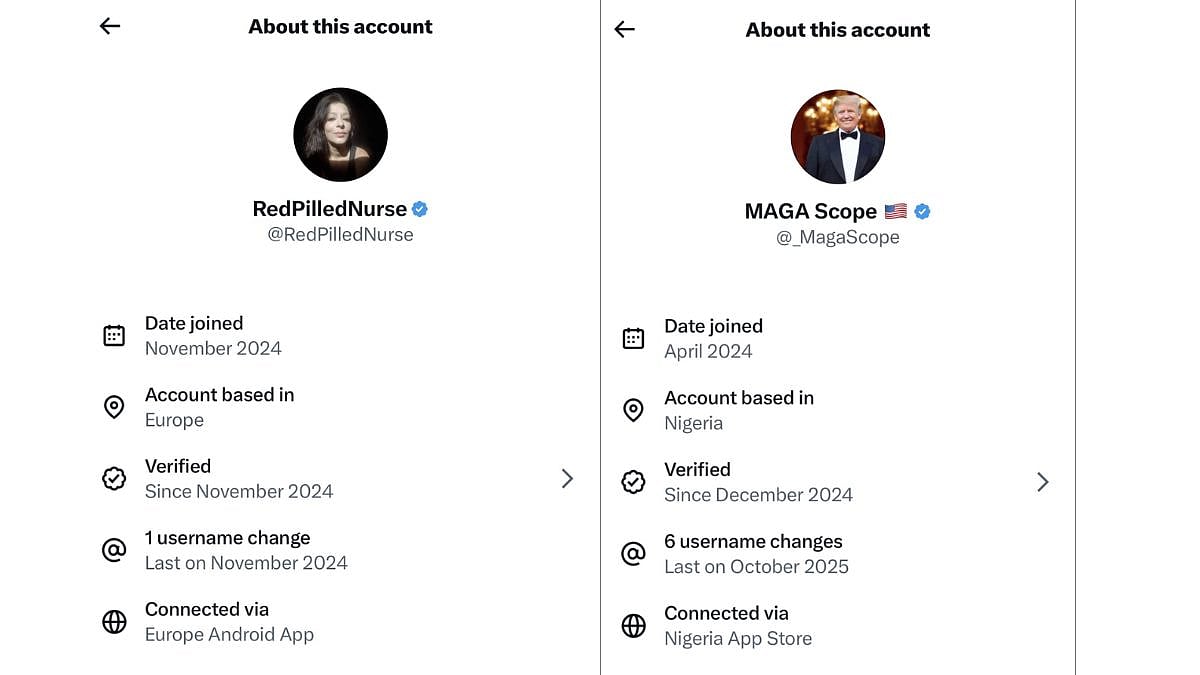
The platform’s “About This Account” feature, now available globally, displays information including an account’s country of origin, creation date, and username change history. Within hours of the rollout, users began discovering that numerous high-profile accounts promoting right-wing and MAGA (Make America Great Again) content were actually based in countries such as India, Bangladesh, Nigeria, Pakistan, and various parts of Eastern Europe.
Among the prominent accounts identified was MAGANationX, which boasts nearly 400,000 followers and describes itself as a “Patriot Voice for We The People.” Despite its staunchly American patriotic positioning, the account appears to be operated from Eastern Europe. Another account, IvankaNews_, which has amassed over one million followers and regularly posts content about immigration concerns and support for former President Donald Trump, was revealed to be based in Nigeria.
India emerged as a particular hotspot for such accounts, with multiple profiles linked to the subcontinent actively amplifying anti-immigrant rhetoric and pro-Trump messaging. Other accounts with similar political leanings were traced to Bangladesh, Thailand, Pakistan, Japan, and New Zealand. One account named “America First” — a relatively new profile that has already gathered 70,000 followers and frequently posts about faith and loyalty to Trump — was among those identified as having origins far from American soil.
The revelations have been met with strong reactions across the political spectrum. Democratic influencer Harry Sisson celebrated the feature’s rollout, calling it “one of the greatest days on this platform” and suggesting it confirms long-held suspicions about foreign actors undermining American democracy through social media manipulation.
Law student Micah Erfan went further, describing the situation as “total armageddon for the online right” and shared extensive documentation of affected accounts in a thread that quickly went viral.
In response to the controversy, X’s director of product, Nikita Bier, acknowledged that the location identification system isn’t without flaws. He explained that the feature relies on data from IP addresses and app download information, which can be complicated by factors such as VPN usage, international travel, or outdated records — particularly for long-established accounts.
The feature briefly disappeared from the platform on Saturday amid the growing controversy before reappearing with additional context about its limitations. The company has promised to refine the system by mid-week to address concerns about accuracy.
The situation highlights ongoing worries about inauthentic behavior and potential foreign interference in political discourse on social media platforms. Digital influence operations have been a significant concern since the 2016 U.S. presidential election, when Russian-linked accounts were found to have engaged in coordinated campaigns to influence American voters.
Social media reaction has been swift, with users creating memes and engaging in partisan finger-pointing across the platform. Neither X nor most of the identified accounts have issued formal statements addressing the allegations, though accounts like MAGANationX have continued posting without acknowledging the controversy surrounding their geographic origins.
The revelations come at a time of heightened political tension in the United States, with the next presidential election cycle already underway and concerns about misinformation and foreign influence at the forefront of discussions about platform governance and digital literacy.
Fact Checker
Verify the accuracy of this article using The Disinformation Commission analysis and real-time sources.

11 Comments
This is a concerning development, if true. Foreign interference in domestic political conversations is a serious issue that warrants close examination. I hope the platforms and authorities can take appropriate action to address any verified cases of manipulation.
While the report raises valid concerns, I would caution against jumping to conclusions. More thorough investigation is needed to determine the full extent and nature of any foreign influence operations. Maintaining objectivity and avoiding knee-jerk reactions will be crucial going forward.
This is an important issue that deserves careful consideration. I’m glad to see platforms taking steps to increase transparency around account origins. However, we must also be vigilant against overreaction or the suppression of legitimate political speech, even from non-domestic sources.
The revelations about these accounts are certainly thought-provoking. I wonder if similar tactics are being employed in other countries as well. Addressing foreign interference in domestic politics is a global challenge that will require international cooperation and innovative solutions.
This highlights the challenges of maintaining transparency and accountability on social media. While freedom of expression is important, the proliferation of foreign-backed influence operations is a growing concern. More robust platform policies and user education could help mitigate these risks.
Interesting report on the origins of influential social media accounts. It’s concerning to see foreign entities seemingly attempting to shape American political discourse. I wonder if there are any clear patterns or motivations behind these operations.
This is a complex issue with no easy solutions. On one hand, we want to protect free speech, but on the other, foreign actors should not be able to surreptitiously influence domestic political conversations. I’m curious to see how policymakers and platforms respond to these findings.
This is a complex and sensitive topic that touches on issues of free speech, national security, and platform accountability. I hope policymakers, tech companies, and civil society can work together to find ways to promote transparency and protect the integrity of online discourse.
I’m not surprised to see these kinds of foreign-based accounts pushing partisan narratives. It’s crucial that social media users remain vigilant and cross-check information sources, rather than blindly accepting content from accounts with unclear origins or motives.
The revelations about the origins of these high-profile accounts are quite troubling. If true, it underscores the need for greater platform oversight and user awareness around potential manipulation tactics. I hope this leads to constructive discussions on safeguarding democratic discourse.
While the findings are concerning, I caution against overreacting or making broad generalizations. It’s important to carefully examine the details and motivations behind these accounts before drawing conclusions. Maintaining a balanced, evidence-based approach will be crucial in addressing this challenge.