


Listen to the article
Vietnam and Laos Strengthen Cooperation in Propaganda and Information Exchange
Vietnam and Laos have taken significant steps to enhance their bilateral cooperation in propaganda and mass mobilization during high-level talks held on December 1. The meeting took place at the headquarters of the Lao People’s Revolutionary Party as part of Vietnamese Party General Secretary To Lam’s state visit to Laos for the 50th anniversary of the Lao People’s Democratic Republic’s National Day.
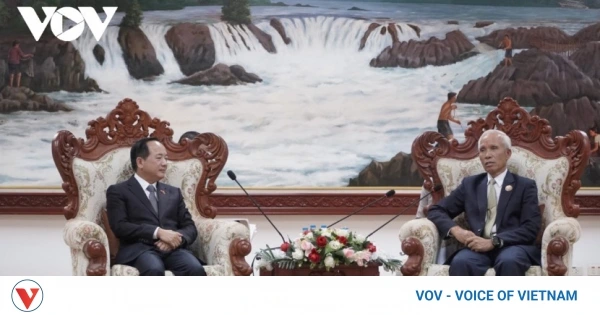
Trinh Van Quyet, Head of Vietnam’s Central Commission for Propaganda and Mass Mobilization, met with his Lao counterpart, Khamphanh Pheuiyavong, Secretary of the Lao People’s Revolutionary Party Central Committee and head of its Commission for Propaganda and Training, to discuss strategic communication initiatives between the two nations.
The officials focused on improving information exchange mechanisms, particularly regarding theoretical and practical issues that emerge during each country’s ongoing reform processes, development initiatives, and international integration efforts. Both sides identified key topics of mutual interest and agreed to formulate a new cooperation plan following each nation’s respective Party Congress, targeting priority areas to enhance coordination quality.
Recent collaborative efforts between Vietnam and Laos have successfully leveraged various media channels, with particular emphasis on social media platforms, to promote the special solidarity between the two countries. These initiatives have played a crucial role in strengthening mutual understanding between Vietnamese and Lao citizens, officials noted.
During the talks, Khamphanh Pheuiyavong specifically requested Vietnam’s continued assistance in sharing its expertise in communicating Party and State policies to citizens effectively. The Lao official emphasized his country’s desire for Vietnam’s ongoing support in capacity building for officials responsible for managing public information, noting that such assistance contributes significantly to political and social stability while supporting Laos’ development objectives.
The meeting reflects the broader context of Vietnam-Laos relations, which have historically been characterized by close cooperation across multiple sectors. Both nations, governed by communist parties, share similar governance structures and face comparable challenges in balancing economic development with ideological continuity.
The timing of these discussions is particularly significant as they coincide with General Secretary To Lam’s participation in the grand celebration of Laos’ 50th National Day at ThatLuang Square in Vientiane on December 2. Lam attended the event with his spouse as part of a senior Vietnamese delegation, highlighting the importance Vietnam places on its relationship with its neighbor.
In a parallel diplomatic engagement, Vietnamese Prime Minister Pham Minh Chinh departed for Laos on December 2 to attend a meeting between the Political Bureaus of Vietnam and Laos. Chinh will also co-chair the 48th meeting of the Vietnam-Laos Intergovernmental Committee from December 2-3, at the invitation of Lao Prime Minister Sonexay Siphandone.
These concurrent high-level visits underscore the comprehensive nature of Vietnam-Laos relations, which extend beyond propaganda and information sharing to encompass economic cooperation, cultural exchange, and political alignment.
The cooperation in propaganda and information sectors represents an important aspect of bilateral relations, as both countries seek to manage messaging in an era of rapid digital transformation and increasing global information flows. For both Vietnam and Laos, effective communication strategies are seen as essential tools for maintaining social cohesion and advancing national development goals.
As the two nations look toward their respective Party Congresses, the commitment to develop new cooperation frameworks signals an intention to adapt their communication strategies to evolving domestic and international environments while preserving their special relationship.
Fact Checker
Verify the accuracy of this article using The Disinformation Commission analysis and real-time sources.

18 Comments
Strengthening collaboration on public communication and community engagement between Laos and Vietnam is an interesting development. However, the language around ‘propaganda and mass mobilization’ gives me pause. I hope their efforts focus on genuine dialogue and empowering citizens, not just top-down messaging.
Agreed. Effective public engagement requires open, two-way communication that incorporates diverse perspectives, not just one-party narratives. The success of these initiatives will depend on how well they balance national interests with democratic values and civic participation.
This news highlights the complex power dynamics and ideological tensions in Southeast Asia. While regional cooperation is important, the focus on ‘propaganda and mass mobilization’ raises concerns about the potential erosion of democratic freedoms.
You make a fair point. Without strong civil society engagement and independent media, there are risks of these communication initiatives being used to further consolidate power rather than serve the public good. Transparency and accountability will be critical.
Cooperation on propaganda and information exchange is concerning, especially between one-party states like Laos and Vietnam. I hope they are truly aiming to improve public communication, not just control the narrative.
Indeed, the language around ‘mass mobilization’ raises red flags. Effective public engagement requires open, transparent dialogue – not just directives from the party.
Boosting information exchange and public outreach between Laos and Vietnam is understandable given their close political ties. However, the language around ‘mass mobilization’ gives me pause – I hope they focus on genuine public engagement, not just top-down messaging.
Agreed. Effective communication requires mutual understanding, not just one-way propaganda. The success of these initiatives will depend on how well they incorporate diverse public voices and perspectives.
This news highlights the challenges of promoting transparency and democratic values in Southeast Asia. While regional cooperation is important, I worry these efforts may prioritize regime stability over citizen empowerment.
You raise a fair point. Without strong civil society engagement and independent media, there are risks of these propaganda and communication initiatives being used to further consolidate power rather than serve the public good.
While regional cooperation is important, the focus on ‘propaganda and mass mobilization’ in this announcement is worrying. I hope Laos and Vietnam can find ways to improve public communication that prioritize transparency, accountability, and citizen empowerment.
Agreed. Effective public engagement requires open, two-way dialogue – not just top-down messaging and control of information. The success of these initiatives will depend on how well they incorporate diverse public voices and perspectives.
This announcement highlights the complex geopolitics and ideological divides in Southeast Asia. While regional cooperation is important, I’m concerned these propaganda and information exchange efforts could undermine democratic freedoms in the long run.
A fair point. Balancing national interests, regime stability, and public accountability is an ongoing challenge in the region. Transparency and civic engagement will be key to ensuring these initiatives truly benefit citizens.
Interesting to see Laos and Vietnam strengthening their propaganda and public communication efforts. I wonder what specific initiatives they have planned to enhance information exchange and ‘mass mobilization’.
Yes, the focus on ‘theoretical and practical issues’ during each country’s ‘ongoing reform processes’ seems quite vague. I hope they maintain transparency and engage the public in meaningful ways.
Collaboration on ‘propaganda and mass mobilization’ between Laos and Vietnam raises some red flags for me. I hope their efforts focus on open, two-way communication with the public, not just top-down messaging and control of information.
You’re right to be cautious. The language used is concerning, as it suggests a desire to influence and direct public opinion rather than empower citizens. Meaningful public engagement requires genuine dialogue, not propaganda.