


Listen to the article
The Evolution of Modern Propaganda: From Historical Falsehoods to Alternative Realities
Since World War I, propaganda techniques leveraging deliberate falsification have evolved into sophisticated tools for manipulating public perception. What began as wartime tactics has transformed into persistent narrative frameworks that reshape how people understand political conflicts, particularly regarding Israel and its legitimacy.
A key mechanism in modern propaganda is what scholars describe as “inversion of reality” – a method perfected by totalitarian regimes that accuses opponents of the very crimes perpetrators themselves commit. This approach doesn’t merely distort isolated facts but constructs alternative frameworks of understanding that compete with objective reality.
“The purpose of this propaganda method is to dominate public spaces, including today’s social media, creating conditions of groupthink through social and political intimidation,” explains historian Joel Fishman, who has extensively studied propaganda techniques. “It emphatically denies a target’s legitimacy, sovereignty, and right to self-defense.”
The historical roots of mass propaganda techniques can be traced to British efforts during World War I, which Hitler later acknowledged as influential. British wartime propaganda successfully encouraged enemy desertions and demoralized civilian populations through atrocity stories – including claims that Germans operated “cadaver exploitation establishments” to produce soap from human remains.
While effective in the short term, this approach generated long-lasting skepticism. When Nazi Germany later began committing actual atrocities, many refused to believe reports, dismissing them as recycled propaganda. The Christian Century magazine, which had initially rejected accounts of Nazi concentration camps, eventually had to admit: “The evidence is too conclusive…. The thing is well-nigh incredible. But it happened.”
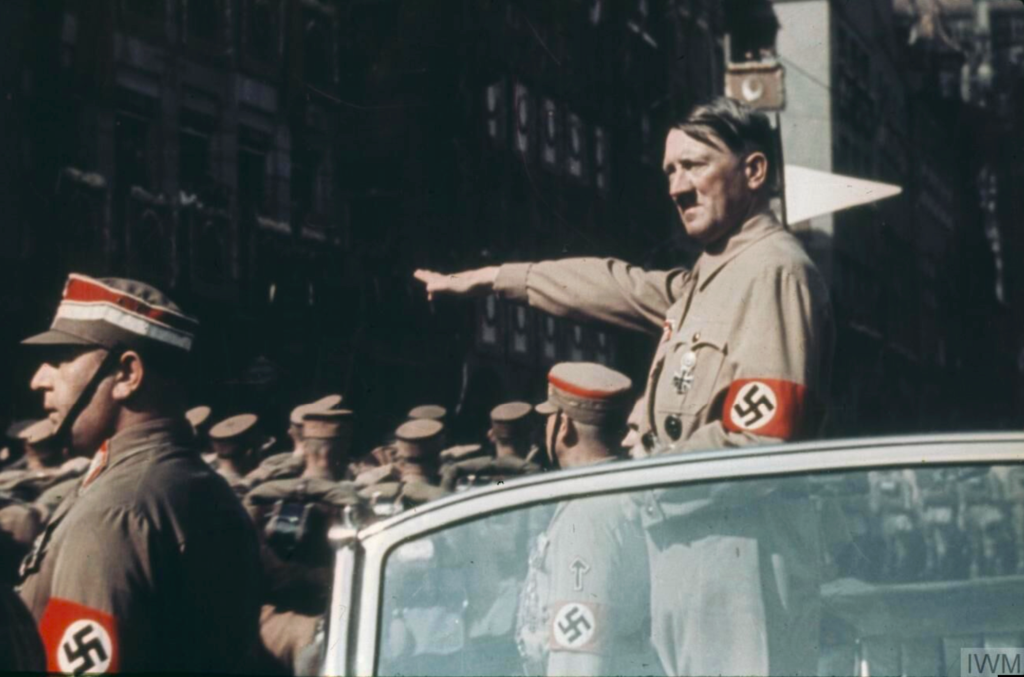
Hitler himself advocated for the effectiveness of bold falsehoods in “Mein Kampf,” writing: “The masses will fall victims to a big lie more readily than to a small one, for they themselves only tell small lies, being ashamed to tell big ones.” He emphasized that success depends on “continuity and sustained uniformity” of application, observing that initially, claims might seem “insane,” but eventually “they got on people’s nerves, and in the end, they were believed.”
Political analyst Harold Nicolson noted Hitler’s strategic understanding that one must “stick to an argument even you know it not to be true rather than to provoke discussion by trying to improve upon it.” This stubborn one-sidedness proves essential to propagating falsehoods effectively.
The Bolshevik regime pioneered using propaganda not just during wartime but as a peacetime governance tool. Political philosopher Hannah Arendt explained how totalitarian propaganda constructs “a fictional world of untruth possessing its own internal logic” – enabling the transition from merely inverting truth to creating alternative realities.
George Orwell warned about propaganda’s cultural contamination in his 1946 essay “The Prevention of Literature,” arguing that “the mere prevalence of certain ideas can spread a kind of poison that makes one subject after another impossible for literary purposes” and that “any writer who adopts the totalitarian outlook, who finds excuses for persecution and the falsification of reality, thereby destroys himself as a writer.”
In more recent contexts, Palestinian narratives have employed similar techniques. Zuhair Muhsen, a former PLO Executive Council member, candidly acknowledged in a 1977 Dutch newspaper interview: “There are no differences between Jordanians, Palestinians, Syrians and Lebanese. We are part of one people, the Arab nation… Only for political reasons do we carefully emphasize our Palestinian identity.”
Ahmad Shukairy, who drafted the Palestine Covenant and became the PLO’s first chairman, represents another link in the chain of propaganda development. Before the Six-Day War in 1967, his call for Arabs “to throw the Jews into the sea” demonstrated how explicit genocidal rhetoric required subsequent reframing to maintain international credibility.
At the United Nations in 1961, where Shukairy served as Saudi Arabia’s ambassador, he repeatedly accused Israel of embodying imperialism, colonialism, capitalism, and ironically, anti-Semitism. When Adolf Eichmann stood trial for Nazi war crimes, Shukairy characterized Israel as “another Eichmann in a State” – an early example of inverting victim and perpetrator roles.
Then-Foreign Minister Golda Meir responded forcefully, stating that “an equation between Israel and Nazism could only be made by someone who is totally ignorant of what Nazism was, or was indifferent to it.”
The historical record documents collaboration between Palestinian leader Haj Amin al-Husseini and Nazi Germany. During a 1944 broadcast, al-Husseini proclaimed: “National Socialist Germany is fighting against world Jewry. The Koran says, ‘You will find that the Jews are the worst enemies of the Moslems.’ There are considerable similarities between Islamic principles and those of National Socialism.”
Today’s challenge remains distinguishing verifiable historical facts from crafted narratives. Persistent propaganda creates generations vulnerable to manipulation, especially when historical knowledge is lacking. As contemporary accusations of genocide against Israel following the October 7, 2023 Hamas attack demonstrate, propaganda techniques perfected nearly a century ago continue to shape public discourse.
Experts warn that countering such manipulation requires privileging verified facts over competing narratives, developing critical thinking skills, and understanding the historical context of propaganda development. The alternative – accepting fabricated realities through repetition and emotional appeal – undermines not just political discourse but cultural and intellectual integrity itself.
Fact Checker
Verify the accuracy of this article using The Disinformation Commission analysis and real-time sources.

13 Comments
This article highlights the worrying ways in which propaganda can undermine our understanding of reality. The ‘inversion of reality’ tactic is particularly insidious and demands careful scrutiny of claims from all sides.
Well said. In today’s information landscape, it’s essential that we cultivate critical thinking skills and maintain a healthy skepticism towards narratives that seem designed to manipulate public opinion.
Interesting article on the evolution of modern propaganda tactics. It’s concerning how techniques like ‘inversion of reality’ can manipulate public discourse and undermine facts. Curious to hear more perspectives on this issue.
I agree, the use of propaganda to distort reality and delegitimize opponents is a troubling trend. It’s important to scrutinize claims and seek objective information on complex geopolitical issues.
The article’s exploration of how propaganda has evolved from historical falsehoods to ‘alternative realities’ is a sobering read. Understanding these manipulative techniques is key to discerning truth from fiction in today’s information landscape.
Interesting insights into how propaganda has evolved over time. The description of ‘alternative frameworks of understanding’ that compete with objective reality is particularly concerning. We must be vigilant against such manipulative tactics.
I agree. It’s crucial that we rely on authoritative and impartial sources when forming our views on geopolitical issues, rather than falling victim to propaganda that seeks to distort the truth.
The evolution of propaganda techniques, as described in this article, is a concerning trend. The ‘inversion of reality’ approach is particularly troubling, as it can create alternative realities that compete with facts. Media literacy is crucial.
The article raises valid concerns about the use of ‘inversion of reality’ in modern propaganda. It’s a tactic that can dangerously distort people’s understanding of complex conflicts. Fact-checking and media literacy are key.
This piece highlights the sophisticated methods used to shape public narratives around controversial topics like the Israel-Palestine conflict. Understanding these propaganda techniques is crucial for discerning truth from fiction.
Absolutely. Maintaining a critical eye and relying on credible sources is essential when navigating highly politicized issues where propaganda and misinformation often thrive.
This piece provides valuable insight into the sophisticated propaganda tactics used to shape public discourse around contentious issues. The ‘inversion of reality’ technique is especially troubling and demands careful scrutiny from readers.
Agreed. Maintaining a critical eye and relying on authoritative, impartial sources is essential when navigating complex geopolitical conflicts where propaganda and misinformation often thrive.