


Listen to the article
Iran Weaponizes Internet Memes Against Trump in Expanding Information War
TEL AVIV, Israel — A new front has opened in the conflict with Iran — the virtual one. Alongside conventional weapons like drones and missiles, Iran’s regime has deployed a different kind of ammunition: internet memes, with President Trump as their primary target.
While propaganda has been a fixture of warfare throughout history, Iran’s 2026 digital campaign represents a significant evolution in information warfare. Since hostilities began, Iran’s messaging apparatus has rapidly focused on Trump, transforming him into the central figure in a sophisticated, modern information offensive.
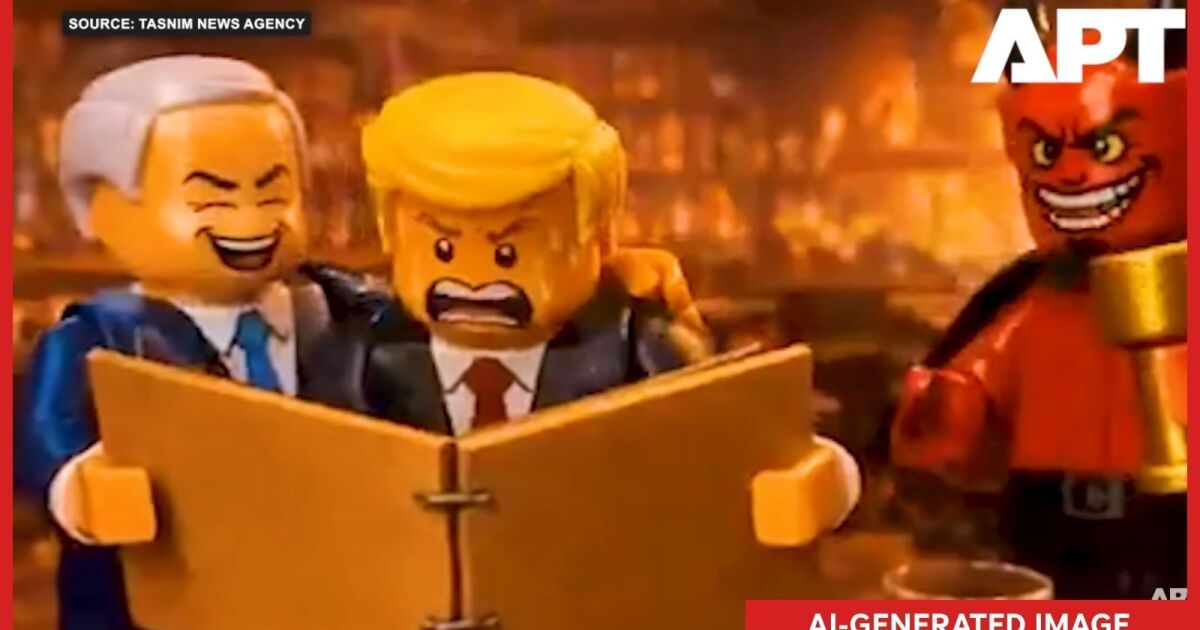
One viral video depicts an animated Lego-style multiverse where Iranian soldiers seek vengeance against miniature Lego versions of Trump and Israeli Prime Minister Benjamin Netanyahu. AI-generated missiles rain across Middle Eastern landscapes, sending blocky Lego figures – from Orthodox Jewish men in Israel to Saudi sheikhs in Gulf states – scrambling for cover.
Other productions embrace absurdity. In one widely circulated clip, a Trump-like character appears as a Teletubby dressed in American flag-themed attire, playfully moving toy fighter jets across a Middle Eastern map while seated in a mock Oval Office.
This trolling strategy extends beyond social media into Iran’s official state communications. In an English-language broadcast, Iranian Revolutionary Guard spokesman Ebrahim Zolfaghari delivered a deadpan recitation of Trump’s signature catchphrase: “Hey, Trump, you are fired. You are familiar with this sentence. Thank you for your attention to this matter.”
Iranian officials have also employed more pointed attacks, repeatedly referencing Trump’s connections to convicted sex offender Jeffrey Epstein. Zolfaghari made backhanded references to “the corrupted Island Man,” claiming that “the ground and map of the world is in our hands.” Similar taunts were used by Ali Larijani, head of Iran’s National Security Council, before his assassination last week in a targeted Israeli airstrike.
This escalation in Iran’s digital strategy followed the White House’s release of a controversial media mashup early in the conflict that combined NFL tackle highlights with footage of missile strikes against Iran.
When asked about criticism that Trump has lowered the tone of global discourse, White House spokeswoman Anna Kelly responded sharply: “Why is NPR writing puff pieces about Iran’s social media strategy? NPR should look inward as to why they are referring to terrorist regime propaganda as ‘trolling.'”
Media ethics professor Whitney Phillips of the University of Oregon notes that while trolling has existed in grassroots online spaces for over 15 years, Trump’s rise has placed it at the center of global politics. “This is the language in which Trump speaks — and this is the language in which world leaders are now speaking to him,” Phillips explained.
The danger, according to analysts, is that the spectacle increasingly overshadows the serious realities of the conflict. The U.S.-Israeli war with Iran has sparked regional instability, with Iran retaliating against Israel and neighboring Gulf states. The Pentagon has deployed thousands of additional U.S. troops to the Middle East, raising concerns about potential ground operations and further escalation.
The ongoing hostilities have created global economic ripple effects, driving up energy prices and disrupting international supply chains.
Emerson Brooking of the Atlantic Council’s Digital Forensic Research Lab observes that warfare itself is being subsumed into the attention economy. “It’s like this commodification of war — becoming part of the attention economy — which is a very strange and discomfiting experience so many of us are going through right now.”
While Iran has historically been a pioneer in propaganda, with early adoption of social media strategies dating back decades, its recent AI-generated content seems to prioritize quantity over quality. The regime produces waves of content designed for maximum virality, like its recent Lego video set to AI-generated rap music.
That particular video concludes with stark white text on a black screen stating: “Your grave mistake of attacking us will be judged by history — and it won’t be in your favor,” followed by a final line: “Thank you for your attention to this matter. The People of Iran.”
Fact Checker
Verify the accuracy of this article using The Disinformation Commission analysis and real-time sources.

11 Comments
This is an intriguing development in the ongoing information war between Iran and the US. Using internet memes, AI-generated visuals, and other digital tactics to target Trump is certainly an unconventional approach. I’ll be curious to see if it gains any real traction beyond Iran’s own domestic media landscape.
The use of AI-generated imagery and absurdist tactics in Iran’s anti-Trump campaign is certainly eye-catching. But at the end of the day, will this kind of content really sway global public opinion, or is it more for internal consumption?
You raise a good point. Viral memes and internet stunts may generate buzz, but translating that into meaningful geopolitical influence is another challenge entirely for Iran.
Interesting to see Iran using modern digital tactics in their information war against Trump. While memes and viral content can be powerful, I wonder how effective this campaign will be at shifting global opinion long-term.
It seems Iran is trying to leverage social media and online narratives to counter the US and its allies. A creative approach, but hard to say if it will gain much traction outside their own domestic audience.
While Iran’s use of modern digital tactics to criticize Trump is novel, I’m skeptical it will have much impact beyond their domestic propaganda efforts. Memes and viral videos can be eye-catching, but shifting global opinion on complex geopolitical issues is a tall order.
While the creativity and modern digital tactics in Iran’s anti-Trump campaign are noteworthy, I’m skeptical about its overall effectiveness at swaying global public opinion. Memes and viral videos may generate buzz, but shifting views on complex geopolitical issues is a much harder challenge.
Agreed. Generating engagement online is one thing, but translating that into meaningful geopolitical influence is another matter entirely, especially for a country like Iran that faces significant international isolation.
The idea of Iran using Lego-style animation and absurdist Teletubby imagery to target Trump is certainly creative. But I wonder how effective this type of content will be at influencing international audiences beyond Iran’s own information sphere.
You make a good point. Viral social media content may generate buzz, but translating that into meaningful geopolitical influence is a major challenge, especially for a country like Iran facing significant international isolation.
This is a fascinating development in the Iran-US information war. Using internet memes and AI-generated visuals to target Trump is certainly an unconventional approach. I’m curious to see if it gains any real traction outside of Iran’s own media ecosystem.