


Listen to the article
U.S. Authorities Arrest Iranian General’s Relatives in Los Angeles, Revoke Green Cards
Federal authorities have arrested two Los Angeles residents related to a deceased Iranian military leader, citing one woman’s vocal support for the Iranian regime while both enjoyed a lavish Western lifestyle documented extensively on social media.
Hamideh Soleimani Afshar and her daughter Sarinasadat Hosseiny were taken into custody by U.S. Immigration and Customs Enforcement (ICE) agents on Friday. Secretary of State Marco Rubio announced that their green cards had been revoked due to Afshar’s “outspoken” support of what he called the “totalitarian, terrorist regime in Iran.”
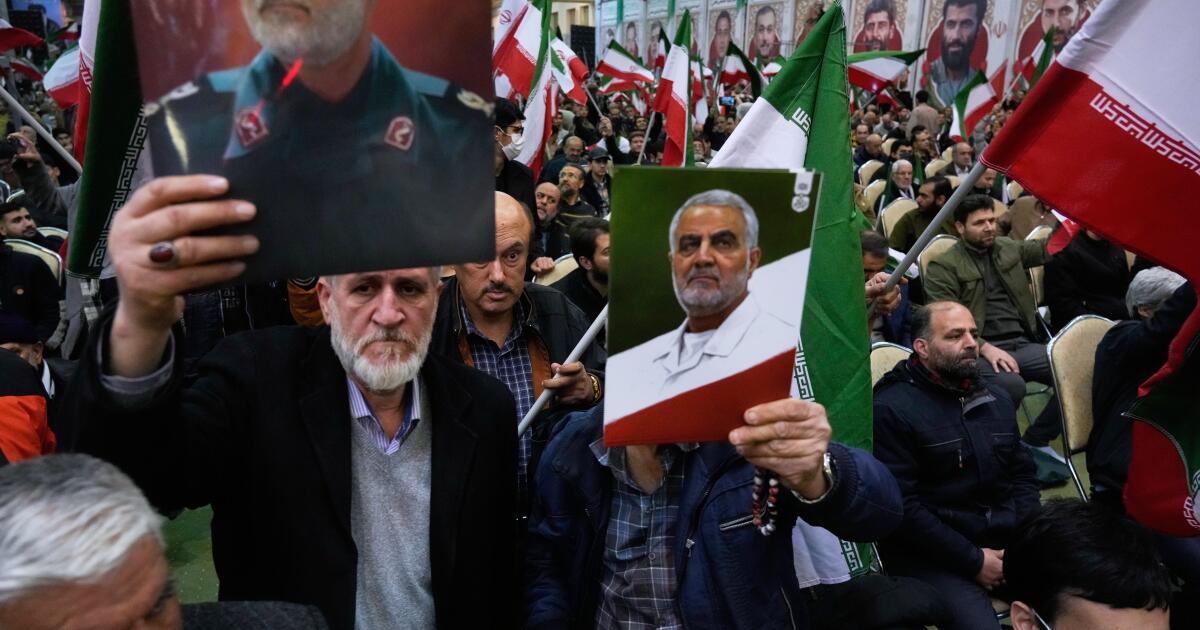
According to Rubio, the women are the niece and grand-niece of Major General Qasem Soleimani, a high-ranking commander in Iran’s Islamic Revolutionary Guard Corps (IRGC) who was killed in a U.S. drone strike during the final days of President Trump’s first term. This family connection has become a point of contention, with the general’s daughter reportedly issuing a statement through Iranian media denying any relation between the women and General Soleimani, characterizing the State Department’s claims as a “lie.”
Social media accounts belonging to both women, now apparently deactivated, portrayed lives of considerable wealth and Western indulgence. Screenshots captured by news outlets show Soleimani Afshar regularly posing in what appear to be designer clothes, riding in a Hummer, and sharing glamour shots in revealing attire. Her daughter’s posts were reportedly similar, sometimes featuring more provocative content – creating a stark contrast with the strict Islamic dress codes enforced in Iran.
This disconnect prompted mockery from some social media users. “She hates America,” wrote one commenter on an Instagram post about the arrests. “I can’t wait to see what she wears back home.”
Maziar Aflaki, a Los Angeles resident who claims to have met Soleimani Afshar through mutual connections, supported the arrests. “They don’t like it in America — they shouldn’t be here,” he told the Times, identifying himself as a critic of the current Iranian regime. Aflaki added that Soleimani Afshar had recently contacted him for advice after being questioned by the FBI about her residence, and claimed she had previously shown him photos of herself with high-ranking Iranian military officials, including one she identified as her uncle.
In his statement, Rubio alleged that while living in the U.S., Soleimani Afshar “promoted Iranian regime propaganda, celebrated attacks against American soldiers and military facilities in the Middle East, praised the new Iranian Supreme Leader, denounced America as the ‘Great Satan,’ and voiced her unflinching support for the Islamic Revolutionary Guard Corps, a designated terror organization.”
The immigration history of both women is central to the case. According to Lauren Bis, Acting Assistant Secretary at the Department of Homeland Security, Soleimani Afshar entered the U.S. on a tourist visa in 2015, was granted asylum in 2019, and received her green card in 2021. She reportedly traveled to Iran four times afterward, information she disclosed when applying for citizenship last year. Hosseiny arrived on a student visa, received asylum in 2019, and was granted a green card in 2023.
DHS officials pointed to Soleimani Afshar’s trips to Iran as evidence that her asylum claims were “fraudulent,” suggesting she faced no genuine threat in her home country despite representations to U.S. immigration authorities.
The arrests come amid heightened tensions between the United States and Iran, with the Trump administration taking a particularly hardline stance. “The Trump Administration will not allow our country to become a home for foreign nationals who support anti-American terrorist regimes,” Rubio declared in his statement.
According to a searchable database of ICE detainees, both women are currently being held at a facility in Pearsall, Texas, as their immigration cases proceed.
Fact Checker
Verify the accuracy of this article using The Disinformation Commission analysis and real-time sources.
