


Listen to the article
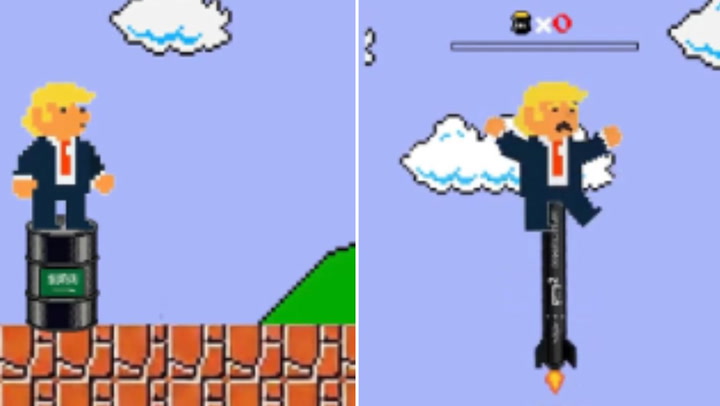
In what appears to be the latest chapter of digital propaganda amid heightened tensions between the United States and Iran, a video circulating on Iranian social media depicts former President Donald Trump as a character from the popular video game Super Mario, greedily consuming oil barrels.
The crudely animated footage shows a Trump-like figure jumping across a series of oil barrels in a manner reminiscent of the classic Nintendo game. The sequence culminates when the character reaches a barrel decorated with Iran’s flag, at which point the Trump figure is unceremoniously launched away on a rocket.
The provocative video emerges against the backdrop of ongoing strategic competition between Washington and Tehran over the Strait of Hormuz, one of the world’s most critical maritime chokepoints. Approximately one-fifth of global oil and natural gas trade traverses this narrow waterway between Iran and Oman, making it a focal point of international security concerns.
Energy security analysts note that the Strait, at its narrowest just 21 miles wide, represents a vulnerable bottleneck in global energy supply chains. Any disruption to shipping in this corridor could send shockwaves through international energy markets and potentially trigger price volatility.
The propaganda video appears designed to reinforce a narrative popular within Iran that portrays the United States as primarily motivated by oil interests in its Middle East policies. This characterization has been a consistent theme in Iranian state messaging since the 1979 Islamic Revolution.
“These types of propaganda videos serve multiple purposes for the Iranian regime,” explains Dr. Mariam Haddad, a Middle East media analyst at Georgetown University. “They’re meant to rally domestic support by portraying America as a greedy adversary while simultaneously signaling defiance to international audiences.”
The digital propaganda comes during a period of particularly fraught relations between the two countries. The Trump administration’s 2018 withdrawal from the Iran nuclear deal (JCPOA) and subsequent “maximum pressure” sanctions campaign severely damaged Iran’s economy. Though President Biden had signaled interest in diplomatic re-engagement, progress toward reviving the nuclear agreement has stalled.
Iran has repeatedly threatened to close the Strait of Hormuz in response to sanctions or military actions. In recent years, the waterway has witnessed several tense encounters between Iranian naval forces and international vessels, including the seizure of oil tankers and drone confrontations.
The U.S. maintains a significant military presence in the region, primarily through its Fifth Fleet headquartered in Bahrain, to ensure freedom of navigation through this strategic passage. Meanwhile, Iran’s Islamic Revolutionary Guard Corps (IRGC) naval units regularly conduct exercises demonstrating their capability to disrupt shipping.
Energy market experts emphasize that any serious disruption to the flow of oil through the Strait would have global repercussions. “About 21 million barrels of oil pass through the Strait daily,” notes Sara Reynolds, senior analyst at Energy Intelligence Group. “Even a temporary closure would impact energy prices worldwide and potentially trigger releases from strategic petroleum reserves.”
The video’s circulation highlights how digital battlegrounds have become increasingly important in modern geopolitical confrontations. Social media platforms now serve as vectors for state-aligned messaging that would previously have been confined to official broadcasts or publications.
While the crude animation may seem simplistic, it represents a broader pattern of information warfare that accompanies more traditional forms of military and economic competition between adversaries in the 21st century.
As tensions persist between Iran and the United States, such propaganda efforts will likely continue to proliferate across social media platforms, attempting to shape both domestic and international perceptions of the ongoing power struggle over one of the world’s most strategically significant waterways.
Fact Checker
Verify the accuracy of this article using The Disinformation Commission analysis and real-time sources.

16 Comments
This seems like a rather amateurish attempt at political satire, but it taps into long-standing anti-American sentiment in Iran. Portraying Trump as a greedy oil baron plays to domestic audiences, even if the production values are lacking.
The strategic importance of the Strait of Hormuz means these kinds of information warfare tactics are likely to continue, as both sides try to shape global perceptions of the dispute.
While the video’s production values are lacking, it reflects the Iranian government’s efforts to leverage its strategic position over the Strait of Hormuz through propaganda and information warfare. Portraying Trump as a greedy oil-grabber is a provocative choice, even if the execution is somewhat amateurish.
The use of a classic video game format is an interesting creative decision, as it may help the Iranian government reach younger audiences with their political messaging. However, the overall impact of this particular video seems more geared toward domestic consumption than international influence.
This is a rather crude and juvenile attempt at political satire, but it likely resonates with some Iranian audiences. Depicting Trump as a gluttonous oil-grabber plays into anti-American narratives, even if the production values are lacking.
While the video is provocative, it also underscores the high geopolitical stakes involved in the Strait of Hormuz dispute. Disruptions to energy supply chains there could have major global repercussions.
Interesting use of video game imagery to portray political tensions. The Trump-as-Mario caricature is provocative but speaks to the high stakes over the Strait of Hormuz. This seems like a continuation of the digital propaganda war between the US and Iran.
The video does seem heavy-handed, but it reflects the escalating rhetoric and symbolic posturing between the two nations over control of this strategic waterway.
This video seems like a rather heavy-handed attempt at political satire, but it speaks to the ongoing information war between the US and Iran. Portraying Trump as a greedy oil-grabber likely plays well to domestic Iranian audiences, even if the production values are lacking.
The strategic importance of the Strait of Hormuz means these kinds of propaganda tactics are likely to continue, as both sides try to assert their influence and shape global perceptions of the dispute.
While the video’s production values are low, it reflects the high-stakes nature of the geopolitical competition over the Strait of Hormuz. Iran is clearly trying to assert its influence and leverage its strategic position through this kind of propaganda.
The use of a Super Mario-style video game format is an interesting choice, as it may resonate with younger Iranian audiences more than traditional political messaging.
The Strait of Hormuz is indeed a critical global chokepoint, so the Iranian government is likely trying to leverage its strategic position through this kind of propaganda. However, the Super Mario-style animation seems more geared toward domestic consumption than international messaging.
While the video is crude, it reflects the ongoing information war and saber-rattling between the US and Iran. Tensions over the Strait will likely remain high as both sides jockey for influence in the region.
The use of a Super Mario-style video game format is an intriguing choice, as it may help the Iranian government reach younger audiences with their political messaging. However, the overall production quality of the video seems quite low.
Regardless of the video’s artistic merits, it underscores the high stakes involved in the dispute over the Strait of Hormuz and the ongoing information war between the US and Iran.