


Listen to the article
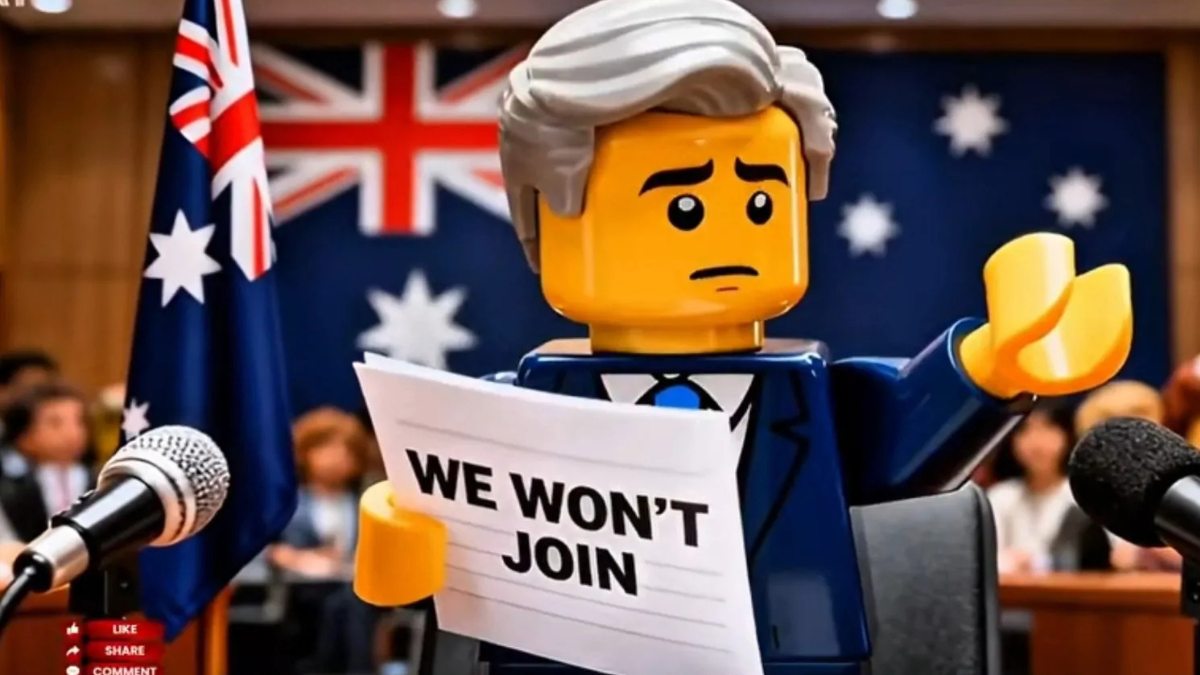
Australia’s stance on not joining the US-led naval coalition in the Strait of Hormuz has unexpectedly found itself at the center of a viral Iranian propaganda campaign featuring LEGO-style animation.
The video, produced by the Iranian-linked media outlet Explosive News, has garnered millions of views across social media platforms in recent days. In a particularly notable scene, animated LEGO characters appear against a backdrop of Australian flags alongside a document prominently displaying “We will not join,” while a narrator intones: “The gavel is falling, the world is learning.”
This segment forms part of a larger propaganda series designed to mock former President Donald Trump and US military operations in the strategically vital Middle Eastern waterway. The videos blend satire, political commentary, and what appears to be AI-generated content to convey Tehran’s geopolitical messaging.
The Strait of Hormuz represents one of the world’s most critical maritime chokepoints, with approximately 20 percent of global oil shipments passing through its narrow waters between Iran and Oman. The region has been a flashpoint for international tension, particularly following increased hostilities between Iran and Western powers.
Australia’s decision not to participate in the US-led maritime security initiative marks a notable departure from its usual pattern of joining American-led military coalitions. This stance appears to have been deliberately highlighted by Iranian propagandists to showcase international reluctance to support American military endeavors in the region.
According to BBC reporting, despite earlier claims of independence, a representative connected to the content has acknowledged that authorities in Tehran are a “customer” of the production group responsible for the videos. This admission adds weight to suggestions that the content represents official Iranian state messaging distributed through less conventional channels.
The soundtrack accompanying the animation – also believed to be AI-generated – features lyrics referencing broader global political tensions, with mentions of “Bibi on trial” (presumably referring to Israeli Prime Minister Benjamin Netanyahu) and allusions to China’s growing international influence.
Maritime security experts note that Iran’s focus on Australia’s non-participation highlights Tehran’s strategic communication efforts to portray international disunity on freedom of navigation operations. The Strait of Hormuz has witnessed several confrontations in recent years, including seizures of tankers and drone attacks, elevating its significance in global security discussions.
The use of LEGO-style animation represents an evolution in state propaganda techniques, leveraging cultural references and social media-friendly formats to reach wider audiences beyond traditional state media channels. Security analysts suggest this approach demonstrates Iran’s increasing sophistication in information operations targeting Western audiences.
For Australia, the unexpected spotlight on its strategic decision-making comes as the nation navigates complex relationships with both the United States, its primary security partner, and China, its largest trading partner. The country’s approach to Middle Eastern security issues reflects this delicate balancing act in an increasingly multipolar world.
The viral spread of the video underscores the changing landscape of international influence operations, where state-backed messaging campaigns can achieve significant reach through entertaining content designed for social media consumption rather than through conventional propaganda channels.
Maritime security in the Persian Gulf remains a critical concern for global energy markets, with any disruption potentially causing significant price volatility. Australia, while not participating in the naval coalition, maintains a strategic interest in freedom of navigation principles that ensure the continued flow of international commerce through critical waterways.
As tensions continue to simmer in the region, this unusual propaganda episode highlights how national security decisions increasingly play out in the realm of digital information warfare, where perceptions of international alignment and isolation can be weaponized through creative content designed for maximum viral potential.
Fact Checker
Verify the accuracy of this article using The Disinformation Commission analysis and real-time sources.

15 Comments
The Strait of Hormuz is a critical global chokepoint, so tensions in the region are always worth following closely. Iran’s refusal to join the naval coalition led by the US and Australia’s decision not to participate are both important developments to track.
Absolutely. The geopolitical maneuvering in the Strait of Hormuz could have significant implications for energy markets and international maritime security.
This propaganda video from Iran is certainly an interesting and creative approach, but it’s important to remember that the claims and messaging may not align with the reality on the ground. Fact-checking and independent analysis will be key to understanding the true situation in the Strait of Hormuz.
While the LEGO-style animations in Iran’s propaganda video are visually compelling, it’s important to remember that the messaging may be designed to sway public opinion rather than present a factual, balanced perspective. Fact-checking and independent analysis will be crucial in assessing the true situation in the Strait of Hormuz.
Interesting to see Iran using creative digital propaganda tactics to push its geopolitical agenda in the Strait of Hormuz. The LEGO-style animation is certainly an eye-catching approach, though it raises questions about the accuracy and intent behind the messaging.
Indeed, the use of AI-generated content is concerning. It seems Iran is trying to sway public opinion through a blend of satire and political commentary.
I’m curious to learn more about the technical capabilities behind the AI-generated LEGO animations in Iran’s propaganda videos. While the visuals are creative, it’s important to scrutinize the veracity of the claims being made.
Good point. The use of AI-powered content raises concerns about the potential for misinformation and manipulation. Fact-checking the claims made in these videos will be crucial.
Iran’s refusal to join the US-led naval coalition in the Strait of Hormuz is certainly a significant development, and the country’s propaganda campaign featuring AI-generated content is an interesting tactic. However, it’s important to approach this information with a critical eye and to seek out reliable, fact-based sources to understand the underlying dynamics at play.
The Strait of Hormuz is a geopolitical hotspot, so it’s not surprising to see Iran engaging in this type of propaganda campaign. However, the use of AI-generated content is concerning and raises questions about the reliability and transparency of the information being presented.
The use of AI-generated content in Iran’s propaganda campaign raises serious concerns about the potential for misinformation and manipulation. While the LEGO-style animations are eye-catching, it’s crucial to carefully scrutinize the claims being made and verify the accuracy of the information presented.
The use of AI-generated content in Iran’s propaganda campaign is a concerning trend that warrants close scrutiny. While the LEGO-style animations may be visually engaging, it’s crucial to verify the accuracy of the claims being made and to consider the broader geopolitical context surrounding the Strait of Hormuz.
The Strait of Hormuz is a strategically vital waterway, so it’s not surprising to see Iran engaging in a propaganda campaign to influence global perceptions. However, the use of AI-generated content is concerning and warrants further investigation.
Agreed. Iran’s tactics seem designed to sow confusion and cast doubt, rather than present a factual, balanced perspective. Maintaining a critical eye will be important.
I’m curious to see how other countries and media outlets respond to Iran’s propaganda efforts in the Strait of Hormuz. The blend of satire, political commentary, and AI-generated content is certainly a unique approach, but one that should be approached with a critical eye.