


Listen to the article
Spain’s Polarized Politics: The Resurrection of Franco for Political Gain
Fifty years after the death of Francisco Franco, the dictator who ruled Spain for 36 years, his political ghost has been deliberately resurrected in the country’s contemporary political landscape. What might seem like a natural commemoration of a historical milestone has instead become a calculated political strategy by the current government.
Prime Minister Pedro Sánchez’s coalition government, comprising his mainstream progressive PSOE party alongside newer left-wing parties and regional nationalist groups from the Basque Country and Catalonia, has launched an initiative called “Spain in Freedom.” This year-long series of commemorations, panels, and speeches celebrates concepts of “democratic memory” and “historic memory” while placing Franco’s legacy at the center of political discourse.
Political communication analysts note this as a clear attempt to control the narrative. By reviving Franco’s specter, the Sánchez administration effectively divides the political arena into a binary framework: those who oppose Francoism and those who allegedly perpetuate it. This strategy creates a powerful “us versus them” dichotomy that transcends normal policy disagreements.
Since taking office, Sánchez has consistently made Franco a central talking point in Spanish politics. This “Francostein” approach, as critics have labeled it, has allowed the government to paint opposition viewpoints on issues ranging from immigration to housing policy as manifestations of Francoist ideology. This framing makes substantive debate increasingly difficult as legitimate policy disagreements become morally charged.
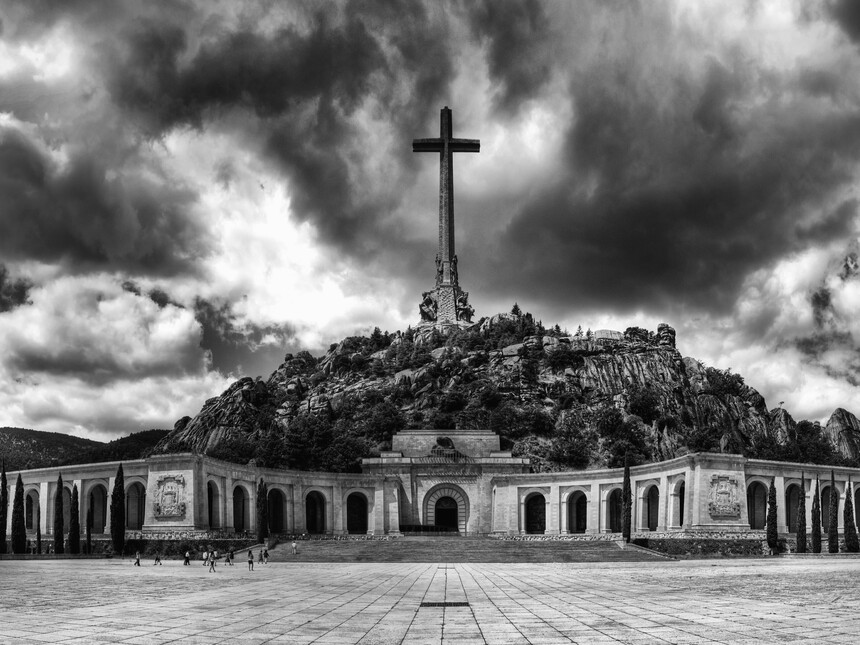
The government’s decision to physically exhume Franco’s remains from the Valley of the Fallen a few years ago symbolized this commitment to keeping his legacy alive in political discourse, ironically while claiming to bury it. Rather than allowing Spain to move forward, the strategy reopens historical wounds that many believed had healed during Spain’s transition to democracy.
This tactic is not unique to Spain. Throughout Latin America, similar strategies have been deployed across the political spectrum. In Chile, left-wing parties label opponents as “Pinochetistas,” while in Peru, Keiko Fujimori faces constant reminders of her father’s controversial presidency. Venezuelan opposition figures risk being branded as “chavistas” if they show any willingness to compromise, while Colombian politics remains divided between “uribistas” and their opponents.
Psychologists compare this political strategy to trauma avoidance. Just as individuals might avoid restaurants, foods, or entertainment associated with negative memories, voters are encouraged to reject political figures or parties by associating them with polarizing historical figures. The strategy effectively weaponizes collective historical trauma for electoral gain.
Beyond the immediate electoral advantages, this approach carries significant societal costs. Political scientists warn that it narrows the “Overton Window” – the range of policies and ideas considered acceptable in mainstream discourse. By linking opposing viewpoints to Franco, legitimate policy positions become tainted as extremist or unacceptable, pushing some voters to feel unrepresented in the political system.
Historians are particularly troubled by how this strategy distorts historical understanding. The complexity of the past gets flattened into simplistic narratives of good versus evil. Nuance disappears as historical facts become secondary to their political utility. This revisionism serves short-term electoral goals at the expense of societal learning and reconciliation.
The strategy also comes with financial costs. Public funds are directed toward cultural initiatives, commemorations, and publications that reinforce the government’s preferred historical narrative. Critics argue these resources could be better spent addressing present-day challenges rather than relitigating the past.
The challenge of dealing with difficult historical legacies extends beyond Spain. Post-war Germany and Austria underwent denazification processes, but completely purging public institutions of anyone with ties to previous regimes often proves impractical. The same challenges will likely face countries like Cuba or Venezuela when they eventually transition away from their current systems.
As Spain marks this significant anniversary, the political weaponization of Franco’s memory raises important questions about how democracies should address their authoritarian pasts. Rather than using history as a divisive tool, perhaps the more productive path would be fostering understanding of the complex factors that enabled authoritarianism and strengthening the democratic institutions that prevent its return.
For now, Franco remains more politically alive in death than many would have thought possible fifty years after his passing – proving García Lorca’s observation that “in Spain, the dead are more alive than the dead of any other country in the world.”
Fact Checker
Verify the accuracy of this article using The Disinformation Commission analysis and real-time sources.

8 Comments
Interesting look at how politicians can leverage historical figures for modern political gain. It’s a delicate balance to commemorate the past while avoiding divisive rhetoric.
Reviving Franco’s legacy seems like a risky move that could backfire and further polarize Spanish politics. The government should tread carefully and focus on unifying the country rather than reigniting old divisions.
This is a concerning example of how political leaders can exploit historical narratives to advance their own agendas. The Spanish government should focus on uniting the country rather than rehashing old divisions.
The article raises important questions about how governments can manipulate public memory for political gain. It’s a sobering reminder of the need for critical thinking and independent historical analysis.
Agreed. Maintaining a clear-eyed, non-partisan view of the past is essential for a healthy democracy. Politicians should avoid using history as a cudgel against their opponents.
This piece highlights the dangers of using propaganda tactics to shape political narratives. Leaders should be cautious about weaponizing history for their own ends, as it can undermine democratic discourse.
Well said. Objectivity and balance are crucial when examining historical figures and events, especially in a politically charged climate.
The article raises valid concerns about how the ‘Spain in Freedom’ initiative could be used to score political points rather than promote genuine historical reflection. Nuance is key when dealing with complex legacies.