


Listen to the article
Russian Propagandist Margarita Simonyan Named Among Financial Times’ Most Influential People for 2025
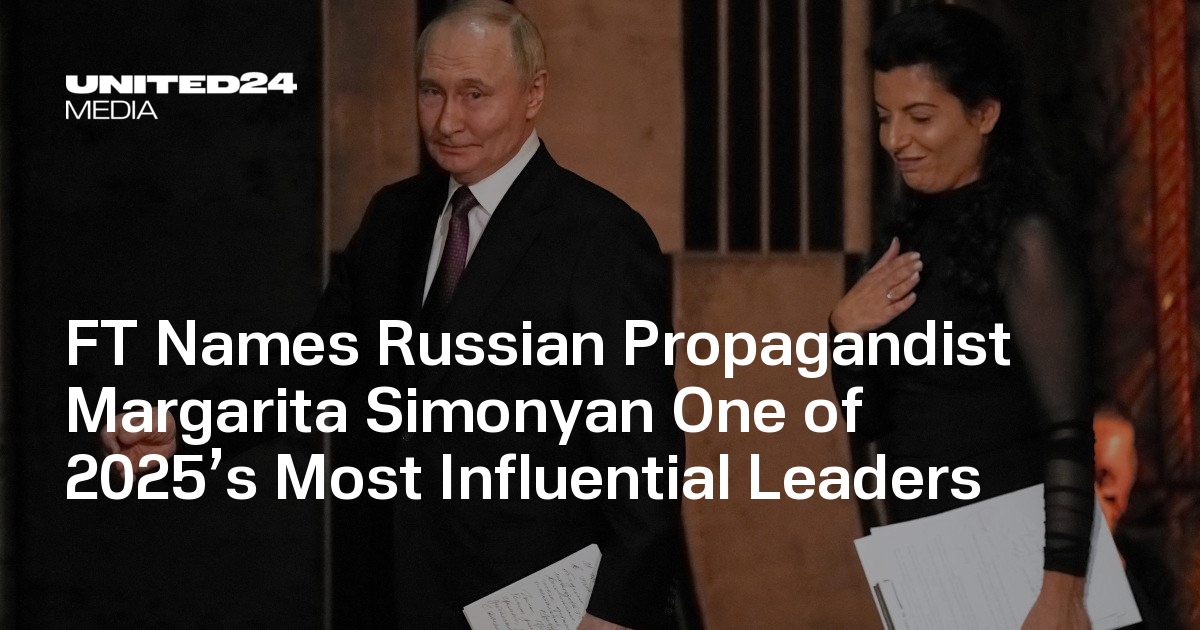
The Financial Times has included Margarita Simonyan, head of Russian state media outlet Russia Today (RT), in its prestigious list of the most influential people for 2025, placing her in the “Leaders” category according to the publication released on December 5.
Julia Ioffe, an American journalist of Russian descent, characterized Simonyan in the listing as “the most fiercely loyal messenger” of the Kremlin and a “Valkyrie of propaganda,” highlighting her significant role in Russia’s information warfare apparatus.
Since Russia’s initial invasion of Ukrainian territory in 2014, Simonyan has been a vocal advocate for annexing Ukrainian land. Following the full-scale invasion in 2022, she has pushed for increasingly extreme measures, according to Ioffe’s assessment. These include suggestions to use Russia’s blockade of the Black Sea as leverage to “starve the world into submission” and proposals to detonate a nuclear bomb in the atmosphere above Siberia to paralyze global communication systems.
The Financial Times portrayal also describes Simonyan as an “ostentatiously religious woman” who maintains that Western nations, particularly the United Kingdom, harbor jealousy toward Russia. This narrative aligns with broader Kremlin messaging that positions Russia as a righteous power standing against Western hegemony.
Simonyan’s influence extends far beyond traditional journalism. As the head of RT since its founding in 2005, she has transformed the network into one of Moscow’s most potent tools for international information operations. Under her leadership, RT has established a global presence with broadcasts in multiple languages, allowing the Kremlin to project its perspective to audiences worldwide.
Her role in Russia’s propaganda apparatus has not gone unnoticed by Western governments. Simonyan currently faces sanctions from the European Union, United Kingdom, and United States for her involvement in state-run media operations and alleged participation in foreign influence campaigns. These restrictions are part of broader Western efforts to counter Russian disinformation and election interference activities.
Media analysts note that Simonyan’s RT has been particularly effective at blending legitimate news coverage with state-directed narratives, creating content that appears credible while advancing Kremlin interests. This sophisticated approach has made RT more effective than the crude propaganda tools of the Soviet era.
In recent months, Simonyan and other Russian state media figures have attempted to reframe Russia’s military actions in Ukraine. Following a deadly missile attack on the Ukrainian city of Sumy, Russian propagandists characterized the event as a Western-orchestrated provocation designed to sabotage potential peace talks with Moscow, comparing it to a “new Bucha” scenario—referring to the Ukrainian town where evidence of Russian war crimes emerged in 2022.
The inclusion of Simonyan on the Financial Times’ influential list comes at a time when Russia’s information warfare capabilities face increasing scrutiny. Despite sanctions and restrictions on RT broadcasting in many Western countries, the network has demonstrated remarkable resilience, finding alternative distribution channels and adapting its messaging strategies.
Media freedom advocates have criticized the Financial Times’ decision, arguing that including a figure central to Russian disinformation efforts legitimizes propaganda work that has helped enable military aggression. Defenders of the selection counter that influence lists should reflect real-world impact rather than moral endorsement, noting Simonyan’s undeniable role in shaping international narratives about Russia’s actions.
As geopolitical tensions persist, Simonyan’s recognition highlights the growing importance of information warfare in modern conflicts and the influential role that media figures play in shaping public perception across borders.
Fact Checker
Verify the accuracy of this article using The Disinformation Commission analysis and real-time sources.

19 Comments
If AISC keeps dropping, this becomes investable for me.
Good point. Watching costs and grades closely.
Good point. Watching costs and grades closely.
Exploration results look promising, but permitting will be the key risk.
Good point. Watching costs and grades closely.
Exploration results look promising, but permitting will be the key risk.
Good point. Watching costs and grades closely.
Good point. Watching costs and grades closely.
Exploration results look promising, but permitting will be the key risk.
Good point. Watching costs and grades closely.
Nice to see insider buying—usually a good signal in this space.
Uranium names keep pushing higher—supply still tight into 2026.
Good point. Watching costs and grades closely.
Silver leverage is strong here; beta cuts both ways though.
Good point. Watching costs and grades closely.
The cost guidance is better than expected. If they deliver, the stock could rerate.
Good point. Watching costs and grades closely.
Nice to see insider buying—usually a good signal in this space.
Uranium names keep pushing higher—supply still tight into 2026.