


Listen to the article
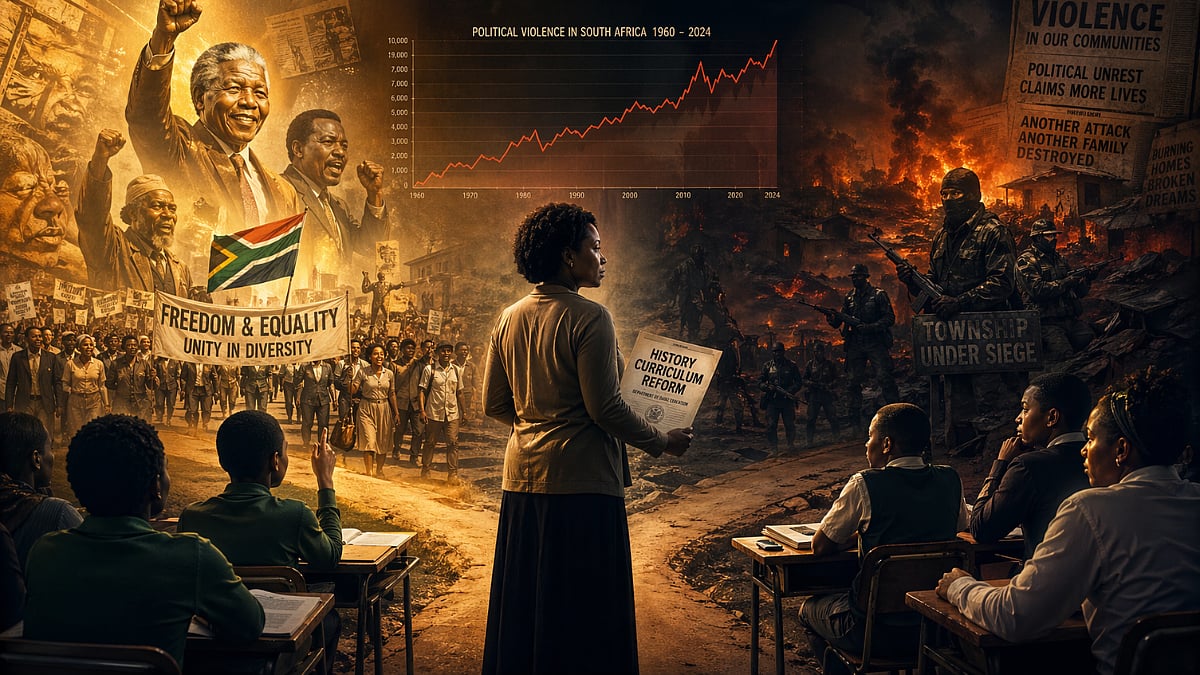
The South African education system has become embroiled in controversy over what critics describe as a revisionist approach to history education in schools. Dr. Anthea Jeffery, a prominent academic and policy researcher, has raised alarm about what she characterizes as propaganda being disseminated through the national curriculum, particularly regarding the historical narrative of the African National Congress (ANC).
According to Jeffery’s analysis, South African school textbooks present a sanitized version of the country’s liberation struggle, one that glorifies the ANC while minimizing its controversial aspects. This “pristine” portrayal, she argues, omits critical historical facts about the organization’s past activities and governance record since coming to power in 1994.
The controversy centers on how pivotal events in South African history are presented to students. Jeffery points to specific examples where textbooks allegedly downplay or entirely omit the ANC’s endorsement of violent resistance strategies, including the “people’s war” campaign that resulted in significant civilian casualties during the 1980s and early 1990s.
Education experts not affiliated with Jeffery’s research have noted that history curriculum development in post-apartheid South Africa has indeed been politically contentious. The challenge of creating balanced historical narratives following decades of apartheid-era propaganda has proven difficult, with the pendulum potentially swinging from one ideological perspective to another.
“What we’re seeing is the natural tension that emerges in societies transitioning from authoritarian rule to democracy,” explains Professor Sipho Mkhize, an education policy specialist at the University of Cape Town. “The history taught during apartheid was heavily skewed, but the solution isn’t to replace it with another skewed narrative.”
The Department of Basic Education has consistently maintained that its curriculum aims to present a balanced view of South African history. In previous statements, the department has emphasized that textbooks undergo rigorous review processes involving diverse stakeholders and historians with various perspectives.
However, critics like Jeffery argue that these processes have been inadequate in ensuring balanced historical accounts. She suggests that the historical narrative presented in schools serves a political purpose—reinforcing the ANC’s legitimacy as the primary liberator of South Africa while minimizing the contributions of other anti-apartheid organizations and movements.
The implications of this debate extend beyond academic circles. South Africa’s youth form their understanding of their nation’s complex past largely through school education. A selective or incomplete historical education could impact their political perspectives and civic engagement as they enter adulthood.
Business leaders have also expressed concerns about how historical education affects South Africa’s economic trajectory. Several economists have noted that an accurate understanding of both successes and failures in governance is crucial for developing policies that address the country’s persistent economic challenges, including high unemployment and inequality.
International education observers point to similar debates in other post-conflict societies, from Eastern Europe to Latin America, where the teaching of history often becomes a battlefield for competing narratives about national identity and political legitimacy.
The controversy highlights broader questions about how democracies should approach teaching complex and contested historical narratives. Some education theorists advocate for multiperspective approaches that present students with diverse interpretations of historical events, teaching critical thinking rather than prescribing a single authorized version of history.
Parents’ groups across South Africa have shown mixed reactions, with some supporting efforts to correct apartheid-era distortions and others concerned about potential indoctrination from any political perspective.
As South Africa continues to develop its democratic institutions nearly three decades after the end of apartheid, the debate over history education reflects ongoing struggles to reconcile different perspectives on the country’s past. The controversy underscores that in young democracies, how history is taught remains as politically significant as the history itself.
Education experts suggest that greater transparency in curriculum development, inclusion of diverse historical sources, and teaching students to evaluate historical evidence critically may offer ways forward in addressing these complex challenges.
Fact Checker
Verify the accuracy of this article using The Disinformation Commission analysis and real-time sources.

7 Comments
Sanitizing the ANC’s past activities and governance record is a disservice to students and the public. Transparent, fact-based history education is essential for a healthy democracy.
Revisionist history that glorifies the ANC while downplaying its controversial actions is a disservice to students. An honest, fact-based approach is essential for a nuanced understanding of South Africa’s complex past.
Interesting allegations about revisionist history in South African schools. If true, it’s concerning to see textbooks sanitizing the ANC’s past. Objective historical accounts are important, even if controversial.
As someone interested in mining and commodities, I’m curious to see how this debate around historical revisionism in South African schools might impact the country’s extractive industries and economic development.
Minimizing or omitting the ANC’s endorsement of violent resistance strategies during the anti-apartheid movement sounds deeply problematic. Students deserve an unbiased curriculum that presents the full, unvarnished historical record.
As an outsider, I’m curious to learn more about the debate around the ANC’s portrayal in South African education. Highlighting both positive and negative aspects of the liberation struggle seems crucial for an accurate understanding of history.
This controversy over revisionist history in South African schools is concerning. Objective, evidence-based curriculum is needed to foster critical thinking, not political indoctrination.