


Listen to the article
Ghanaian Youth Urged to Combat Digital Misinformation at National Seminar
Over 300 students gathered in Accra on Wednesday for a seminar focused on fighting misinformation and promoting online safety, as digital literacy concerns mount in Ghana’s increasingly connected society.
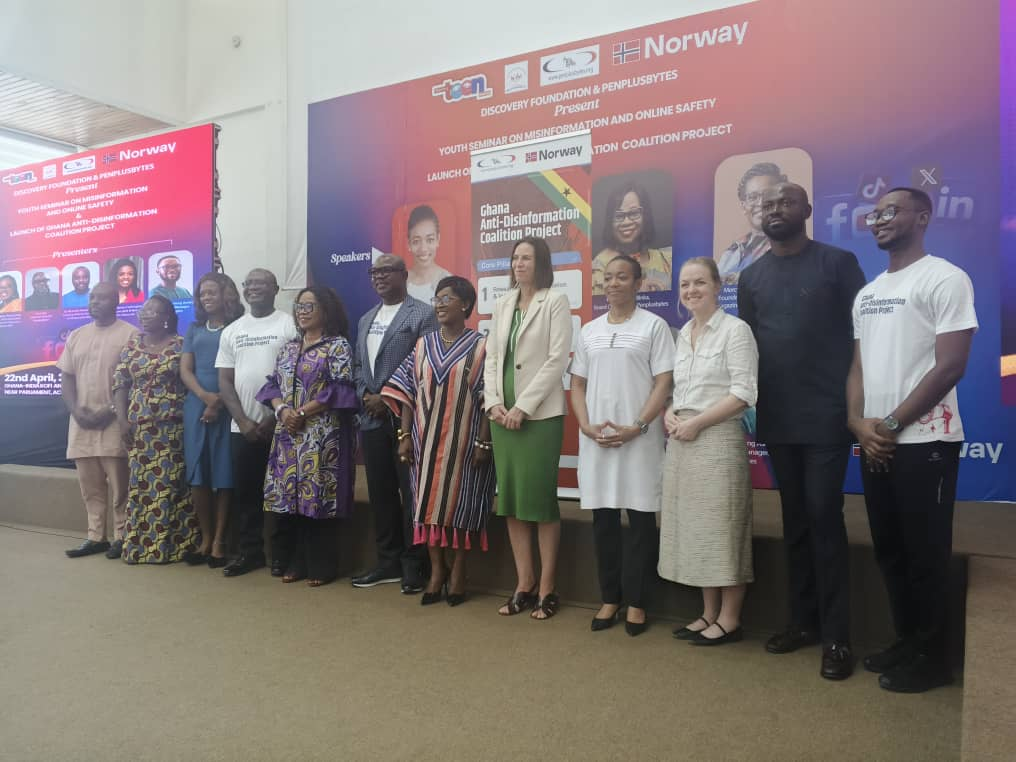
The event, titled “Fake News, Real Consequences: Empowering Young Minds to Combat Misinformation and Stay Safe Online,” brought together students from junior high, senior high, and tertiary institutions at the Ghana-India Kofi Annan Centre of Excellence.
Organized by the Discovery Foundation in collaboration with Pensplusbytes, the seminar addressed the growing challenge of false information spreading through digital channels frequently used by young Ghanaians.
“If you look around, you will see that something is clear… almost everybody has a phone. Everybody is online,” said Mrs. Mercy Catherine Adjabeng, Founder of Discovery Foundation, during her opening remarks. “We practically live online, especially the Gen Zs. You are connecting, you are laughing, you are arguing, you are creating.”
Adjabeng emphasized that while digital platforms offer valuable opportunities for learning and connection, they also present significant risks. “The same feed that can teach you can also trick you with fake news. The same click that connects you to a friend can also share a lie that harms someone’s life,” she cautioned.
The seminar’s objective was not to discourage internet use but to promote responsible digital citizenship. “The internet is a good resource… but we believe that we must use it responsibly. We believe that you can stop the fake, start the facts, and stay safe online,” Adjabeng added.
Norwegian Deputy Ambassador Ingrid Skjølaas highlighted how technological advancements have transformed the landscape of misinformation. “Disinformation is nothing new. But what is new is the speed, the scale, and the intensity in which it is now spreading, facilitated by rapid technological changes and especially AI,” she noted.
Skjølaas called for collaborative efforts to combat the problem, stressing that “digital literacy is now as vital as learning to read and write.”
In her keynote address, Dr. Zanetor Rawlings, Member of Parliament for Korle Klottey, clarified the distinction between related concepts. “Disinformation is when you deliberately put together some kind of data or information that is wrong with the intention to mislead. Misinformation is when you are just passing on wrong information because that’s what you believe,” she explained.
Dr. Rawlings warned about the particular vulnerabilities young people face in navigating digital spaces. “You have access to the internet, and unless you are able to discern truth from fiction, you stand the risk of being a victim… and a potential participant in the dissemination of misinformation,” she said.
She provided practical guidance for information verification, urging students to question online content by asking: “Who posted it? Can I trust the source? Is there proof? Can I find the same information somewhere else?”
The parliamentarian also addressed cybersecurity threats, noting how seemingly innocent actions can lead to significant risks. “Sometimes, the link you click on gives access to your phone… your phone can be used as part of an attack,” she cautioned. Dr. Rawlings also reminded participants about Ghana’s legal framework regarding digital content, particularly laws against sharing intimate images without consent.
A highlight of the event was the official launch of the Ghana Anti-Disinformation Coalition (GADC) Project by Mr. Jerry Sam, Executive Director of Penplusbytes. This three-year national initiative, supported by the Norwegian government, aims to reduce the spread and impact of disinformation through research, AI-driven fact-checking systems in local languages, and capacity building among communities, with a special focus on youth and media.
Students from prominent institutions including Accra Academy, Presbyterian Senior High School in the Ashanti Region, the University of Ghana, UniMAC-IJ, and members of the Canfed Alumni network participated in the program.
The seminar equipped participants with practical skills for identifying false information and engaging responsibly online, while also addressing the emotional and social impacts of misinformation. Attendees were encouraged to become ambassadors for responsible digital behavior within their communities.
“Think. Question. Verify,” Dr. Rawlings told the students in her closing remarks. “Do not believe everything you see. Do not believe everything you hear. And don’t share anything unless you verify it.”
Fact Checker
Verify the accuracy of this article using The Disinformation Commission analysis and real-time sources.

22 Comments
I like the balance sheet here—less leverage than peers.
The cost guidance is better than expected. If they deliver, the stock could rerate.
Silver leverage is strong here; beta cuts both ways though.
Good point. Watching costs and grades closely.
Silver leverage is strong here; beta cuts both ways though.
Good point. Watching costs and grades closely.
I like the balance sheet here—less leverage than peers.
Good point. Watching costs and grades closely.
Good point. Watching costs and grades closely.
If AISC keeps dropping, this becomes investable for me.
Exploration results look promising, but permitting will be the key risk.
Good point. Watching costs and grades closely.
Good point. Watching costs and grades closely.
The cost guidance is better than expected. If they deliver, the stock could rerate.
Good point. Watching costs and grades closely.
Production mix shifting toward Disinformation might help margins if metals stay firm.
Exploration results look promising, but permitting will be the key risk.
Good point. Watching costs and grades closely.
Exploration results look promising, but permitting will be the key risk.
The cost guidance is better than expected. If they deliver, the stock could rerate.
Interesting update on Youth Urged to Verify Facts and Question Content to Combat Misinformation. Curious how the grades will trend next quarter.
Good point. Watching costs and grades closely.