


Listen to the article
South Asia’s growing disinformation crisis threatens to destabilize an already fragile region, with recent incidents triggering diplomatic tensions and communal violence across multiple countries, according to experts preparing for an upcoming regional forum.
The problem has reached alarming levels, particularly following political upheavals like the 2024 ouster of Bangladesh’s Prime Minister Sheikh Hasina. In the aftermath, Indian social media users allegedly amplified isolated incidents of violence with false narratives of “Hindu genocide,” severely straining relations between Dhaka and New Delhi at a critical moment of political transition.
Even more concerning was the May 2025 conflict between nuclear-armed rivals India and Pakistan, which saw sophisticated disinformation campaigns utilizing advanced technological tools. These included deepfakes, manipulated visuals taken out of context, and AI-generated imagery specifically designed to inflame hostilities and distort public understanding of events as they unfolded.
The Maldives, traditionally seen as a stable tourism paradise, has not been immune to these dynamics. The country’s “India Out” campaign, fueled largely by coordinated online disinformation, has significantly damaged relations with its larger neighbor, creating economic and security implications for both nations.
Media analysts note that while political agendas drive much of this content, the profit-driven structures of the modern media ecosystem also play a crucial role. Sensationalized content, regardless of accuracy, drives engagement metrics that translate into advertising revenue across both traditional and social media platforms.
“What we’re seeing is how quickly disinformation can transform from online rhetoric to real-world diplomatic crises,” said Tavishi, South Asia Researcher at the Center for the Study of Organized Hate (CSOH), who will moderate an upcoming panel on the issue. “The technology enabling this has evolved faster than our social and regulatory systems can respond.”
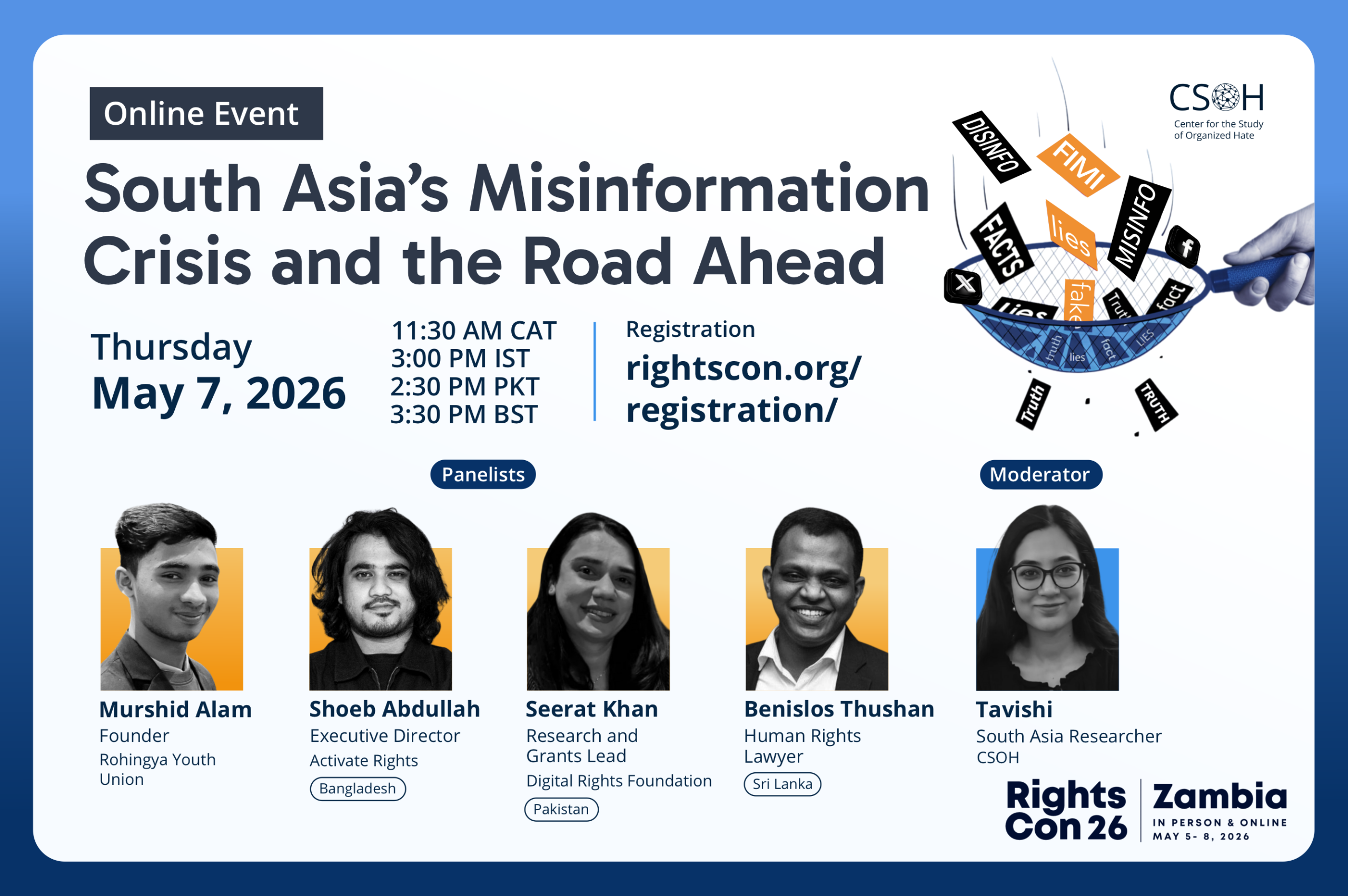
To address these challenges, CSOH is organizing a special session at RightsCon 2026, bringing together civil society organizations and experts from across South Asia. The online event aims to examine both structural and political drivers of disinformation, scrutinize the responsibility of technology platforms, and develop collaborative strategies to prevent online falsehoods from escalating into violence or diplomatic incidents.
The panel features prominent voices from across the region. Benislos Thushan, a Sri Lankan lawyer and founder of Digital Storytelling, brings expertise in empowering citizen journalism as a counterbalance to misinformation. Pakistan’s Seerat Khan, Research and Grants Lead at the Digital Rights Foundation, will provide insights on the gender dimensions of online disinformation, particularly how it affects women journalists and human rights defenders.
Bangladesh will be represented by Shoeb Abdullah, a digital rights activist who co-founded Activate Rights, focusing on preserving authentic digital records of events in an era of manipulation. The panel also includes Murshid Alam, a Rohingya youth leader based in Cox’s Bazar, who brings a crucial perspective on how disinformation affects vulnerable refugee communities.
Regional experts note that South Asia presents particular challenges for combating disinformation due to its linguistic diversity, varying levels of digital literacy, and complex historical tensions between nations. This combination creates fertile ground for falsehoods to spread rapidly across borders while making fact-checking efforts more difficult.
“What makes this region uniquely vulnerable is how digital spaces reflect and amplify existing social and political divisions,” explained a regional media analyst not affiliated with the upcoming event. “When you add in the geopolitical rivalries between states, particularly India and Pakistan, disinformation becomes a tool of statecraft rather than just a social media problem.”
The initiative comes at a critical time when South Asian nations face multiple shared challenges including climate change, economic development, and security concerns that require regional cooperation. Yet the trust deficit between countries, exacerbated by disinformation campaigns, undermines potential collaborative solutions.
The RightsCon session aims to be a step toward creating regional frameworks for information integrity that could ultimately promote stability in a region often characterized by mistrust and conflict. The organizers hope that by bringing together diverse voices from across South Asia, practical solutions can emerge that address the unique regional dimensions of the global disinformation crisis.
Fact Checker
Verify the accuracy of this article using The Disinformation Commission analysis and real-time sources.

11 Comments
Concerning to see how disinformation has escalated regional tensions in South Asia. Fact-checking and media literacy efforts will be crucial to combat these destabilizing narratives.
Agreed. Strengthening digital infrastructure and improving coordination between countries will be key to addressing this growing crisis effectively.
The Maldives’ “India Out” campaign highlights how regional rivalries can be further inflamed by coordinated disinformation campaigns. Promoting inter-state cooperation is crucial to address these challenges.
Agreed. Establishing transparent communication channels and building trust between countries in the region will be essential to defuse tensions and mitigate the spread of harmful narratives.
Interesting to see how the 2024 political upheaval in Bangladesh has led to the amplification of false narratives across the region. Promoting regional cooperation and transparency will be key to addressing this issue.
The experts’ call to address the growing disinformation crisis in South Asia is timely and necessary. Strengthening digital infrastructure, media literacy, and regional cooperation will be key to building resilience against these destabilizing narratives.
It’s concerning to see how disinformation has fueled diplomatic tensions and communal violence in the region. Strengthening media literacy and fact-checking initiatives is a key priority.
The use of advanced technological tools like deepfakes to distort public understanding is particularly alarming. Governments and tech companies must work together to enhance online safety and security.
Absolutely. Investing in robust fact-checking mechanisms and digital forensics capabilities will be vital to identify and counter these sophisticated manipulation tactics.
The use of AI-generated imagery to distort public understanding of events is a worrying development. Investing in digital forensics capabilities and fact-checking will be crucial to counter these threats.
The May 2025 conflict between India and Pakistan, fueled by sophisticated disinformation campaigns, is a stark reminder of the potential for these tactics to escalate regional tensions. Enhancing early warning systems and crisis management mechanisms will be critical.