


Listen to the article
The Verification Crisis in Modern Conflict Reporting
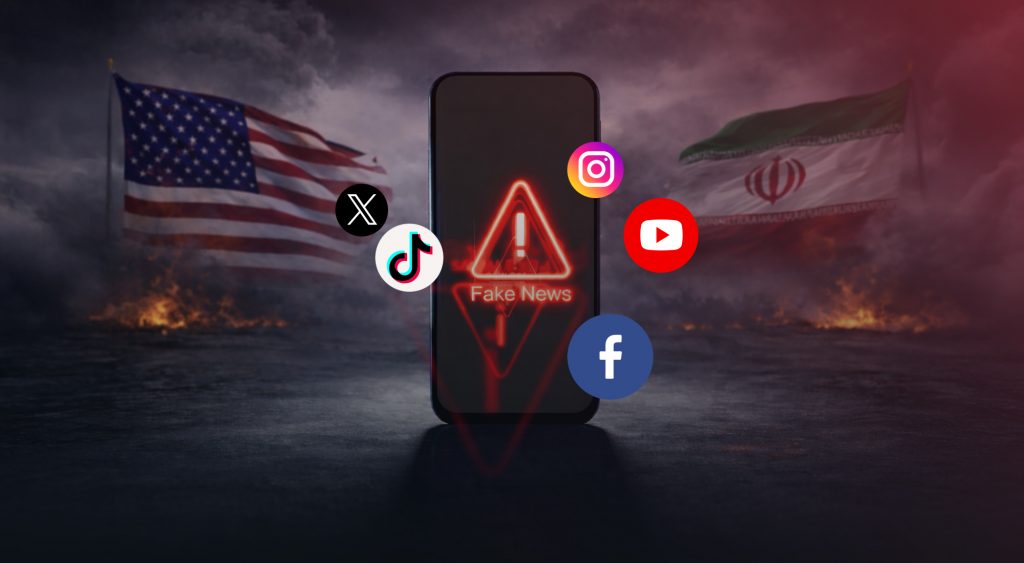
In the spring of 2025, as U.S.-brokered negotiations over Iran’s nuclear program collapsed, another casualty emerged from the chaos: the ability of ordinary people and even trained journalists to distinguish fact from fiction. Across social media platforms like X and Telegram, viral clips depicting alleged destruction from the conflict spread within hours of each major escalation. Some showed genuine events, others repurposed footage from previous conflicts, and an alarming number were entirely synthetic—indistinguishable from authentic imagery to the untrained eye.
This verification crisis represents a dangerous evolution in conflict reporting, particularly in the complex triangle of U.S.-Israel-Iran relations where narrative control has enormous strategic importance.
The Middle East conflict has always featured competing narratives, but the tools available to distort reality have reached unprecedented sophistication. Each principal player in this geopolitical drama faces consistent, high-stakes incentives to shape public perception, while synthetic media and coordinated disinformation increasingly cloud judgment and undermine the evidence base on which audiences, policymakers, and international institutions rely.
For Israel, the narrative challenge involves reassuring its domestic audience that military operations are both necessary and controlled, while convincing Western governments that its actions remain proportionate and legally defensible. Iran must project strength to a population steeped in 45 years of revolutionary messaging while simultaneously portraying itself on the global stage as the aggrieved party subjected to unlawful coercion. The United States occupies perhaps the most uncomfortable position: deeply allied with Israel, rhetorically committed to de-escalation, and acutely aware that its credibility across the Muslim world hangs partly on how the conflict is framed.
The stakes in this narrative competition are substantial. Projecting strength and battlefield success creates deterrence, while perceived victimhood generates international sympathy and legal legitimacy in forums like the UN Human Rights Council. Claims of restraint help neutralize accusations of disproportionate force, while narratives of existential threat justify extraordinary measures, whether Israeli pre-emptive strikes on Iranian nuclear facilities or Iranian proxy operations characterized as defensive resistance.
What distinguishes today’s information landscape from previous conflicts is the radical democratization of media distribution channels. Where state-controlled institutions once dominated messaging, a single Telegram channel can now seed misleading content into global media ecosystems within minutes of an incident. Official communications from Iranian state broadcaster IRIB, Israeli military social accounts, and the U.S. Department of Defense now compete for narrative authority not just with each other but with anonymous accounts of unknown affiliation, AI-generated news sites, and loosely coordinated influence networks.
The resulting verification gap has severe consequences for public understanding. The term “synthetic media” encompasses AI-generated images and video, voice cloning used to fabricate official statements, digitally manipulated photographs that alter apparent damage scales, and algorithmically generated news articles mimicking legitimate outlets. These tools create an environment where forming accurate judgments about ground realities becomes increasingly difficult.
Perhaps most disruptive is not fully synthetic content but the deliberate recirculation of authentic footage stripped of context. During the escalations of late 2024 and early 2025, videos from the Syrian civil war, the 2006 Lebanon war, and even the 2019 Beirut port explosion were repackaged with captions claiming to show recent Israeli strikes or Iranian retaliation. This hybrid deception of real imagery with false context proves particularly challenging for platform moderation algorithms and audiences alike.
The Atlantic Council’s Digital Forensic Research Lab documented a notable case from November 2024, when an image purportedly showing a devastated Iranian military base went viral across multiple platforms. Analysts later identified markers of AI generation—inconsistent shadow angles, physically impossible structural details, and metadata anomalies—that contradicted the claimed authenticity. By the time corrections circulated, the original image had been shared hundreds of thousands of times and picked up by regional news outlets. The correction received only a fraction of that attention.
This pattern has destructive effects on public understanding. When repeatedly exposed to environments where visual “evidence” may or may not be authentic, audiences develop one of two dysfunctional adaptations: either uncritical credulity that accepts vivid imagery at face value, particularly when it confirms existing beliefs, or blanket skepticism that renders all reporting suspect. Both responses serve actors who benefit from a confused, disoriented public.
The strategic dimension of this confusion is significant. Disinformation campaigns timed to critical decision points—elections, congressional hearings on military aid, diplomatic negotiations—can substantially affect outcomes by contaminating deliberative processes. When policymakers operate based partly on synthetic or manipulated information, the very foundations of policy are compromised.
While many consumers of conflict reporting view verification as someone else’s responsibility—professional fact-checkers, platform trust-and-safety teams, or investigative journalists—this instinct is deeply flawed. Platform moderation remains structurally inadequate in the face of content volume generated during military escalations, and professional fact-checking organizations, despite valuable work, have limited capacity and often lag behind viral spread. The responsibility to verify cannot be fully outsourced.
Ordinary users should adopt habitual verification behaviors before sharing conflict content. This includes deliberately pausing before sharing dramatic imagery, as the urgency that viral content creates is precisely the psychological mechanism that disinformation campaigns exploit. Basic source tracing using reverse image search tools takes mere minutes and eliminates many recycled-footage problems. Cross-referencing across multiple independent outlets provides further validation, as credible events typically leave traces across various media sources.
For policymakers, the implications are concrete. Intelligence assessments, congressional testimony, and allied consultations increasingly incorporate open-source material vulnerable to contamination by synthetic media. Institutions lacking formal verification protocols for open-source imagery operate with significant unacknowledged vulnerability—an area where investment in training, tools, and processes lags behind operational threats.
The verification crisis will not end when current hostilities cease. The generative tools producing synthetic media will become cheaper, more capable, and more widely accessible regardless of how this conflict resolves. Treating verification as an operational standard rather than an afterthought is essential for platforms, researchers, policymakers, and individual citizens committed to preserving information integrity during international crises.
Fact Checker
Verify the accuracy of this article using The Disinformation Commission analysis and real-time sources.

29 Comments
The cost guidance is better than expected. If they deliver, the stock could rerate.
Silver leverage is strong here; beta cuts both ways though.
Silver leverage is strong here; beta cuts both ways though.
Production mix shifting toward Disinformation might help margins if metals stay firm.
Good point. Watching costs and grades closely.
Nice to see insider buying—usually a good signal in this space.
Good point. Watching costs and grades closely.
Good point. Watching costs and grades closely.
I like the balance sheet here—less leverage than peers.
Good point. Watching costs and grades closely.
Uranium names keep pushing higher—supply still tight into 2026.
Good point. Watching costs and grades closely.
Good point. Watching costs and grades closely.
I like the balance sheet here—less leverage than peers.
Good point. Watching costs and grades closely.
Good point. Watching costs and grades closely.
Silver leverage is strong here; beta cuts both ways though.
Good point. Watching costs and grades closely.
Good point. Watching costs and grades closely.
If AISC keeps dropping, this becomes investable for me.
Good point. Watching costs and grades closely.
Exploration results look promising, but permitting will be the key risk.
Good point. Watching costs and grades closely.
Good point. Watching costs and grades closely.
I like the balance sheet here—less leverage than peers.
Good point. Watching costs and grades closely.
Production mix shifting toward Disinformation might help margins if metals stay firm.
The cost guidance is better than expected. If they deliver, the stock could rerate.
Good point. Watching costs and grades closely.