


Listen to the article
Digital Authoritarianism in China: How Technology Reinforces State Control
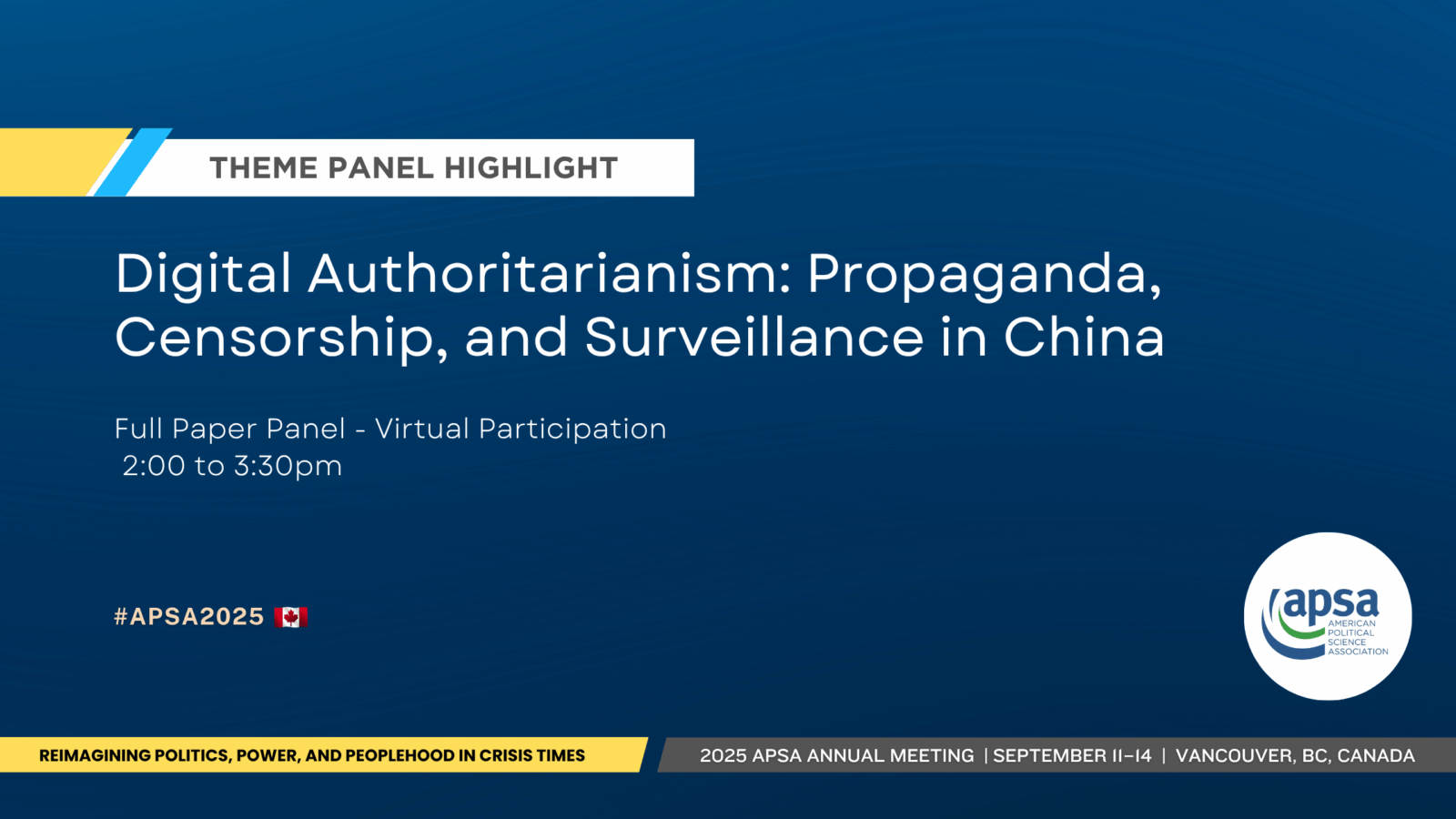
In an era where digital technology was once hailed as a democratizing force, authoritarian regimes have increasingly weaponized these tools to enhance their control. A recent academic panel examined this phenomenon in depth, focusing on China as a case study of advanced digital authoritarianism.
The panel, co-sponsored by the Information Technology and Politics Division, brought together experts including Chair Lynette H. Ong from the University of Toronto and discussants Lizhi Liu from Georgetown University and Eddie Yang from the University of California, San Diego, to explore how the Chinese government has transformed potential threats to its authority into powerful mechanisms of control.
“The initial optimism that digital platforms would inevitably lead to greater freedom has given way to a more complex reality,” noted one participant. “Authoritarian regimes have proven remarkably adaptable in co-opting these technologies.”
Research presented by Yingdan Lu, Xinyi Liu, and Carl Zhou revealed how entertainment platforms in China have become vehicles for state propaganda. Their analysis of Bilibili, a popular video-sharing platform, demonstrated how algorithms strategically amplify state-sponsored content. This “algorithmic pathway” represents a sophisticated approach to expanding the regime’s online influence while maintaining the appearance of organic content distribution.
Meanwhile, Lynette Ong and Jesslene Lee’s work highlighted the critical partnerships between the Chinese government and corporations in managing public opinion. Their research documented how the state outsources technical expertise to both private and state-owned companies, creating a surveillance ecosystem that can simultaneously suppress dissent and monitor shifting public sentiment.
“What we’re seeing is not crude censorship but a calibrated approach to digital repression,” explained Ong. “The state leverages big data analytics to identify potential threats while maintaining just enough openness to gauge public mood.”
The societal consequences of these practices formed the focus of the panel’s second half. Tony Zirui Yang’s analysis of censorship patterns revealed a strategic approach to controlling discourse about democracy. While general discussions of democratic principles are routinely suppressed, Yang found that content linking democracy to conspiracy theories often remains uncensored. This selective approach appears designed to foster conspiratorial thinking about foreign democratic systems while bolstering trust in domestic institutions.
Perhaps most revealing was Xu Xu’s comparative study of digital versus traditional surveillance methods. The research suggests that digital surveillance, despite its broader reach, is perceived as less intrusive than physical monitoring. This reduced visibility has important consequences: while it discourages political participation, it preserves interpersonal trust and, crucially, regime legitimacy.
“Digital surveillance represents a form of control that citizens find more tolerable,” noted Xu. “This acceptance enables authorities to expand surveillance rapidly without triggering significant public resistance.”
These findings have profound implications beyond China. As authoritarian regimes worldwide adopt similar technologies and strategies, understanding the Chinese model becomes increasingly relevant for policymakers, human rights advocates, and democracy activists.
The panel’s work contributes to broader discussions about how technological shifts are reshaping global politics during times of crisis. By illuminating the mechanisms through which digital tools can deepen the divide between democratic and authoritarian systems, the research offers critical insights into one of the defining governance challenges of our era.
For countries navigating their own digital transformations, China’s example serves as both a warning and a case study in how seemingly neutral technologies can be harnessed to reshape public opinion, influence political behavior, and ultimately strengthen authoritarian control.
Fact Checker
Verify the accuracy of this article using The Disinformation Commission analysis and real-time sources.

10 Comments
Fascinating look at how authoritarian regimes like China leverage digital tech to tighten control. The panelists raise valid concerns about the darker side of digital platforms as tools for propaganda and surveillance.
You’re right, the optimism around digital tech empowering freedom has given way to a more nuanced reality. Authoritarian states have proved adept at co-opting these tools for their own purposes.
The panel’s findings on how entertainment platforms in China are being used for state propaganda are quite alarming. It’s a stark reminder that we must remain vigilant in safeguarding digital spaces from authoritarian control.
Absolutely. Protecting the free and open internet should be a top priority, as the weaponization of digital tools by authoritarian regimes poses a serious threat to democracy and individual freedoms.
This article highlights the critical importance of maintaining a free and open internet in the face of rising digital authoritarianism. Protecting online spaces from state control and surveillance should be a key priority.
The panel’s insights into China’s sophisticated use of technology to bolster its authoritarian control are eye-opening. It’s a stark reminder that digital progress does not automatically translate to greater freedom.
You make an excellent point. The initial optimism around the democratizing potential of digital tech has given way to a more complex reality, where authoritarian states have proven adept at co-opting these tools.
The findings about entertainment platforms like Bilibili being used for state propaganda are quite concerning. It’s a sobering reminder that digital tech can be a double-edged sword, empowering both freedom and control.
Absolutely. The weaponization of digital tools by authoritarian regimes to enhance their grip on power is a worrying trend we need to pay close attention to.
This is a concerning trend that deserves close scrutiny. The ability of authoritarian regimes to transform digital platforms into vehicles for propaganda and surveillance is deeply troubling.