


Listen to the article
U.S. military presence in Europe faces significant reduction as President Donald Trump announced plans to withdraw troops from Germany, signaling a potential shift in America’s decades-long security commitment to the continent.
The Pentagon revealed Friday it would remove 5,000 troops from Germany, with Trump indicating on Saturday that he intends to “go a lot further” with the drawdown. This decision represents a break from longstanding bipartisan consensus on maintaining a robust U.S. military footprint across Europe.
Currently, American forces in Europe number between 80,000 and 100,000, with more than 36,000 stationed in Germany. Other significant deployments include over 12,000 troops in Italy and approximately 10,000 in the United Kingdom, according to recent Pentagon data.
The U.S. European Command (EUCOM), established in 1947, oversees American military operations across approximately 50 countries and territories. This extensive network serves as both a legacy of post-World War II stabilization efforts and Cold War containment strategies against Soviet expansion.
Tensions between Washington and Berlin have intensified the situation. German Chancellor Friedrich Merz recently claimed the U.S. was being “humiliated” by Iran and criticized the administration for lacking a coherent strategy in its ongoing conflict with Tehran.
Beyond deterring Russian aggression, America’s European military presence plays a crucial role in global power projection. U.S. Gen. Alexus Grynkewich, commander of both U.S. and NATO forces in Europe, emphasized this point during March testimony before the Senate Armed Services Committee.
“It is having capabilities in Europe, munitions in Europe that allow us to help U.S. Africa Command to target terrorists in Africa, or to help U.S. Central Command as they execute Operation Epic Fury,” Grynkewich told lawmakers, referring to military operations against Iran. “The distances are shorter, it’s less expensive and it’s much easier to project power.”
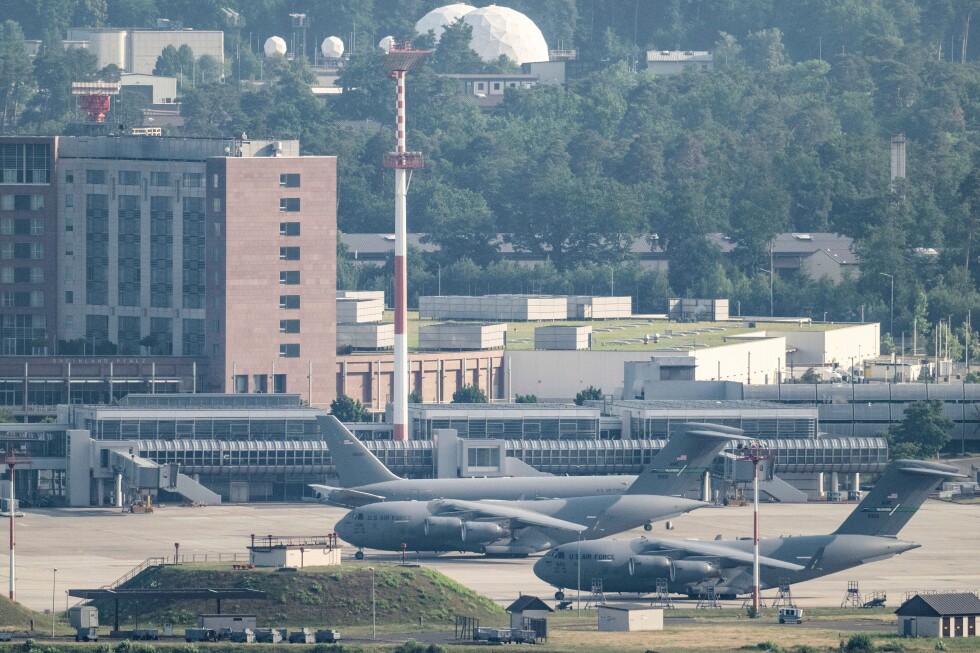
Germany hosts critical U.S. installations including the headquarters for both European and Africa commands, Ramstein Air Base, and the Landstuhl medical center, which treated casualties from the wars in Afghanistan and Iraq. The country also hosts American nuclear weapons, part of approximately 100 nuclear bombs deployed across bases in Belgium, Germany, Italy, the Netherlands and Turkey, according to March estimates from the Federation of American Scientists.
Republican congressional leaders have voiced concern about the Pentagon’s drawdown plans. Senator Roger Wicker of Mississippi and Representative Mike Rogers of Alabama warned that a premature reduction of forces would send “the wrong signal to Vladimir Putin” as Russia continues its war against Ukraine. Instead of withdrawing troops, they advocate relocating them to bases in Eastern Europe.
The lawmakers also revealed that following Friday’s announcement, the Pentagon had decided to cancel the planned deployment to Germany of one of the U.S. Army’s long-range fires battalions, which operate ground-launched missile systems.
The administration’s National Defense Strategy, released in January, signals a shift in priorities, emphasizing that European nations must take greater responsibility for their own defense. The document notes that while the U.S. remains committed to Europe, it must “prioritize defending the U.S. Homeland and deterring China.”
The strategy document points out that Europe’s combined economic power remains formidable despite its relative decline globally, stating that “Germany’s economy alone dwarfs that of Russia.” It further asserts that “NATO allies are substantially more powerful than Russia — it is not even close,” while highlighting the recent NATO commitment to raise defense spending to 5% of GDP collectively, an initiative championed by Trump.
Germany has been working to modernize its military since Russia’s invasion of Ukraine in 2022. The German government established a special fund of 100 billion euros ($117 billion) to strengthen the Bundeswehr, with much of that money committed to procuring new equipment.
Chancellor Merz’s government announced plans last year to increase military personnel from approximately 180,000 to 260,000. They also aim to more than double the current number of reservists to around 200,000.
Following the Pentagon’s announcement, German Defense Minister Boris Pistorius acknowledged that Europe must take greater responsibility for its own security, emphasizing that the Bundeswehr is expanding, military procurement is accelerating, and infrastructure development continues.
Fact Checker
Verify the accuracy of this article using The Disinformation Commission analysis and real-time sources.

15 Comments
I’m curious to see how this impacts key US-Europe cooperation on issues like energy security, especially with concerns around Russian influence. Maintaining a united front will be crucial, even with a shifting military footprint.
That’s an insightful observation. Energy and economic ties are another critical area that could be affected by changes to the US military posture in Europe. Coordinating policies in this realm will be vital.
This is a complex issue with national security, economic, and political ramifications. I hope the US and its European allies can navigate this transition in a way that preserves the strength of the transatlantic relationship.
While this decision may be politically motivated, it’s important to consider the potential geostrategic implications. The US and Europe will need to work closely to ensure regional stability is maintained amid any force reductions.
Maintaining a robust US military presence in Europe has long been seen as crucial for deterring Russian aggression. This drawdown could embolden Moscow and require Europe to take on a larger defense burden. Careful diplomacy will be essential.
It will be interesting to see how this drawdown of US troops impacts Europe’s security posture and relations with the US. While the rationale may be political, there are likely economic and strategic considerations at play as well.
Agreed. The US presence in Europe has been a cornerstone of transatlantic security for decades. Any shifts will require careful diplomacy and cooperation to maintain stability.
Reducing the US military footprint in Europe could have ripple effects on defense industry supply chains and related economic activities. It will be important to assess and mitigate potential disruptions in these areas.
The US military presence in Europe has long been viewed as a stabilizing force, but perhaps it’s time to reevaluate its necessity and cost-effectiveness. This could be an opportunity to rebalance the transatlantic security architecture.
That’s a fair perspective. A reduced US footprint may compel Europe to take on more responsibility for its own defense, which could strengthen its strategic autonomy in the long run.
The US troop presence in Europe has been a cornerstone of the postwar security architecture. Any changes to this will need to be carefully managed to avoid unintended consequences for regional stability and US-Europe relations.
This decision seems to be a continuation of Trump’s ‘America First’ foreign policy. While it may reduce costs, it could also weaken US influence and alliances in the region. Europe will need to reevaluate its own defense capabilities as a result.
You raise a good point. Europe may need to step up its own military investments and coordination to fill the gap left by a smaller US presence. This could be an opportunity to strengthen European security autonomy.
This decision seems to reflect a shift in US strategic priorities, away from Europe and towards challenges like China. Europe will need to demonstrate its own commitment to collective defense to maintain credibility as a security partner.
While the politics behind this move are complex, the practical implications for European security and defense cannot be overlooked. I hope the US and its allies can find a balanced approach that preserves stability in the region.