


Listen to the article
U.S. Urges China to Pressure Iran on Strait of Hormuz Ahead of Trump-Xi Summit
White House officials are intensifying diplomatic efforts to convince China to use its influence with Iran to reopen the Strait of Hormuz, just days before President Donald Trump and Chinese President Xi Jinping meet for their highly anticipated summit in Beijing.
Secretary of State Marco Rubio has called on Chinese leadership to leverage Iranian Foreign Minister Abbas Araghchi’s recent visit to Beijing as an opportunity to pressure Tehran into ending its blockade of the critical waterway. Chinese Foreign Minister Wang Yi met with Araghchi on Wednesday, according to China’s official Xinhua news agency.
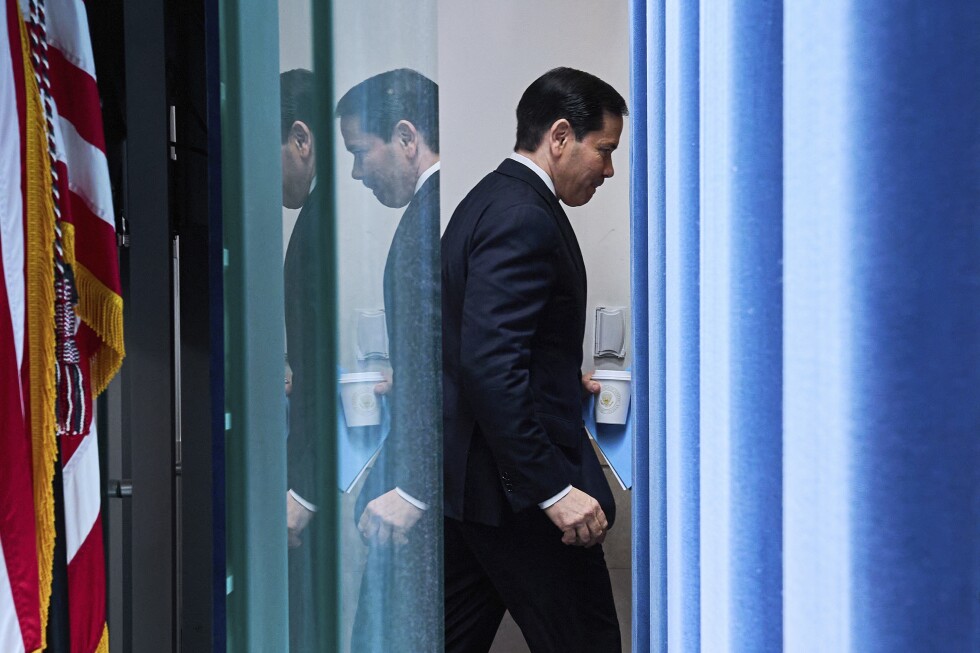
“I hope the Chinese tell him what he needs to be told,” Rubio said during a White House briefing Tuesday. “And that is that what you are doing in the strait is causing you to be globally isolated. You’re the bad guy in this.”
Rubio emphasized that China has suffered more severe economic consequences than the United States from Iran’s two-month blockade. Beijing’s export-driven economy relies heavily on maritime shipping through the strait, with China importing approximately half of its crude oil and nearly one-third of its liquefied natural gas from Middle Eastern sources.
“It is in China’s interest that Iran stop closing the strait,” Rubio stated.
Behind the scenes, American diplomats have been working to persuade China not to veto a new U.S.-backed resolution at the UN Security Council. The resolution aims to reopen the strait and condemn Iran’s actions, according to a diplomat who spoke to The Associated Press on condition of anonymity. Last month, China and Russia—Tehran’s two key allies on the council—vetoed a similar resolution, arguing it went too far and failed to condemn U.S. and Israeli military strikes that triggered the current conflict.
The maritime crisis has become a focal point for Trump’s upcoming visit to China, his first since 2017. Treasury Secretary Scott Bessent confirmed Monday that Iran would feature prominently on the agenda when the two leaders meet.
The effective closure of the Strait of Hormuz has had particularly devastating economic impacts across Asia, which apparently motivated China’s efforts to work with Pakistan in mediating a two-week ceasefire. Trump has acknowledged China’s role in encouraging Iran to accept the fragile ceasefire established last month. Three diplomats familiar with China’s diplomatic initiatives confirmed that Beijing, as Iran’s largest oil customer, used its economic leverage to bring Iranian officials back to negotiations as talks faltered.
Despite these efforts, the Republican administration believes China can do more to help reopen the vital shipping lane.
“The threat of attacks from Iran has closed the strait—we are reopening it,” Bessent said during a Fox News interview. “So I would urge the Chinese to join us in supporting this international operation.”
Trump adopted a more measured tone regarding China’s involvement with Iran, telling reporters in the Oval Office that China hasn’t “challenged” him, even as he continues pressing Iran to abandon its nuclear weapons program and reopen the strait. China, however, has criticized U.S. military actions against its Middle Eastern economic partner.
“You know, in all fairness, he gets, like, 60% of his oil from Hormuz,” Trump said, slightly exaggerating China’s dependence on Middle Eastern oil supplies.
The U.S. government has long accused China of supporting Iran’s ballistic missile program by providing dual-use industrial components that can be used for missile production. However, Trump claimed last month that Xi had agreed not to provide weapons to Iran amid reports that Beijing had considered transferring arms.
Shortly after Trump said he received written assurances from Xi, the president claimed in a CNBC interview that U.S. forces had intercepted a vessel carrying a “gift” from China bound for Iran, though he provided no further details about the incident.
The Biden administration has also increased economic pressure on China for its ties to the Islamic Republic. In late April, the Treasury Department imposed sanctions on a major China-based oil refinery and approximately 40 shipping companies and tankers involved in transporting Iranian oil. These sanctions effectively cut these entities off from the U.S. financial system and penalize anyone conducting business with them.
Meanwhile, China is expected to press the U.S. on reducing weapons sales to Taiwan, which Beijing considers a breakaway province. Rubio confirmed Taiwan would likely be discussed during the Trump-Xi meeting.
“I think both countries understand that it is neither one of our interests to see anything destabilizing happen in that part of the world,” Rubio said. “We don’t need any destabilizing events to occur with regards to Taiwan or anywhere in the Indo-Pacific. And I think that’s to the mutual benefit of both the United States and the Chinese.”
Trump announced an $11.1 billion arms sale to Taiwan in December—a record-setting package—and later suggested he would discuss these sales with Xi, causing concern among Taiwanese officials. Last week, Chinese Foreign Minister Wang Yi urged the United States to “make the right choices” on Taiwan to safeguard “stability” between the two nations, according to a statement from the Chinese Foreign Ministry.
Fact Checker
Verify the accuracy of this article using The Disinformation Commission analysis and real-time sources.

16 Comments
As a major energy importer, China has a strong economic incentive to help reopen the Strait of Hormuz. However, its political ties with Iran may complicate this. It will be a delicate diplomatic dance during the Trump-Xi summit.
You raise a fair point. China’s complex relationships in the region make this a challenging issue for them to navigate.
The Trump administration is clearly trying to leverage China’s influence with Iran to help resolve the Strait of Hormuz blockade. However, China’s own interests and relationships in the region will make this a tricky diplomatic challenge.
You make a good point. China will have to carefully weigh its options and priorities in this high-stakes geopolitical scenario.
This is a prime example of the complex geopolitical challenges facing major powers like the US and China. Striking the right balance between principles, pragmatism, and preserving vital economic interests will be no easy feat.
Well said. The upcoming Trump-Xi summit will be a high-stakes test of their diplomatic skills and ability to find common ground on this thorny issue.
Interesting geopolitical dynamics at play here. China has a tricky balancing act between maintaining ties with Iran while also preserving critical maritime trade routes. It will be fascinating to see how they navigate this issue during the Trump-Xi summit.
Agreed. China’s stance on the Strait of Hormuz blockade could have significant economic and diplomatic implications.
The Strait of Hormuz blockade is undoubtedly causing disruptions to global energy and trade flows. China’s response during the upcoming summit will be crucial in determining how this situation unfolds.
Absolutely. China’s influence with Iran could be a key factor in resolving this impasse, if they choose to exert it.
This situation highlights the delicate nature of global energy and trade dynamics. The US is urging China to pressure Iran, but China will likely try to maintain a more neutral position to protect its own interests in the region.
You make a good point. China has to carefully balance its relationships and priorities in this complex geopolitical landscape.
The Strait of Hormuz is a critical global chokepoint for energy and trade. Iran’s blockade is undoubtedly causing economic hardship, especially for China. It will be intriguing to see if Beijing can leverage its influence to find a diplomatic solution.
Absolutely. The ability to keep this vital shipping route open is crucial for the world economy. China’s role in resolving this dispute bears close watching.
The Strait of Hormuz dispute highlights the interconnected nature of global energy, trade, and geopolitics. China’s response could have far-reaching implications, both for the region and the world economy.
Absolutely. This situation exemplifies the delicate balancing act that major powers must navigate in an increasingly complex and interdependent world.