


Listen to the article
U.S. Oil Giants See Profit Dip Despite Rising Gas Prices, Cite Hedging Challenges
Exxon Mobil and Chevron, the two largest U.S. oil companies, reported significant drops in first-quarter profits Friday despite skyrocketing crude and gasoline prices. The unexpected decline stems primarily from financial hedges that backfired following military actions by the U.S. and Israel against Iran in late February.
The profit decline appears to be largely a paper setback rather than an operational one. Both energy behemoths still managed to exceed Wall Street’s expectations on an adjusted basis, sending their shares higher in pre-market trading after an already strong week.
Industry analysts note the situation highlights the complex relationship between geopolitical tensions, oil market dynamics, and corporate financial strategies. The companies had arranged standard hedging contracts early in the year when energy prices were lower, aiming to protect themselves from market volatility.
However, these hedges became problematic when the Strait of Hormuz—a critical maritime pathway through which approximately 20% of the world’s oil typically flows—was effectively closed off due to regional conflicts. The companies cannot book gains on these hedges until the physical delivery of crude occurs, which became impossible under current conditions.
“If you look at the unprecedented disruption in the world’s supply of oil and natural gas, the market hasn’t seen the full impact of that yet,” Exxon CEO Darren Woods explained during a conference call. “There’s more to come if the strait remains closed. Why haven’t we seen those impacts manifest themselves fully in the market yet? Well, I think we all know there was a lot of water and a lot of oil in transit on the water, a lot of inventory on the water.”
Exxon reported earnings of $4.18 billion ($1 per share) for the quarter ending March 31, down sharply from $7.7 billion ($1.76 per share) in the same period last year. The company lost nearly $4 billion on what it described as “unfavorable estimated timing effects” of its hedges. Adjusted earnings of $1.16 per share still outpaced analyst projections by 9 cents.
Similarly, Chevron saw its quarterly profit fall to $2.21 billion ($1.11 per share) from $3.5 billion ($2 per share) a year earlier. Its results included a $360 million net loss related to a legal reserve, while foreign currency effects reduced earnings by $223 million. On an adjusted basis, Chevron earned $1.41 per share, significantly exceeding market expectations.
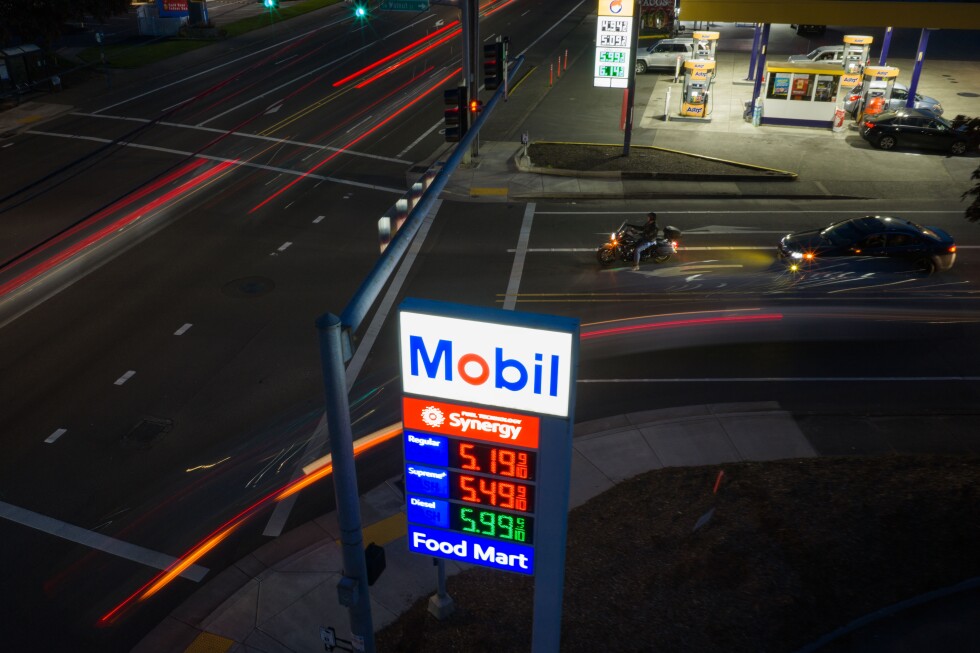
The earnings reports come amid mounting consumer frustration over gasoline prices, which reached new multi-year highs this week. The national average hit $4.39 on Friday, according to AAA—an increase of more than 8% in just one week. This surge contributes significantly to inflation pressures already straining household and business budgets across the country.
March inflation figures from the Department of Labor showed the largest jump in gasoline prices in six decades, creating particular hardship for lower and middle-income families trying to cover basic necessities. The ripple effects are spreading throughout the economy, with airlines worldwide beginning to cancel flights as jet fuel supplies tighten and costs soar.
Exxon reported first-quarter net production of 4.6 million oil-equivalent barrels per day, down from 5 million in the previous quarter. Meanwhile, both companies saw strong revenue performance, with Exxon’s $85.14 billion and Chevron’s $48.61 billion both exceeding analyst forecasts.
These results follow BP’s announcement earlier this week that its first-quarter profit more than doubled, highlighting the uneven impact of current market disruptions across the global energy sector.
Oil prices did show some moderation on Friday, providing a measure of relief to the few stock markets operating during the May Day holiday. However, industry observers remain concerned about continued volatility as long as geopolitical tensions persist in the Middle East.
The situation underscores how financial instruments designed to manage risk can sometimes amplify it when extraordinary global events disrupt normal market operations—creating a complex picture where energy giants can report declining profits even as consumers face rapidly increasing prices at the pump.
Fact Checker
Verify the accuracy of this article using The Disinformation Commission analysis and real-time sources.

10 Comments
It’s striking to see how quickly regional conflicts can impact the bottom line of massive, multinational oil firms. This incident underscores the importance of diversifying supply chains and developing more resilient business models in the energy sector.
While the first-quarter profit decline is certainly noteworthy, I’m not overly concerned about the long-term prospects for these oil giants. Their core operations seem strong, and they’ve demonstrated an ability to adapt to market challenges in the past.
I’m curious to see how Exxon and Chevron navigate these financial challenges in the quarters ahead. Their ability to adapt their hedging practices could be a key factor in determining their overall performance for the year.
The complexity of managing commodity price volatility through financial hedging is really highlighted in this case. It’s a good lesson in the importance of vigilantly monitoring and adjusting hedging strategies to account for shifting market and geopolitical conditions.
Well said. Effective risk management is clearly crucial for these major oil companies, especially given the inherent unpredictability of the global energy market.
While the first-quarter profits decline is notable, it’s reassuring to hear that the companies still exceeded Wall Street’s expectations on an adjusted basis. This suggests they have the operational strength to weather these types of temporary financial setbacks.
Absolutely, their ability to outperform expectations despite the hedging challenges is a positive sign for their underlying business performance.
It’s interesting to see how geopolitical tensions can impact oil companies’ financial performance, even when market conditions are otherwise favorable. The hedging strategies seem to have backfired in this case, highlighting the complexities of managing commodity price volatility.
Declining profits for big oil firms in the first quarter is likely just a temporary setback, given the current high prices for crude and gasoline. Adjusting their hedging strategies will be crucial for these companies to maintain profitability amid ongoing market and geopolitical uncertainties.
The profit dip for major US oil companies is a good reminder that even industry giants can face unexpected headwinds. It will be interesting to see if they can quickly recover and capitalize on the broader rise in oil and gas prices.