


Listen to the article
House Republican Seeks to Limit Iran War Powers Despite Administration Claims
A House Republican facing a tough re-election battle has introduced legislation that would impose strict limits on U.S. military operations against Iran, directly challenging the Trump administration’s assertion that hostilities have ended.
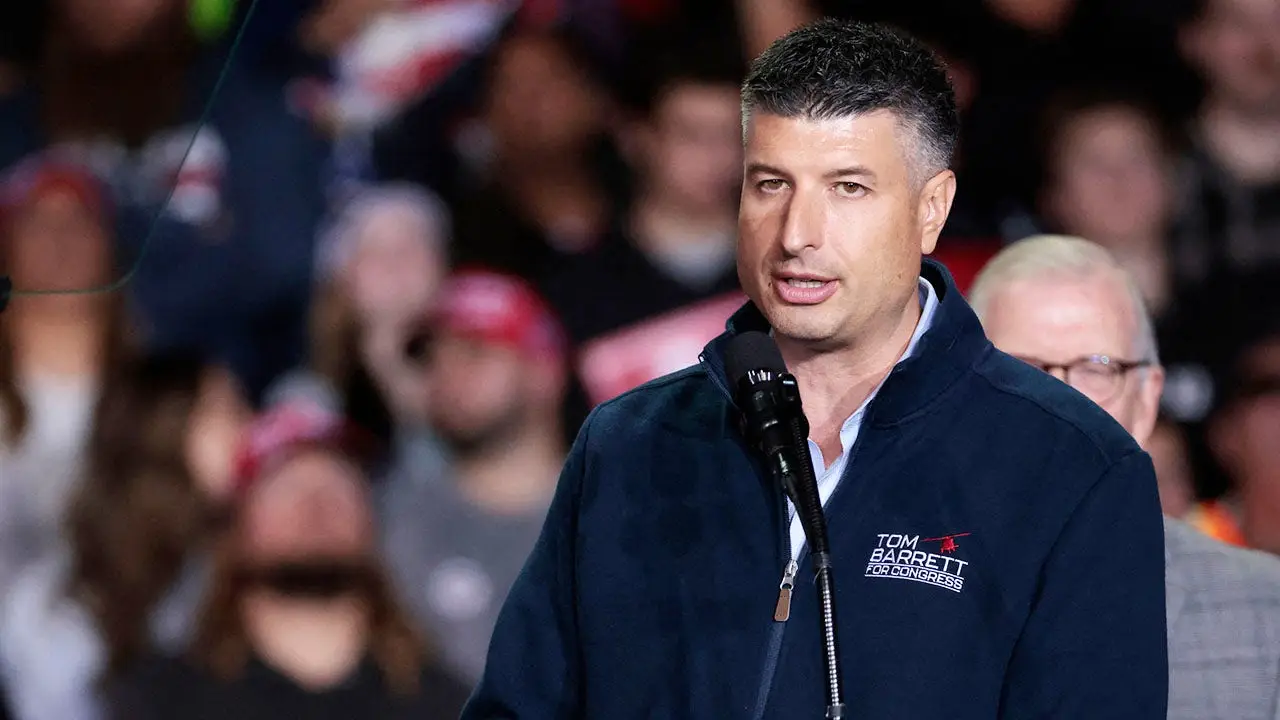
Rep. Tom Barrett, R-Mich., on Thursday proposed a resolution that would authorize military action against Iran through July 30, with specific parameters for what operations would be permitted. The measure aims to allow U.S. forces to permanently degrade Iran’s nuclear program, address “imminent threats,” enforce a naval blockade, and ensure safe passage through the strategically vital Strait of Hormuz.
However, Barrett’s resolution includes significant constraints on military operations, prohibiting “nation-building,” occupation of Iranian territory, and limiting the deployment of ground troops.
“Two things have been clear from the very beginning: Iran cannot be allowed to develop a nuclear weapon and the United States of America cannot be dragged into another endless war,” said Barrett, an Army veteran who served multiple tours in the Middle East. “The commander in chief has the sole authority to lead our troops in wartime, but I’ve lost too many friends on the battlefield to allow that to happen without Congress exercising its constitutional role.”
The Michigan congressman’s proposal comes as the White House has effectively disregarded a key 60-day deadline under the 1973 War Powers Resolution. The administration argues that a ceasefire initiated on April 7 has essentially stopped the clock on the law’s requirement to end hostilities within 60 to 90 days without congressional approval.
“For War Powers Resolution purposes, the hostilities that began on Saturday, February 28 have terminated,” a senior administration official told Fox News Digital last week. “Both parties agreed to a two-week ceasefire on Tuesday, April 7 that has since been extended. There has been no exchange of fire between U.S. Armed Forces and Iran since Tuesday, April 7.”
Barrett’s office contradicted this claim, stating in a press release that “U.S. military operations are ongoing.”
The congressman’s initiative is not isolated. Senator Lisa Murkowski, R-Alaska, has also pledged to introduce similar legislation in the Senate to establish clear boundaries for military action against Iran, which she has characterized as a “restraint” on Trump.
Secretary of State Marco Rubio has taken a different stance, arguing Tuesday that the 1973 War Powers Resolution itself is unconstitutional, though the administration has been complying with notification requirements “to preserve good relations with Congress.”
If passed, Barrett’s resolution would also include a 30-day “wind-down period” should the administration seek to extend military operations beyond the July 30 deadline.
The timing of Barrett’s proposal is significant as he faces what could be a difficult re-election campaign in a district rated as a “toss-up” by the nonpartisan Cook Political Report. His Michigan district, which includes Lansing, is being targeted by Democrats, with former U.S. Ambassador to Ukraine Bridget Brink and retired Navy SEAL Matt Maasdam among those competing in a crowded Democratic primary to challenge him.
It remains unclear whether Barrett will join Democrats in supporting a broader war powers resolution aimed at blocking military action against Iran without congressional authorization when lawmakers return to Washington next week.
The debate over war powers reflects long-standing tensions between Congress and the executive branch regarding military authority, with lawmakers from both parties periodically seeking to reassert congressional oversight during conflicts. Barrett’s resolution represents one of the more detailed attempts to define the parameters of military engagement while acknowledging the reality of ongoing operations.
Fact Checker
Verify the accuracy of this article using The Disinformation Commission analysis and real-time sources.

21 Comments
Appreciating the nuance and care in Rep. Barrett’s approach. Seeking to degrade Iran’s nuclear program while avoiding another protracted conflict is a worthy and challenging goal.
Kudos to Rep. Barrett for bringing a measured, thoughtful approach to a highly charged foreign policy debate. Avoiding mission creep and protracted conflicts should be a top priority.
As a veteran, Rep. Barrett likely has a nuanced perspective on the costs and consequences of military action. Trying to strike a balance between addressing Iran’s nuclear ambitions and avoiding another quagmire is a tricky challenge.
Curious to see how this legislation progresses and whether it can gain bipartisan support, given the divisive politics around Iran policy.
This seems like a thoughtful, pragmatic effort to address a complex geopolitical challenge. Kudos to Rep. Barrett for taking a stance that breaks from partisan lines.
Limiting ground troop deployments and nation-building efforts could help avoid the pitfalls of past conflicts. Curious to see if this proposal resonates with colleagues on both sides of the aisle.
Striking the right balance between military action and diplomatic engagement on Iran is no easy feat. This proposal appears to at least make a good-faith effort in that direction.
Interesting to see a GOP lawmaker from a swing district take a stance that diverges from the administration’s posture on Iran. This could signal shifting political winds on this issue.
The specific parameters around naval operations and nuclear program degradation seem prudent. Curious to see if this proposal can garner bipartisan support.
The Strait of Hormuz is a vital global chokepoint, so ensuring safe passage is a legitimate national security concern. But military constraints like limiting ground troops seem prudent to avoid mission creep.
I wonder how this proposal would impact the administration’s broader Iran strategy. Hopefully it can at least prompt a serious debate on the appropriate use of force.
This is an interesting development. It’s good to see a GOP lawmaker breaking from the party line on a critical foreign policy issue like Iran. Thoughtful limits on war powers seem prudent to avoid another protracted conflict.
I agree, the specific parameters outlined seem reasonable – allowing targeted action against the nuclear program and threats, while avoiding open-ended occupation or nation-building.
Thoughtful constraints on military action against Iran, especially around ground troops and occupation, could help avoid the pitfalls of past conflicts. Kudos to Rep. Barrett for this pragmatic approach.
Limiting ground troops and nation-building efforts while still allowing targeted actions against Iran’s nuclear program and threats seems like a reasonable compromise. Curious to see how this plays out.
As a veteran, Rep. Barrett likely understands the human and financial costs of prolonged military engagements. This proposal reflects an effort to balance strategic priorities and operational realities.
This proposal appears to strike a careful balance between addressing Iran’s nuclear ambitions and avoiding another protracted conflict. Kudos to Rep. Barrett for bringing a measured perspective to this debate.
Curious to see if this bipartisan effort can gain traction and influence the broader conversation around US-Iran policy in Congress.
As an Army veteran, Rep. Barrett likely has valuable on-the-ground experience to draw from in crafting this legislation. Balancing strategic priorities and operational constraints is no easy task.
Curious to see if this proposal can gain traction and influence the broader debate around Iran policy in Congress.
As a veteran, Rep. Barrett likely understands the human toll of prolonged military operations. His call for constraints on the use of force against Iran merits serious consideration.