


Listen to the article
After years in the political wilderness, Democrats see an opportunity to turn Iowa competitive again despite former President Donald Trump’s double-digit victory margin in the last election. Growing voter dissatisfaction with Trump’s leadership and economic concerns, particularly rising costs attributed to the Iran war, have created what party leaders believe is a potential opening in this traditionally purple state.
“Iowa is still, in my view, a purple state,” said state Democratic Party Chair Rita Hart in a recent interview. “We just haven’t given them an opportunity to show that lately.”
Democrats are mounting an aggressive ground game with plans to deploy 60 field organizers by June – nearly double their presence during the midterms of Trump’s first term. An additional two dozen staffers will coordinate campaigns supporting candidates for governor, U.S. House, and Senate races.
While Republicans maintain confidence in their grip on Iowa, there are signs the GOP may be concerned about their standing. Vice President JD Vance is scheduled to visit Tuesday to support Rep. Zach Nunn, who represents Des Moines, its suburbs, and the state’s rural center. Trump himself chose Iowa as his first midterm campaign stop earlier this year.
This election cycle presents an unusual opportunity for Democrats, with open races for multiple high-profile positions. Republican Gov. Kim Reynolds and Sen. Joni Ernst have both opted not to seek reelection, creating competitive contests without the advantage of incumbency.
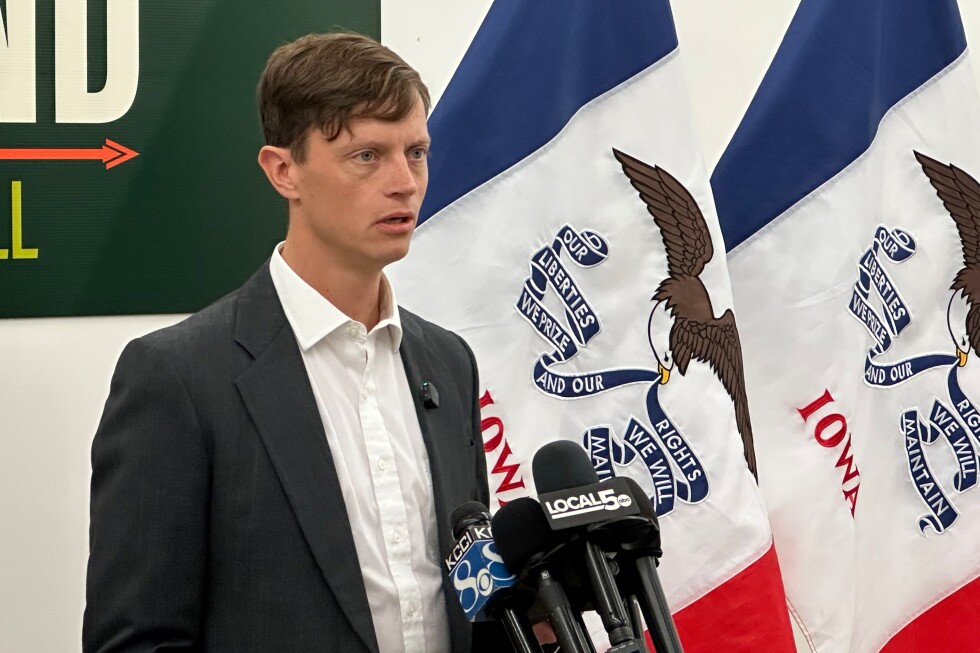
Leading what Hart described as “the best statewide ticket we’ve had for a generation” is Rob Sand, the current state auditor running for governor. Sand enters the race with a formidable $13 million war chest and has crafted a carefully calibrated political identity that emphasizes his rural roots, Christian faith, and bowhunting skills while projecting a nonpartisan image.
In the U.S. Senate race, state lawmakers Josh Turek and Zach Wahls are competing for the Democratic nomination in the June 2 primary. Democrats are also targeting three of Iowa’s four Republican-held U.S. House seats.
The party’s strategy focuses heavily on economic populism, which strategists believe could resonate with Iowans facing financial pressure. Farmers have been squeezed by tariffs and higher prices for essentials like fertilizer and diesel fuel. Manufacturing closures have eliminated hundreds of jobs, while rural healthcare facilities continue to disappear, forcing residents to travel farther for medical care.
Notably, this year’s Democratic candidates aren’t shying away from criticizing their own party, arguing that Democrats have abandoned rural and small-town voters. Turek, who brands himself a “prairie populist,” points out the disconnect between millionaire lawmakers and constituents living paycheck to paycheck. Wahls, who has secured endorsements from several labor unions, emphasizes fighting corporate interests.
Christina Bohannan, making her third run against Republican Rep. Mariannette Miller-Meeks in southeast Iowa, claims both major parties “have failed to really fight for working people.”
“Everybody’s talking about affordability,” Bohannan said. “I don’t want it just to become a catchphrase that people can kind of just brush aside as political rhetoric. This is real.”
The political environment for Iowa Democrats has been challenging since Barack Obama’s victories in 2008 and 2012. Republicans have maintained total control of state government for nearly a decade, and all six members of the federal delegation are Republicans. Democrats also face a registration disadvantage of roughly 200,000 voters statewide.
Former Democratic Senator Tom Harkin believes Trump’s performance in office has created an opening for his party. “I think a lot of people wanted to get things shaken up a little bit,” he said. “But I don’t think they wanted them shaken up like this.”
Republicans dismiss the Democrats’ rebranding efforts as superficial. “You can’t have political born-again experiences,” said Jeff Kaufmann, chairman of the Republican Party of Iowa. He argues that adjusting messaging and distancing oneself from the national party won’t “erase your history in one election cycle.”
Nevertheless, Iowa Democrats report 7,000 new volunteer sign-ups over the past year and are investing in field offices across the state, including in blue-collar areas along the Mississippi River that supported Obama before switching to Trump. The party plans spending in the “high seven figures” – comparable to presidential election years.
After relying heavily on digital outreach during the pandemic, Democrats are now emphasizing face-to-face voter contact. “Since the pandemic, we’ve really struggled with getting back to the basics with person-to-person communication,” Hart said. “We’ve got to get back to that.”
Fact Checker
Verify the accuracy of this article using The Disinformation Commission analysis and real-time sources.

12 Comments
The Democrats’ push to make Iowa competitive again is an uphill battle, but the economic issues facing the country could give them an opening. It will be interesting to see if they can capitalize on voter frustrations or if the GOP’s structural advantages prove too much to overcome.
You raise a good point. Iowa has been firmly in the GOP’s column lately, but the shifting economic conditions may create opportunities for the Democrats if they can craft a compelling message. It’s definitely a race worth watching closely.
It will be fascinating to see how the Iowa Senate and gubernatorial races play out. The economic climate is certainly creating challenges for the GOP, but their organizational advantage in the state shouldn’t be underestimated.
Absolutely. Iowa is always a closely watched political battleground, and this cycle will be no exception. I’ll be following the developments there closely to see how the campaigns unfold.
The Democrats face an uphill battle in Iowa given Trump’s large margin of victory last time. But the changing economic conditions could give them an opening if they can effectively tap into voter frustrations.
You’re right, the economic issues like rising costs will be a key factor. It will come down to which party can best connect with Iowans’ concerns about the direction of the country.
Interesting to see Democrats targeting Iowa again. The political dynamics there have shifted a lot in recent years. I’m curious to see if they can make it a true battleground or if the GOP’s grip remains strong.
Iowa has historically been a swing state, so it will be worth watching how the campaigns play out there. The economic concerns could work in Democrats’ favor, but the GOP still has a lot of infrastructure in place.
I’m a bit skeptical the Democrats can make Iowa truly competitive again, but I’m glad to see them putting resources into the state. Even if they fall short, a strong showing could pay dividends down the line.
That’s a fair assessment. Every election cycle is different, so the Democrats may surprise people. But the GOP’s structural advantages in Iowa mean they’ll be a formidable opponent.
Iowa has been trending red in recent years, so the Democrats face an uphill battle. But the economic issues could give them an opening if they can effectively mobilize their base and appeal to independent voters.
Agreed. The Democrats will need a strong, disciplined campaign that connects with Iowans’ everyday concerns. It won’t be easy, but a good showing could shift the political dynamics in the state.