


Listen to the article
Delhi Assembly Speaker Condemns Opposition’s Absence, Defends House Proceedings
Delhi Assembly Speaker Vijender Gupta sharply criticized opposition members on Monday for what he described as a “completely negative approach” during the recently concluded assembly session, characterizing their absence from proceedings as unjustified and concerning.
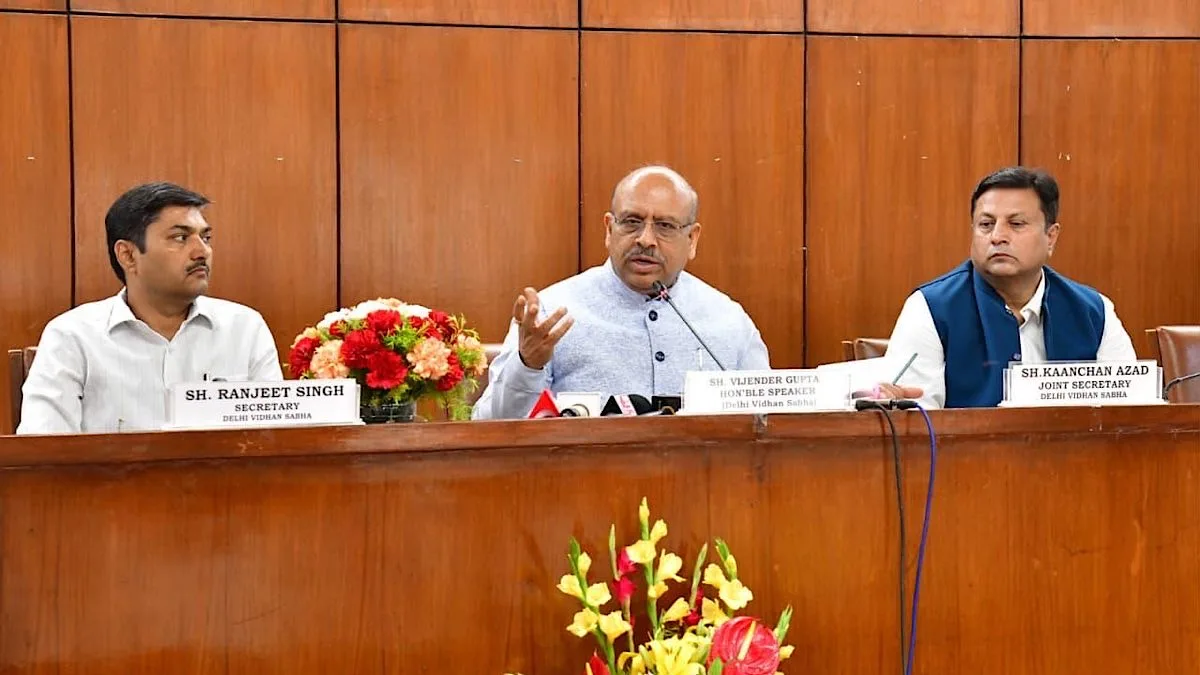
Speaking at a press conference, Gupta expressed dismay over opposition legislators’ decision to boycott house proceedings “without any substantive issue.” He termed their absence “unprecedented in legislative practice” and rejected their claims of protest as groundless.
“Boycotting the House without any issue, disrupting its functioning, and attempting to mislead the public cannot be justified,” Gupta said, suggesting the opposition’s conduct undermined parliamentary norms.
The Speaker addressed the controversial suspension of opposition members, explaining that he had met with the Leader of the Opposition on March 21 to clarify that suspensions automatically expire when the House is prorogued. Gupta referenced Rule 77, which stipulates that suspended members are barred from entering House precincts and participating in committee meetings, though exceptions can be granted for specific purposes with the Speaker’s approval.
“It was clearly conveyed that if the Opposition had any grievance, they could attend the House, present their case, and time would be allotted for discussion,” Gupta said, adding that despite this assurance, opposition members chose to stay away.
Despite the political tension, Gupta highlighted several achievements of the session. Chief among these was the tabling of all seven pending Comptroller and Auditor General (CAG) reports, marking complete compliance with audit requirements. These reports, covering state finances, revenue, economic issues, social and general sectors, public sector undertakings, the Delhi Jal Board, and universities under the Government of the National Capital Territory of Delhi (GNCTD), were subsequently referred to the Public Accounts Committee.
The assembly also passed key legislation during the session, including the Delhi Appropriation (No. 2) Bill, 2026, the Societies Registration (Delhi Amendment) Bill, 2026, and the Delhi Appropriation (No. 3) Bill, 2026. These bills represent significant policy and financial decisions for the capital territory’s governance.
In a nod to technological advancement, Gupta announced the successful implementation of “Vidhan Saathi,” an artificial intelligence-enabled chatbot designed to provide real-time legislative research support. The system operates in both Hindi and English and includes voice-enabled access, representing a modernization of assembly resources.
The Speaker also reported the constitution of important financial oversight bodies, including the Public Accounts Committee, the Estimates Committee, and the Committee on Government Undertakings, which play crucial roles in maintaining accountability in government spending and operations.
The current tensions in the Delhi Assembly reflect broader political divides in the capital territory, where the Aam Aadmi Party (AAP) government and opposition parties have frequently clashed over governance issues. Delhi’s unique status as the national capital with limited statehood powers has historically created jurisdictional conflicts, further complicating legislative proceedings.
Political analysts note that such legislative standoffs are not uncommon in Indian state assemblies but can impede policy implementation and undermine public confidence in democratic institutions. The Delhi Assembly’s functioning is particularly significant given the capital’s prominence and the high visibility of its governance challenges.
As the assembly moves forward from this contentious session, observers will be watching closely to see whether procedural disputes continue to hamper legislative business or if both sides can find common ground on key issues facing Delhi’s residents.
Fact Checker
Verify the accuracy of this article using The Disinformation Commission analysis and real-time sources.

8 Comments
This is an unfortunate situation that highlights the need for greater civility and a shared commitment to democratic norms in the legislative process. I hope all sides can work to find a constructive path forward.
This seems like a complex situation with valid concerns on both sides. I hope the Speaker and opposition can find a way to engage constructively and restore the public’s trust in the legislative process.
While I understand the Speaker’s frustration, I’m concerned that boycotts and suspensions could further polarize the situation. Effective governance requires compromise and good-faith dialogue.
The public deserves a legislature that can put partisan differences aside and focus on addressing the issues that matter most to citizens.
This seems like a concerning situation where the legislative process is being disrupted. I hope the Speaker and opposition can find a constructive way to address their differences and ensure the House can function effectively.
Boycotting the House without clear justification does seem problematic. The public deserves a functioning legislature that can debate and address important issues.
Suspending opposition members is a serious step. I’m curious to learn more about the specific issues and whether there were attempts at compromise before resorting to that measure.
The Speaker’s comments about the importance of adhering to parliamentary norms are well-taken. Healthy debate is vital, but disrupting proceedings without cause is concerning.