


Listen to the article
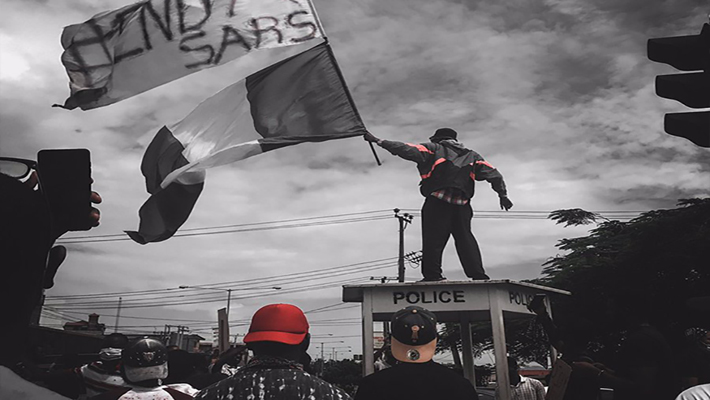
Nigeria’s former Information Minister Lai Mohammed has attributed the escalation of the October 2020 #EndSARS protests to the spread of misinformation rather than government communication failures, sparking fresh debate about the movement that captivated global attention three years ago.
Speaking at a high-level forum at the London School of Economics and Political Science last Friday, Mohammed claimed that while the protests began as legitimate demonstrations against police brutality, they were subsequently “hijacked by those with ulterior motives” and further intensified by the deliberate circulation of false information across media platforms.
“The problem we had was not the usual communication gap between the government and the citizens. It was fake news and disinformation, coupled with unbridled violence,” Mohammed stated according to a press release issued by his media aide, Nnamdi Atupulazi.
The former minister’s remarks represent his most detailed public assessment of the protests since leaving office following the conclusion of President Muhammadu Buhari’s administration in 2023. The #EndSARS movement began as youth-led protests against the Special Anti-Robbery Squad (SARS), a police unit repeatedly accused of extrajudicial killings, extortion, and human rights abuses.
Mohammed specifically criticized international media organizations for their coverage of the protests, accusing them of relying on “unverified and, in some cases, doctored content” that he claims distorted global understanding of events in Nigeria during that period. “What we saw during EndSARS was the dangerous power of disinformation in real time,” he asserted.
His statements come amid ongoing controversies surrounding the government’s response to the protests, which culminated in the shooting at Lekki Toll Gate in Lagos on October 20, 2020. That incident remains contentious, with human rights organizations and a judicial panel documenting casualties while government officials have provided conflicting accounts.
During the same LSE forum, Mohammed also discussed Nigeria’s communication strategy during the COVID-19 pandemic, which he characterized as successful despite unprecedented challenges. “When COVID-19 broke out, there was no template to fall back on. The last major pandemic, the Spanish Flu, had occurred over 100 years earlier. So we had to devise our own communication strategy on the go,” he explained.
According to Mohammed, the Nigerian government implemented a “coordinated and adaptive communication framework” based on principles of transparency and consistency. This included daily briefings, multi-platform messaging, and continuous media engagement to ensure citizens received accurate information throughout the health crisis.
The former minister detailed how government agencies and partners developed communication materials in various Nigerian languages and pidgin to maximize public understanding across the country’s diverse linguistic landscape. These efforts represented a significant public health communication campaign in Africa’s most populous nation during a global emergency.
Mohammed’s current speaking engagements in the United Kingdom are part of a three-day tour promoting his new book, “Headlines & Soundbites: Media Moments That Defined an Administration,” which chronicles his eight-year tenure as government spokesperson under the Buhari administration from 2015 to 2023.
Media analysts note that Mohammed’s retrospective assessment of the #EndSARS movement comes at a time when Nigeria continues to grapple with challenges around information integrity in its evolving digital media landscape. The country has one of Africa’s most active social media user bases, with platforms like Twitter and WhatsApp playing increasingly significant roles in political discourse and civic engagement.
Communications experts suggest that Mohammed’s emphasis on disinformation rather than addressing the underlying grievances that sparked the protests represents a continuation of the previous administration’s narrative around the #EndSARS movement, which many activists and human rights observers have contested.
The ongoing debate highlights the complex intersection of social movements, media coverage, government communication, and digital information ecosystems in contemporary Nigerian politics.
Fact Checker
Verify the accuracy of this article using The Disinformation Commission analysis and real-time sources.

5 Comments
The minister’s comments raise valid points about the role of disinformation. However, it’s important not to lose sight of the legitimate concerns that drove the protests in the first place. A nuanced approach is needed.
While fake news contributed to the unrest, the core grievances around police brutality and lack of accountability seem to have been real and widespread. Simply blaming misinformation oversimplifies a complex situation.
Well said. The government needs to show it’s taking substantive steps to address the underlying issues, not just focus on the information landscape.
Interesting take from the former minister. Misinformation certainly played a role, but the government’s response to the legitimate protests was also a major factor behind the escalation. Curious to hear more details on how they plan to address these issues moving forward.
Agreed, the government’s handling of the protests was arguably as big an issue as the spread of misinformation. Transparency and open dialogue will be key to rebuild trust.