


Listen to the article
Coordinated Misinformation Campaign Targeting India Amid Iran-Israel Tensions Uncovered
A sophisticated network of social media accounts, predominantly linked to Pakistan, has been orchestrating a coordinated disinformation campaign against India amid escalating tensions between Iran, Israel, and the United States, according to a comprehensive investigation by the Digital Forensics Research and Analysis Center (DFRAC).
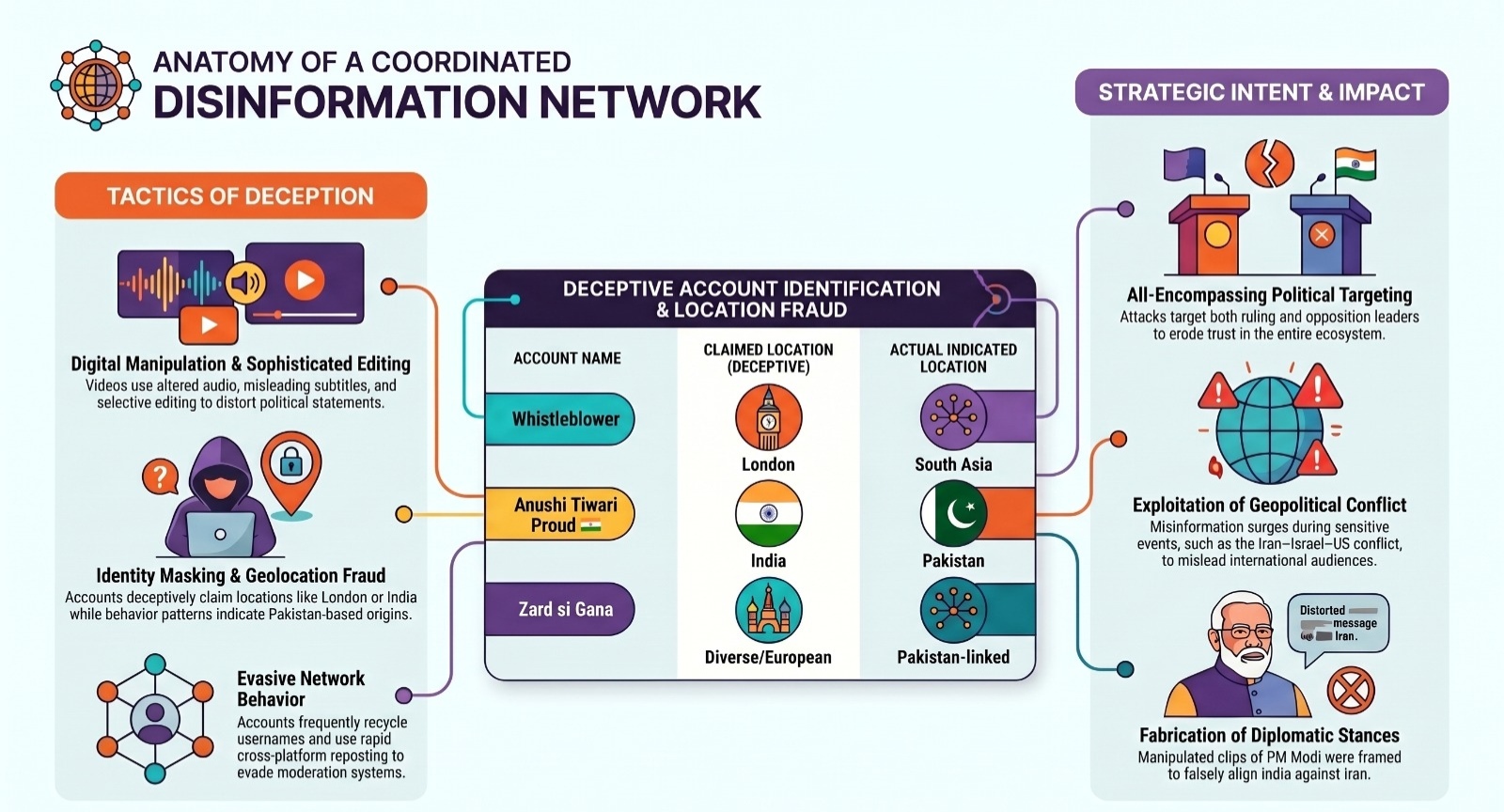
The investigation reveals a systematic effort to distort India’s global image and misrepresent its foreign policy stance through digitally manipulated videos, fabricated narratives, and strategic content amplification. The campaign falsely portrays India as aligned against Iran in the ongoing conflict, contradicting India’s official neutral position.
“These claims are not supported by official statements or verified sources and are amplified using deceptive editing techniques,” noted the DFRAC report, which detailed seven key components of the disinformation strategy.
At the heart of the campaign is the widespread deployment of digitally altered and AI-generated videos designed to mimic Indian officials, military leaders, and media personalities. One manipulated video falsely showed Defence Minister Rajnath Singh endorsing US military actions against Iran, while another doctored clip claimed Army Chief General Upendra Dwivedi admitted that India had shared intelligence about IRIS Dena with Israel.
Perhaps most concerning was a fabricated video depicting Prime Minister Narendra Modi allegedly making provocative remarks, including referring to Israel as a “global fatherland.” These sophisticated forgeries were often accompanied by misleading captions and fabricated subtitles to further distort context.
The campaign has specifically targeted India’s governmental institutions, military leadership, and media organizations. In one notable instance, a viral claim alleged that Bahrain had arrested an Indian engineer for passing intelligence to the Israeli intelligence agency Mossad. Supporting images purportedly from a Bahraini press release were digitally altered to insert an Indian identity, though no credible evidence substantiated this claim.
This coordinated effort consistently pushes narratives portraying India as a covert ally of Israel, a betrayer of Iran, and an aggressor in regional geopolitics. Many posts falsely attribute statements to Indian officials, claiming intelligence-sharing with Israel or plans for hostile actions against Iran. These fabrications directly contradict India’s actual diplomatic stance of neutrality in the conflict.
Security analysts point out that the timing of these disinformation waves suggests a deliberate strategy aligned with key geopolitical developments. A surge in posts using the hashtag #IndiaBetraysIran immediately followed the sinking of IRIS Dena on March 4, 2026. Similarly, the false Bahrain “Indian spy” narrative gained traction during heightened diplomatic activity on March 11, 2026.
“Each surge aligned with key geopolitical developments, indicating an attempt to insert India into the conflict narrative at moments of heightened global attention,” explained a senior DFRAC analyst who requested anonymity due to security concerns.
The investigation identified several accounts playing central roles in propagating misinformation, including one operating under the name “Anushi Tiwari” that alleged Rajnath Singh had issued warnings to Iran regarding Indian oil tankers. Another account, “Shadowfox_11” (alias Schlangenjäger), was responsible for circulating the doctored video of Prime Minister Modi.
The operators demonstrate sophisticated evasion tactics, including content recycling and rapid replication across multiple platforms. When accounts are flagged or suspended, new profiles quickly emerge with similar names and messaging patterns, indicating a resilient network.
“What we’re seeing is not isolated incidents but rather a structured campaign with clear objectives,” said a cybersecurity expert familiar with the investigation. “The use of deep fakes, fabricated narratives, and synchronized amplification across platforms reveals a well-resourced operation.”
The DFRAC findings come at a critical juncture in regional politics, as South Asian nations navigate their diplomatic positions amid the complex Iran-Israel tensions. The campaign appears designed to undermine India’s diplomatic credibility particularly among audiences in Muslim-majority countries and the Global South by portraying it as a “neo-colonial” actor aligned against Iran.
Regional security experts suggest that by timing these disinformation waves to coincide with Pakistan’s involvement in US-Iran ceasefire negotiations, the campaign may seek to divert attention from Pakistan’s diplomatic positioning while simultaneously damaging India’s international standing.
As digital forensics capabilities improve, investigations like DFRAC’s highlight the growing sophistication of state-aligned information operations and the challenges they present to regional stability and diplomatic relations in an increasingly complex information environment.
Fact Checker
Verify the accuracy of this article using The Disinformation Commission analysis and real-time sources.

10 Comments
The use of AI-generated and digitally altered videos to spread false narratives is a worrying trend. Governments and platforms need to invest more in detecting and removing such deceptive content.
Absolutely. The stakes are high when it comes to international relations and national security. Robust fact-checking and content moderation are essential to maintain transparency and trust.
The use of AI-generated and digitally altered videos to spread false narratives is a worrying development. Platforms and governments need to be proactive in identifying and removing such deceptive content.
This report highlights the need for robust fact-checking and media literacy initiatives to counter the rise of sophisticated disinformation campaigns. Maintaining trust in institutions and reliable information sources is paramount.
This alleged disinformation campaign seems troubling, if true. Maintaining transparency and fact-based discourse is crucial, especially on issues that could impact regional stability.
I agree. Coordinated efforts to manipulate information and sway public opinion are very concerning. Responsible reporting and independent verification are essential in these situations.
This is a concerning report on coordinated disinformation targeting India’s global image. It’s important to rely on official sources and verified information when discussing sensitive geopolitical issues like this.
Agreed, digital manipulation and fabricated narratives can be very misleading. Fact-checking and critical analysis are crucial to counter such coordinated misinformation campaigns.
While I’m curious to learn more, this report raises serious concerns about the potential for misinformation to distort geopolitical dynamics. Balanced and objective analysis is key in sensitive situations like this.
Well said. We should be vigilant about unverified claims, especially when they involve complex foreign policy matters with high stakes. Relying on authoritative sources is the best approach.