


Listen to the article
Afghan Media Outlet “Al-Mirsad” Revealed as Taliban Intelligence Propaganda Tool, Study Finds
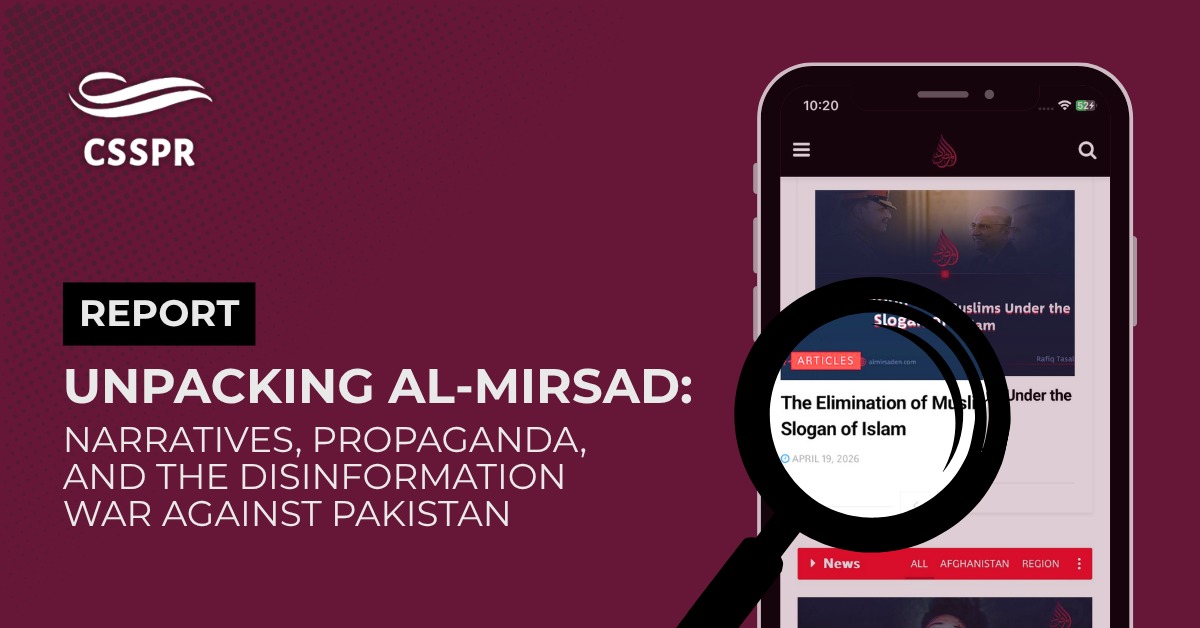
A comprehensive research study has uncovered that Afghan media outlet “Al-Mirsad” operates as a sophisticated propaganda platform directly controlled by the Afghan Taliban’s intelligence apparatus, according to researchers at the University of Lahore.
The investigation, conducted by the Center for Security, Strategy and Policy Research (CSSPR), reveals that Al-Mirsad, launched in 2023, functions not as an independent news organization but as a coordinated information warfare tool designed specifically to target Pakistan and undermine its stability.
“This is not journalism or analysis, but a structured propaganda weapon,” explained the researchers, who documented how the platform operates under centralized control linked to Taliban leadership. The outlet’s primary objective appears to be advancing ideological warfare by crafting narratives that simultaneously legitimize the Taliban regime while delegitimizing Pakistan’s government and institutions.
Security analysts note that Al-Mirsad’s operations represent a significant evolution in regional information warfare tactics. The platform employs a multi-layered digital strategy, producing content in six languages—English, Urdu, Pashto, Arabic, Dari, and Hindi—to reach diverse audiences across South and Central Asia.
The CSSPR study details how Al-Mirsad utilizes modern distribution techniques across multiple social media channels, including Telegram, X (formerly Twitter), WhatsApp, and YouTube. Evidence suggests the operation employs AI-driven amplification methods to maximize its reach and impact, ensuring narrative saturation across target populations.
Perhaps most concerning to regional security experts is what the report describes as the “weaponization of religion.” The platform systematically distorts Islamic concepts and principles to frame militant violence as religious duty while portraying Pakistan’s counterterrorism operations as illegitimate and un-Islamic.
This religious framing serves a dual purpose, according to the researchers. It provides ideological cover for extremist groups while simultaneously undermining Pakistan’s religious legitimacy in the eyes of its Muslim-majority population.
The study specifically highlights Al-Mirsad’s role as a “force multiplier” for militant organizations, particularly in its legitimization of Tehreek-e-Taliban Pakistan (TTP), a designated terrorist organization responsible for numerous attacks against Pakistani civilians and security forces. The platform deliberately obscures the well-documented connections between the Afghan Taliban and TTP operations, researchers found.
“What we’re seeing is a convergence of terrorism and information warfare,” noted a security analyst familiar with the study. “This propaganda isn’t just about influencing perceptions—it’s designed to justify violence, recruit supporters, and actively destabilize Pakistan.”
Al-Mirsad’s psychological warfare extends to exploiting Pakistan’s internal ethnic divisions, particularly in Pashtun and Baloch regions, where historical grievances and socioeconomic challenges create vulnerabilities. The platform also attempts to co-opt global Muslim causes, such as Palestinian solidarity, to embed anti-Pakistan narratives within broader Islamic discourse and appeal to younger audiences.
The CSSPR analysis points to what it terms “strategic silence” in Al-Mirsad’s coverage—the platform notably avoids any criticism of the Taliban’s domestic policies, including its severe restrictions on women’s rights, education access, and civil freedoms. Instead, it focuses exclusively on propagating fabricated narratives and conspiracy theories aimed at portraying Pakistan as an “immoral” and “anti-Islamic” state.
Beyond targeting Pakistan’s domestic stability, the platform appears designed to damage Pakistan’s international relations, particularly with regional economic partner China, by questioning the country’s security environment and ability to protect foreign investments like the China-Pakistan Economic Corridor.
The findings come amid growing concerns about cross-border security challenges facing Pakistan, which has experienced an uptick in terrorist attacks in recent years, many attributed to militants operating from Afghan territory.
Regional security experts suggest this study underscores the need for more sophisticated approaches to countering information warfare and propaganda in South Asia, particularly as digital tools make cross-border influence operations increasingly accessible to non-state and state actors alike.
Fact Checker
Verify the accuracy of this article using The Disinformation Commission analysis and real-time sources.

10 Comments
This report on the Taliban’s use of the Al-Mirsad media outlet as a propaganda tool is a concerning development. The level of centralized control and the objective of undermining Pakistan’s stability is worrying. Addressing such information warfare tactics will be crucial for the region’s security.
The findings in this report about the Taliban’s propaganda operation through the Al-Mirsad media outlet are quite alarming. It’s a stark reminder of the dangers of unchecked disinformation and the need for rigorous fact-checking, especially in conflict-affected regions.
Absolutely, the report highlights the need for greater media oversight and transparency to prevent such manipulation. Countering coordinated propaganda efforts will require a multi-faceted approach involving fact-based reporting, digital literacy, and international cooperation.
The Taliban’s use of media manipulation to target Pakistan is a worrying trend. Spreading false narratives to undermine a neighboring country’s stability is a dangerous game. I hope this report leads to greater scrutiny and countermeasures against such propaganda efforts.
Interesting report on the Taliban’s use of media as a propaganda tool against Pakistan. It’s concerning to see how disinformation campaigns can spread through coordinated efforts like this. I wonder what steps Pakistan and the international community are taking to counter these tactics.
The findings in this report about the Taliban’s propaganda operation through Al-Mirsad are quite disturbing. Using a media outlet as a front for ideological messaging and disinformation is a serious threat to regional stability. Concerted efforts will be needed to counter such sophisticated information warfare tactics.
Centralized Taliban control of a supposedly independent media outlet like Al-Mirsad is a clear abuse of press freedoms. This report highlights the need for more transparency and accountability in the region’s media landscape to prevent the spread of disinformation.
I agree, having a media outlet directly controlled by the Taliban as a propaganda tool is very concerning. Robust fact-checking and media literacy efforts will be crucial to counter the impact of such coordinated misinformation campaigns.
This report sheds light on the Taliban’s evolving information warfare tactics. Using a media outlet as a front for ideological messaging and delegitimizing a neighboring country is a worrying development. Comprehensive responses will be needed to address this threat.
This reveals some quite sophisticated information warfare tactics being employed by the Taliban. Using a media outlet as a front for their propaganda is a concerning development. I hope the report’s findings can help authorities respond effectively to this threat.