


Listen to the article
U.S. Government Quietly Operates Covert News Sites Pushing Foreign Policy Agenda
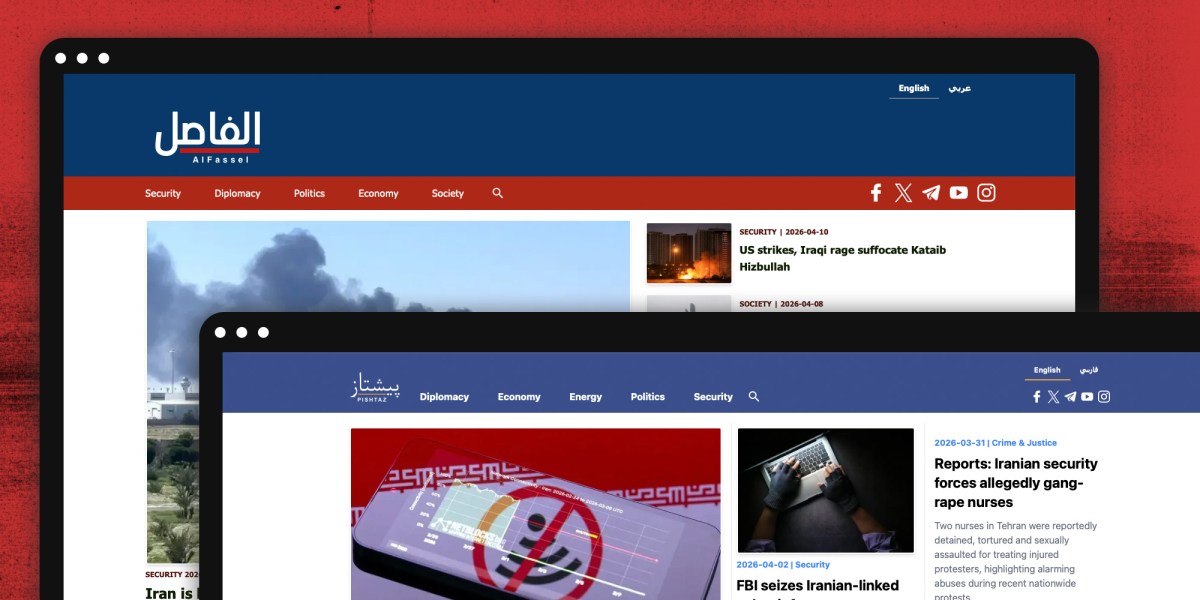
Two seemingly independent Middle Eastern news outlets, Al-Fassel and Pishtaz News, appear to be part of a U.S. government-funded propaganda network designed to advance American foreign policy objectives in the region, an investigation has revealed.
While presenting themselves as legitimate Arabic and Farsi news sources, both outlets publish content that consistently aligns with Washington’s positions on Iran, Gaza, and other regional flashpoints. The websites feature professionally designed homepages and maintain active social media accounts, where they share reports and videos on Middle Eastern geopolitics in multiple languages.
Only deep within their “About” pages do the sites disclose they are “a product of an international media organization publicly funded from the budget of the United States Government.” This disclosure remains entirely absent from their social media platforms like Instagram, despite policies requiring state-backed media to be labeled as such.
Evidence suggests these outlets are the latest iteration of a Pentagon psychological operations campaign dating back to 2008, when U.S. Special Operations Command launched the Trans-Regional Web Initiative (TRWI). This program created fake online newsrooms to disseminate pro-American messaging in support of military objectives.
Though Congress defunded TRWI in 2014, a 2022 report from the Stanford Internet Observatory and Graphika revealed many of these operations had simply rebranded, continuing to operate with new disclosures mentioning U.S. Central Command (CENTCOM) funding. Following that report’s revelations, some sites shut down while others changed their disclosure language to the same phrasing now found on Al-Fassel and Pishtaz News.
Technical analysis reveals multiple connections between these sites and previously identified military propaganda operations. They share identical design elements, URL structures, and editorial patterns with known CENTCOM-affiliated publications. Posts from Al-Fassel are frequently geotagged from Lutz, Florida – near CENTCOM headquarters in Tampa.
The content strategy appears calculated to advance specific U.S. foreign policy objectives. Both outlets extensively promote anti-Iranian narratives, portraying the country’s military and government as weak and divided. A March 27 Pishtaz News tweet threatened Iranians in Farsi: “You will be systematically annihilated. Your commanders are hiding in bunkers. They have sent their families and wealth abroad—why are you still fighting for them?”
Coverage of Gaza similarly echoes the U.S.-Israel position, blaming Palestinian suffering entirely on Hamas rather than Israeli military actions. A December Al-Fassel YouTube video, which garnered nearly 1.7 million views, portrayed Trump’s “Board of Peace” initiative as heralding a new era of prosperity for Palestinians, alongside AI-generated images of a futuristic Gaza cityscape.
Experts identified further deceptive practices, including the apparent use of AI-generated newscasters. Videos featured an Arabic-speaking presenter whose unnaturally perfect appearance and lack of blinking strongly suggested synthetic media, according to researchers from Georgetown University and human rights organization Witness.
At least one expert quoted in these outlets was unaware his statements were being used by a U.S. government publication. Energy analyst Umud Shokri told investigators: “I was not aware of any affiliation between alfasselnews.com and the U.S. government. I also did not have any direct interview with the platform.”
While the sites’ overall reach appears limited—with modest social media followings that include numerous suspected bot accounts—their content occasionally breaks through to Western audiences. Academic journals, policy reports, and even submissions to UN committees have cited these propaganda outlets as legitimate news sources.
Emerson Brooking, a former Pentagon cyber policy adviser now with the Atlantic Council, believes these operations continue despite limited impact due to their relatively small cost within the defense budget and their utility as evidence that the military is actively working to counter adversaries in “information space.”
The continued operation of these propaganda sites raises questions about transparency in government communications and the blurring line between legitimate journalism and state-sponsored messaging campaigns aimed at foreign audiences.
Fact Checker
Verify the accuracy of this article using The Disinformation Commission analysis and real-time sources.

28 Comments
Exploration results look promising, but permitting will be the key risk.
I like the balance sheet here—less leverage than peers.
Good point. Watching costs and grades closely.
If AISC keeps dropping, this becomes investable for me.
Good point. Watching costs and grades closely.
Good point. Watching costs and grades closely.
Exploration results look promising, but permitting will be the key risk.
Good point. Watching costs and grades closely.
Interesting update on Middle Eastern News Sites Identified as U.S. Government Propaganda Operations. Curious how the grades will trend next quarter.
Good point. Watching costs and grades closely.
The cost guidance is better than expected. If they deliver, the stock could rerate.
Good point. Watching costs and grades closely.
Interesting update on Middle Eastern News Sites Identified as U.S. Government Propaganda Operations. Curious how the grades will trend next quarter.
Good point. Watching costs and grades closely.
Good point. Watching costs and grades closely.
If AISC keeps dropping, this becomes investable for me.
Good point. Watching costs and grades closely.
Silver leverage is strong here; beta cuts both ways though.
Good point. Watching costs and grades closely.
Silver leverage is strong here; beta cuts both ways though.
The cost guidance is better than expected. If they deliver, the stock could rerate.
Good point. Watching costs and grades closely.
Good point. Watching costs and grades closely.
Exploration results look promising, but permitting will be the key risk.
If AISC keeps dropping, this becomes investable for me.
Good point. Watching costs and grades closely.
Exploration results look promising, but permitting will be the key risk.
Good point. Watching costs and grades closely.