


Listen to the article
AI-Driven Misinformation Emerges as Major Threat to Indian Electoral Process
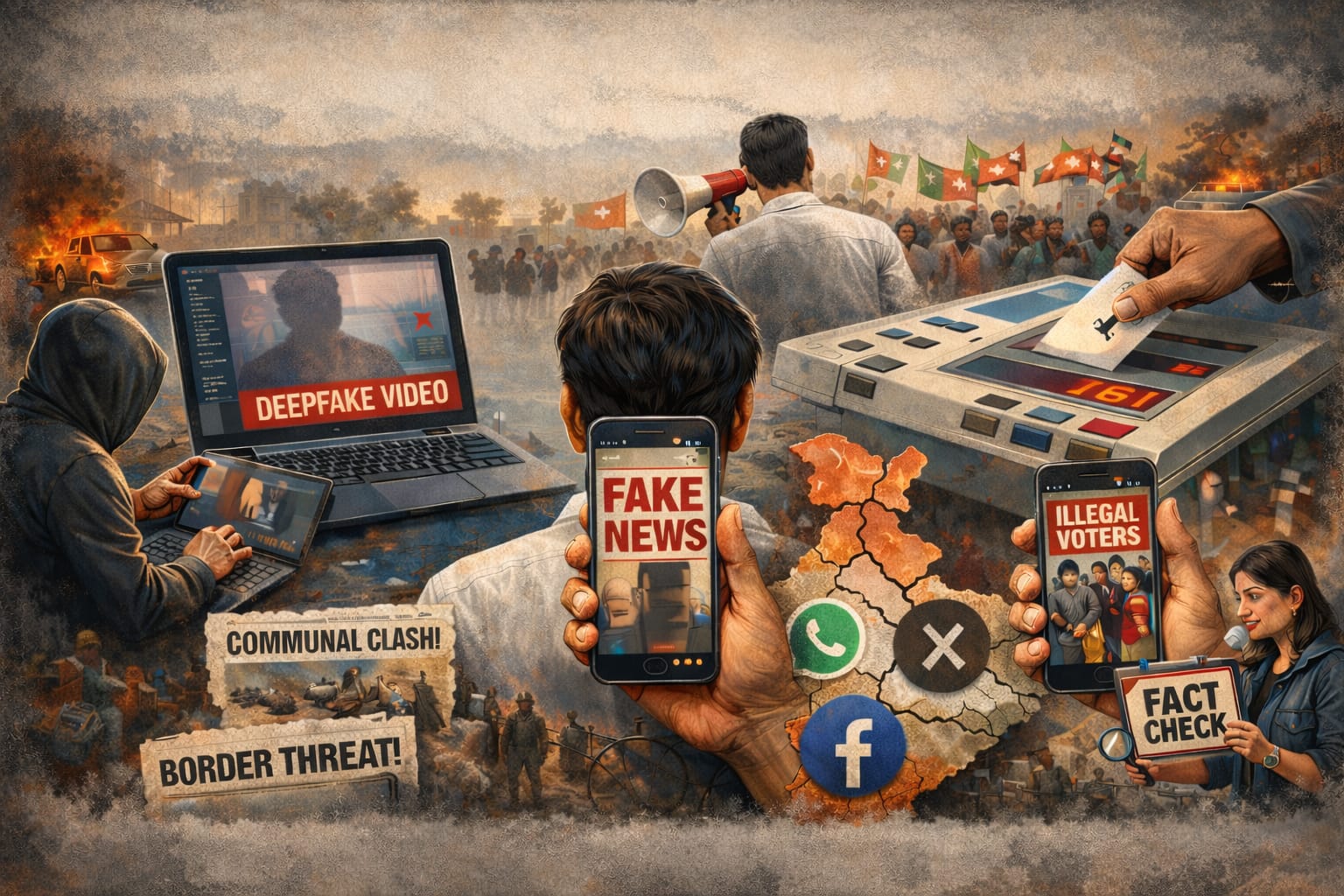
Elections in India have traditionally been contested through ground campaigns and strategic narratives, but recent state elections mark a decisive shift toward digital battlegrounds. What was once confined to whispered rumors has transformed into sophisticated algorithmic warfare, with misinformation flowing through platforms like WhatsApp and X (formerly Twitter) at unprecedented scales.
The rise of AI-generated content has emerged as a particular concern across recent elections in West Bengal, Assam, Kerala, Tamil Nadu, and Puducherry. Political campaigns increasingly deploy artificial intelligence to create highly targeted content that often crosses ethical boundaries. Manipulated videos, voice cloning technology, and repurposed archival footage circulate widely, falsely depicting political leaders making controversial statements or engaging in misconduct.
This trend has prompted the Election Commission of India to issue explicit warnings against deepfakes while pledging stricter enforcement measures, including filing FIRs and ordering content takedowns when violations occur.
In West Bengal, where political tensions run high, social media platforms frequently overflow with misleading content during election cycles. Images and videos of political violence—often stripped of context or entirely fabricated—spread rapidly, inflaming already volatile communal tensions. Political actors strategically weaponize narratives around “infiltration” and border security, sometimes exaggerating or distorting facts to consolidate their voter bases. The result is a deeply polarized electorate where perception increasingly overshadows reality.
The northeastern state of Assam presents another troubling example, with misinformation typically centering on the politically sensitive issues of identity and migration. WhatsApp groups routinely circulate unverified claims about “illegal voters” or alleged large-scale voter fraud. Videos purportedly showing individuals with fake voter IDs or being transported across state lines create widespread suspicion and anxiety. These narratives not only undermine electoral trust but often stigmatize entire communities.
Tamil Nadu has witnessed more technologically sophisticated forms of misinformation. Speeches by political leaders have been edited or synthetically generated to make it appear they endorsed controversial positions on religious or cultural issues. In one prominent case, false claims circulated suggesting a well-known political leader supported practices like animal sacrifice before fact-checkers could intervene. Such content proves particularly dangerous as it exploits cultural sensitivities and can rapidly shift public sentiment.
Even Kerala, with its high literacy rates, isn’t immune to the problem. Misinformation there often takes more subtle forms, including false political advertisements, unverified allegations, and manipulated narratives. The spread of fake news in Malayalam creates additional verification challenges, as language-specific misinformation ecosystems can become highly insular, allowing falsehoods to circulate unchecked within communities.
Smaller electoral arenas like Puducherry face unique challenges. The integration of AI tools into campaign strategies has enabled hyper-local misinformation tailored to specific constituencies. Lesser-known candidates prove particularly vulnerable, as damaging fabrications can destroy reputations without attracting the scrutiny or fact-checking resources that more prominent campaigns might receive.
The strategic deployment of these false narratives represents a coordinated effort rather than random noise. Misinformation campaigns deliberately exploit existing social fault lines—religion, caste, language, and regional identity—to maximize impact. Social media architecture itself compounds the problem, as sensational content typically travels faster and reaches wider audiences than verified information.
The consequences for Indian democracy are profound. Trust in both institutions and fellow citizens erodes when voters cannot reliably distinguish between fact and fiction. Voter behavior becomes distorted when decisions that should be based on policies and performance are instead influenced by falsehoods and emotional manipulation. Political polarization deepens as elections transform into zero-sum battles defined by fear rather than democratic debate.
Regulatory responses have proven inconsistent. While the Election Commission has implemented measures like monitoring deepfakes and mandating advertisement certification, enforcement remains challenging. The speed and scale at which misinformation spreads typically outpaces institutional responses.
Technology platforms face their own dilemmas. Companies like Meta and X have introduced fact-checking and content moderation measures, but these efforts often react to problems rather than preventing them. Encrypted platforms like WhatsApp present additional challenges, as tracing misinformation sources remains difficult without compromising user privacy.
As India prepares for future elections, the integrity of its democratic processes hangs in the balance. The world’s largest democracy now confronts a fundamental challenge: ensuring that voters can make choices based on facts rather than fabrications. If left unchecked, AI-driven misinformation threatens not just to influence elections but to fundamentally redefine the democratic exercise itself.
Fact Checker
Verify the accuracy of this article using The Disinformation Commission analysis and real-time sources.

13 Comments
AI-driven misinformation is a complex challenge with no easy solutions. Balancing free speech and curbing the spread of falsehoods will require a nuanced, multi-stakeholder approach. The Election Commission’s actions are a step in the right direction, but more needs to be done.
Agreed. Combating this issue will require concerted efforts from the government, social media platforms, and the public. Maintaining public trust in the electoral process is paramount.
This article highlights the growing influence of technology in shaping political narratives, which is a concerning trend not just in India, but globally. Robust fact-checking, media literacy, and strengthening democratic institutions will be crucial to addressing this challenge.
The proliferation of AI-driven misinformation in India’s elections is a worrying trend that deserves urgent attention. Maintaining the integrity of the democratic process should be a top priority for policymakers, tech companies, and the public. A multipronged approach is needed to combat this challenge effectively.
Agreed. The Election Commission’s actions are a good start, but more needs to be done to stay ahead of the rapidly evolving tactics used to spread false narratives. Collaboration and a shared commitment to the truth will be essential.
This is a troubling development that could have far-reaching consequences for India’s democratic institutions. The proliferation of deepfakes and other AI-generated content is a serious threat that deserves urgent attention from policymakers and tech companies.
The article highlights an important issue facing India’s elections. Misinformation and disinformation campaigns leveraging AI technology can easily sway public opinion and undermine the will of the voters. Robust safeguards and regulatory oversight are needed.
Absolutely. The Election Commission of India is right to take a firm stance against these deceptive practices. Upholding the integrity of the democratic process should be the top priority.
This article highlights the increasingly sophisticated tactics used to influence elections through the spread of misinformation. The rise of AI-generated content is particularly concerning, as it can be difficult for the public to discern fact from fiction. Vigilance and proactive measures will be crucial to protect the democratic process.
Concerning to see the rise of AI-driven misinformation influencing India’s elections. This digital warfare poses serious risks to the integrity of the democratic process. Stricter enforcement and content moderation will be crucial to combat these manipulative tactics.
Agreed. The use of deepfakes and other AI-generated content to spread false narratives is a worrying trend that needs to be addressed head-on. Transparency and fact-checking will be key to maintaining public trust.
The use of AI to create manipulated content and spread misinformation is a worrying development that undermines the integrity of India’s elections. Stricter regulations, content moderation, and public education will be essential to mitigate this threat.
Absolutely. The Election Commission’s efforts to combat deepfakes and other AI-generated falsehoods are commendable, but more needs to be done to stay ahead of this rapidly evolving challenge.