


Listen to the article
In a bold opening address at COP30 in Belém, Brazil, President Luiz Inácio Lula da Silva took aim at what he called “extremist forces” that spread falsehoods about climate change for political gain, dubbing this year’s climate conference the “COP of truth.” His words set the stage for a historic move on Wednesday, when 12 nations signed the first-ever Declaration on Information Integrity on Climate Change.
Belgium, Brazil, Canada, Chile, Denmark, Finland, France, Germany, the Netherlands, Spain, Sweden, and Uruguay have committed to combating the rising tide of misinformation surrounding climate issues. The declaration also promises protection for environmental journalists, scientists, and researchers who face backlash for countering false narratives.
The agreement comes at a crucial moment. According to the Climate Action Against Disinformation (CAAD) coalition, the months leading up to the summit saw an alarming 267 percent increase in climate-related misinformation online. Their analysis with the Observatory for Information Integrity found that COP-related keywords appeared alongside negative terms like “failure” and “joke” approximately 14,000 times between July and September alone.
“This systematic spread of misinformation isn’t just noise—it has real consequences for policy development and public engagement,” said a climate policy expert familiar with the declaration. “When leaders and citizens believe there’s less public support for climate action than actually exists, it creates a false impression that ambitious measures lack popular backing.”
CAAD’s research highlights a troubling perception gap. According to a study published in Nature, policymakers believe only 38 percent of people would contribute one percent of their income to fight climate change, while general public estimates hover around 43 percent. The reality is far more encouraging—survey data shows that 69 percent of people globally are willing to make such financial commitments.
This disconnect between perceived and actual public support represents a significant barrier to more ambitious climate policies. Experts note that when policymakers underestimate public willingness to act, they may propose less ambitious targets than voters would actually support.
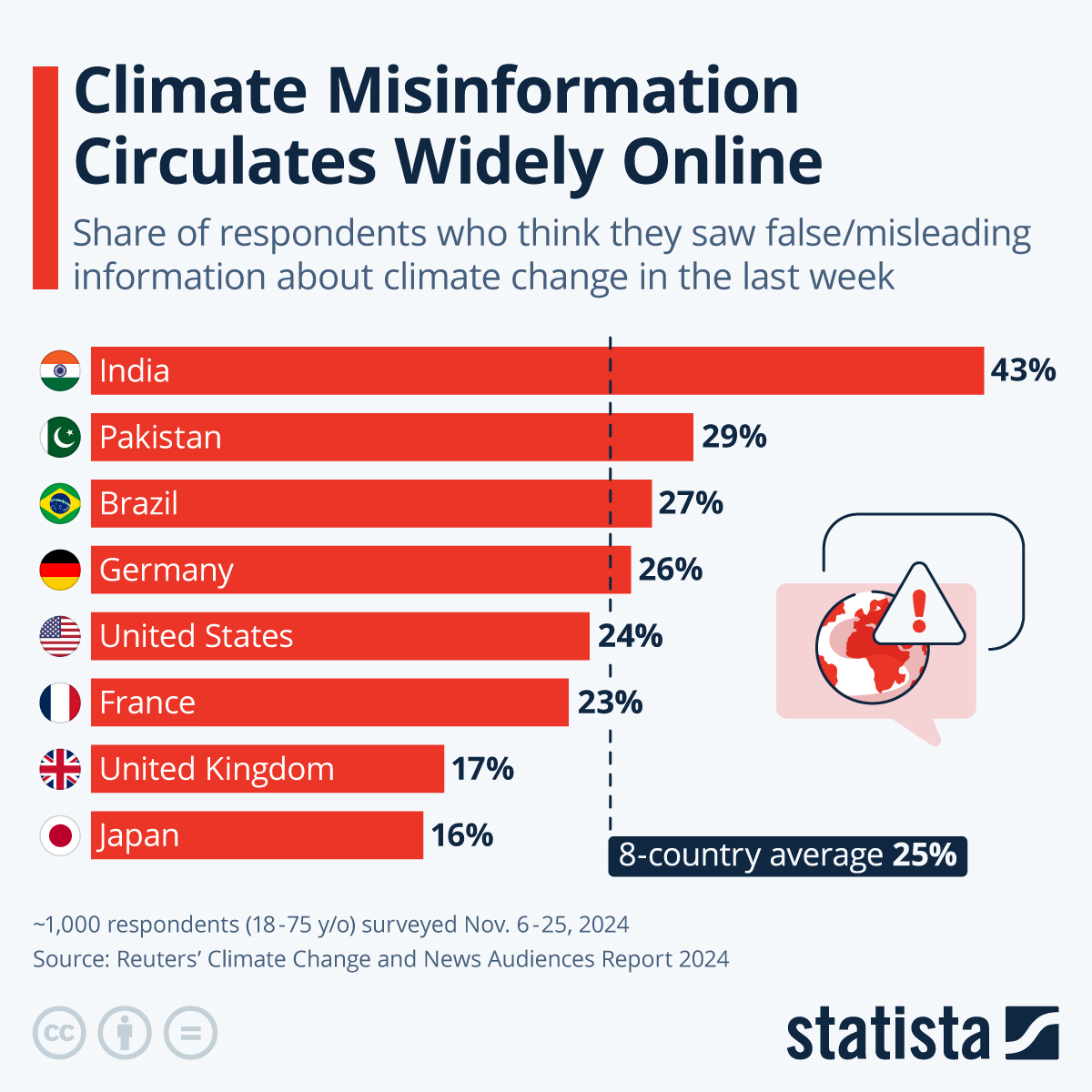
The spread of climate misinformation varies by region but remains a global challenge. A Reuters survey conducted in November 2024 found that 43 percent of respondents in India reported encountering false or misleading climate information online in the previous week. The figures were lower but still concerning in the United States (24 percent), the United Kingdom (17 percent), and Japan (16 percent).
Notably, these percentages have remained relatively stable since 2022, reflecting what analysts describe as “climate perception inertia”—a stagnation in public views despite escalating climate impacts and scientific warnings.
The Reuters survey also revealed important insights about public trust. Across eight countries surveyed, politicians and political parties were most frequently associated with climate misinformation (12 percent), followed closely by governments (11 percent) and activists and celebrities (10 percent). Scientists, by contrast, emerged as the most trusted source of climate information, with 74 percent of respondents expressing confidence in their assessments.
Climate experts warn that this information battlefield will play an increasingly important role in determining whether nations can muster the political will to implement necessary emissions reductions. The new declaration represents an acknowledgment that information integrity is now a critical front in addressing climate change.
“Without accurate information and public understanding, even the best climate policies will face unnecessary resistance,” noted a European diplomat involved in the declaration negotiations. “This agreement recognizes that protecting the information ecosystem is now as important as protecting our physical environment.”
The declaration’s impact will depend on how effectively signatory nations implement its principles and whether additional countries join the effort. Many observers see it as a promising first step in recognizing information integrity as a crucial component of effective climate action.
Fact Checker
Verify the accuracy of this article using The Disinformation Commission analysis and real-time sources.

16 Comments
Combating climate misinformation is crucial for ensuring sound policymaking and public understanding of this critical issue. I’m hopeful this declaration will make a meaningful impact.
Enforcement and accountability will be key to ensuring the success of this agreement. Monitoring and consequences for violators are essential.
While the Declaration on Information Integrity is a positive step, the scale of climate misinformation online remains daunting. Sustained, coordinated efforts will be required to turn the tide.
The surge in climate misinformation is deeply troubling. This declaration is a welcome development, but the real challenge will be in its effective implementation and enforcement.
I appreciate the decisive action taken by these 12 nations to tackle the issue of climate misinformation. Protecting climate scientists and researchers is vital for progress.
Curious to see if other countries will join this coalition to strengthen the international response to this challenge.
It’s disheartening to see the scale of climate misinformation online. But I’m hopeful that this international agreement will help turn the tide and protect those speaking out against false narratives.
Increased public awareness and media literacy are also crucial to combating the spread of climate misinformation. Education will be key.
The rise in climate misinformation is deeply concerning, especially when it’s driven by political agendas. This declaration is a welcome development, but much work remains to be done.
Kudos to the 12 nations for taking this stand against climate misinformation. Protecting the truth and those who champion it is vital for addressing the climate crisis.
I hope this declaration sets a precedent for other countries to join the fight against the spread of climate-related falsehoods.
The Declaration on Information Integrity is a promising step, but the challenge of curbing climate misinformation remains significant. We must stay vigilant and continue to promote factual, science-based information.
I’m curious to see how the 12 signatory nations plan to implement and enforce the terms of the declaration. Tangible actions will be key.
Concerning to see the rise in climate misinformation online. Spreading falsehoods for political gain is extremely damaging. I’m glad to see nations taking a stand and committing to combat this issue.
Protecting journalists, scientists, and researchers who speak the truth is crucial. Their work is vital in the fight against climate change.
The 267% increase in climate-related misinformation is truly alarming. This declaration is a necessary and overdue step to address this growing problem.