


Listen to the article
In a pointed critique of political disinformation, Austria’s President Alexander Van der Bellen has warned that modern technology enables virtually anyone to create convincing fake content—even depicting themselves as Jesus or impersonating professionals—while highlighting that autocrats strategically work to blur the lines between truth and falsehood.
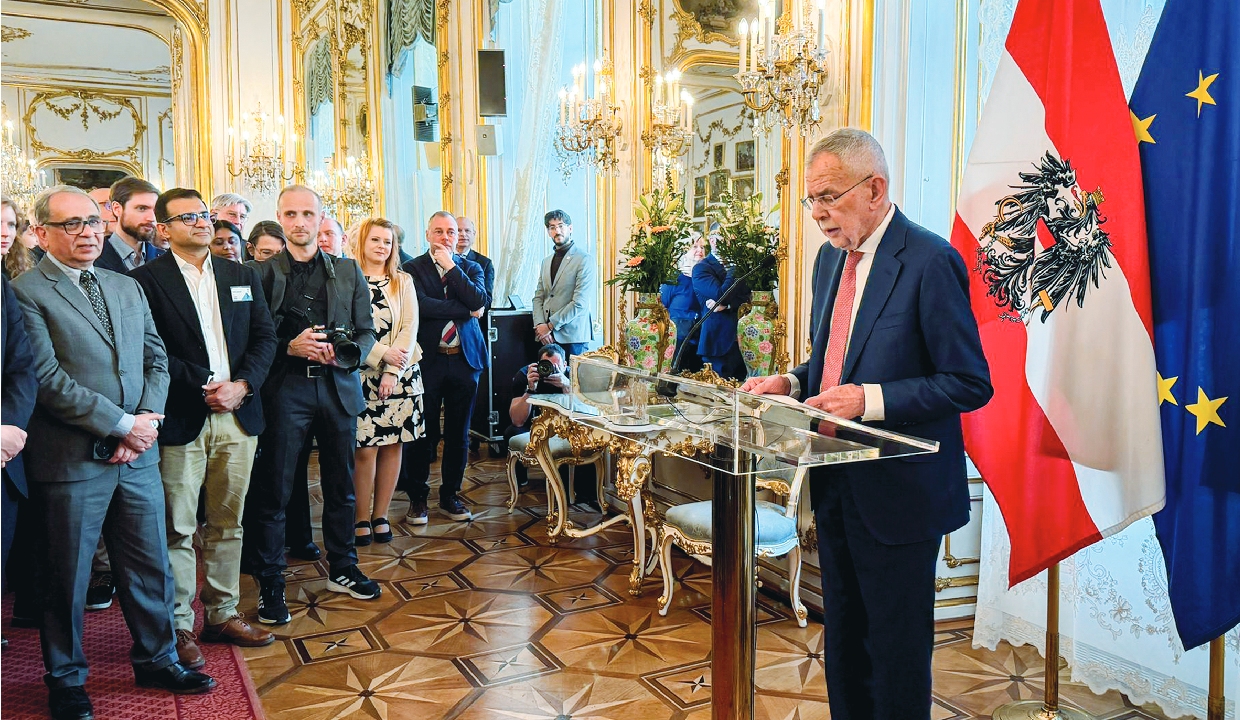
Speaking to a delegation of international news agency executives at the presidential palace on Thursday evening, the 82-year-old president emphasized the growing importance of credible news organizations in an era where artificial intelligence and digital manipulation are becoming increasingly sophisticated.
“With AI technologies rapidly progressing, it has become easy to manipulate what we see, what we hear, to manipulate truth,” Van der Bellen told the gathering, which included PTI’s editor-in-chief Vijay Joshi. “As third-party quality seal, independent from politics, disconnected from clicks of followers, you triple-check and question everything.”
To illustrate his point, Van der Bellen opened his address with an ironic reference to “an amazing crypto investment tip,” drawing attention to a deepfake video he had encountered online. The fabricated clip featured him supposedly endorsing a cryptocurrency investment, complete with an artificial voice that spoke with what he described as a “shockingly” North German accent—an imperfection that revealed the fakery to Austrian audiences familiar with regional dialect differences.
“Basically, anyone with a computer can do it. Anyone can depict opponents in compromising scenes—or himself as Jesus,” the president observed, highlighting the low barrier to entry for creating deceptive content.
While not explicitly naming former U.S. President Donald Trump, Van der Bellen’s remarks were widely interpreted as criticizing Trump’s approach to facts and information. He suggested that authoritarian leaders deliberately foster confusion about reality, stating that the core political strategy of autocrats is ensuring people “no longer know right from wrong.”
Van der Bellen’s outspoken stance against right-wing populism is notable given Austria’s current political landscape, where the far-right Freedom Party leads the coalition government. As Austria’s president—a role that is largely ceremonial but carries the significant powers to dismiss governments, dissolve parliament, and reject ministerial appointments—Van der Bellen represents a counterbalance to the rightward shift in Austrian politics.
The former economics professor and Green Party leader stressed the critical function of news agencies in maintaining democratic discourse. “Truth matters. We need a shared understanding of what is right and what is wrong. Of what is a fact and what is just an opinion… only then we can decide who to vote for, who to believe,” he said.
His comments come at a pivotal moment for media globally, as traditional journalism faces multiple challenges: economic pressures from declining revenue models, competition from social media platforms, and the proliferation of AI-generated content that can be difficult to distinguish from authentic reporting.
Media analysts note that Van der Bellen’s comments reflect growing concern among democratic leaders worldwide about information integrity. The European Union has been at the forefront of regulatory efforts to combat disinformation, introducing the Digital Services Act that requires platforms to address fake news and manipulation.
For news agencies represented at the meeting, the president’s message reinforced their mission at a time when their role as arbiters of fact is simultaneously more challenging and more essential than ever before. As deepfakes and other forms of synthetic media become more convincing, the value of institutional credibility and rigorous verification processes grows increasingly apparent.
Van der Bellen’s warning serves as a reminder that in democratic societies, the health of the information ecosystem directly impacts the quality of civic decision-making and, ultimately, the sustainability of democracy itself.
Fact Checker
Verify the accuracy of this article using The Disinformation Commission analysis and real-time sources.

25 Comments
Production mix shifting toward News might help margins if metals stay firm.
Exploration results look promising, but permitting will be the key risk.
If AISC keeps dropping, this becomes investable for me.
Nice to see insider buying—usually a good signal in this space.
Good point. Watching costs and grades closely.
Good point. Watching costs and grades closely.
If AISC keeps dropping, this becomes investable for me.
Good point. Watching costs and grades closely.
Good point. Watching costs and grades closely.
The cost guidance is better than expected. If they deliver, the stock could rerate.
Good point. Watching costs and grades closely.
Good point. Watching costs and grades closely.
I like the balance sheet here—less leverage than peers.
Uranium names keep pushing higher—supply still tight into 2026.
Good point. Watching costs and grades closely.
Good point. Watching costs and grades closely.
Exploration results look promising, but permitting will be the key risk.
Good point. Watching costs and grades closely.
Interesting update on Austria’s President Warns Against AI-Generated Misinformation in Political Address. Curious how the grades will trend next quarter.
Good point. Watching costs and grades closely.
Good point. Watching costs and grades closely.
Exploration results look promising, but permitting will be the key risk.
Uranium names keep pushing higher—supply still tight into 2026.
Good point. Watching costs and grades closely.
The cost guidance is better than expected. If they deliver, the stock could rerate.