


Listen to the article
Venezuelan Opposition Leader Under Scrutiny for Claims About Maduro Regime
As the Trump administration contemplates potential military action against Venezuelan President Nicolás Maduro, concerns are growing that opposition figures may be promoting exaggerated claims to encourage U.S. intervention. Former diplomats and even some critics of Maduro are questioning the accuracy of assertions made by prominent opposition figures.
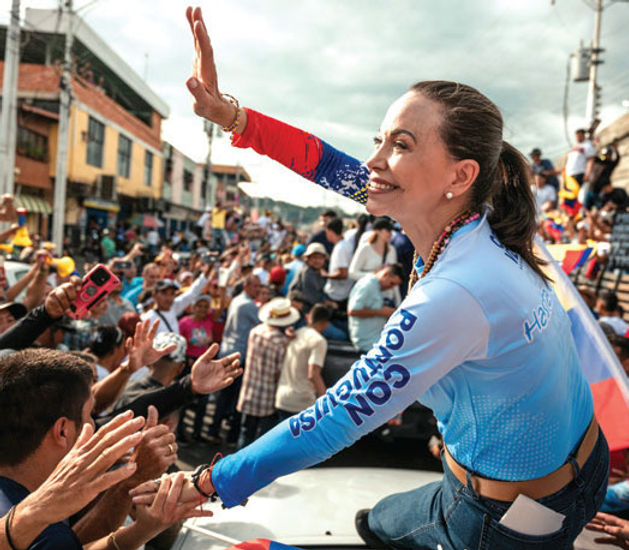
Maria Corina Machado, the Nobel Peace Prize winner who has emerged as the de facto opposition leader, has recently aligned herself closely with President Donald Trump while amplifying controversial claims about the Maduro regime. In an interview with Bloomberg News, Machado stated, “I have no doubt that Nicolás Maduro, Jorge Rodríguez and many others are the masterminds of a system that has rigged elections in many countries, including the U.S.”
This assertion, which echoes unproven claims that Trump himself has repeated about Venezuelan interference in the 2020 U.S. election, has raised eyebrows among regional experts and former diplomats.
Machado and other opposition leaders have also characterized Maduro as simultaneously heading two different drug-trafficking organizations that allegedly threaten U.S. national security: Tren de Aragua and the Cartel de los Soles. The Trump administration recently designated both groups as terrorist organizations and has cited narco-terrorism as justification for strikes on 21 boats since September, operations that have reportedly killed at least 83 people.
However, U.S. intelligence agencies, experts on Latin America’s drug trade, and some Venezuelan opposition figures have disputed claims that Maduro directly controls these organizations or is weaponizing them against the United States. While experts acknowledge that elements within Venezuela’s military have been involved in drug smuggling, many question whether these entities even qualify as transnational drug cartels.
John D. Feeley, a former U.S. ambassador to Panama who worked for Secretary of State Colin Powell before the Iraq War, expressed concerns about the current situation. “It’s time to summon the ghost of Ahmad Chalabi,” Feeley said, referring to the Iraqi politician who provided false intelligence about Saddam Hussein’s regime that helped justify the 2003 invasion. “It’s unbelievable how these guys are too stupid to read their own history and know that they’re headed for the same thing.”
In response, a White House official maintained that Maduro’s government is a “narco-terrorist cartel” and that Maduro is not a legitimate president.
Drug trade experts point to more nuanced realities. They describe the Cartel de los Soles not as a formal organization but rather as shorthand for drug trafficking activities within Venezuela’s armed forces—a problem that affects many countries throughout the Americas, including democracies.
DEA findings indicate that less than 10% of cocaine reaching the United States from South America flows through Venezuela. Additionally, fentanyl, the primary driver of overdose deaths in the U.S., originates from Mexico, not Venezuela.
Regarding Tren de Aragua, American intelligence agencies reportedly circulated findings in February indicating the gang is not controlled by the Venezuelan government. The group originated in a prison in Venezuela’s Aragua state, and its leader is believed to be Hector Rusthenford Guerrero Flores, who escaped from that facility.
David Smolansky, a Venezuelan politician representing Machado in Washington, defended the opposition’s stance: “In our case the cartel is the state.” He noted that several Latin American countries have recently joined the United States in designating the Cartel de los Soles as a terrorist organization. “These designations mean the Maduro regime is now like the Taliban, the only government in full exercise of power recognized as a terrorist organization,” Smolansky added.
However, according to Insight Crime, a research group focused on organized crime, no evidence has been found that Tren de Aragua is engaged in cross-border drug trafficking.
The situation has drawn comparisons to the lead-up to the Iraq War, with concerns that foreign politicians might be promoting exaggerated narratives to persuade the United States to overthrow a foreign government.
David Smilde, a Venezuela expert at Tulane University, suggested Machado’s strategy is clear: “She’s saying our problem is actually your problem because it’s a national security issue for you. This can fit into existing agendas in D.C. and provide an extra emphasis to citizens who are not specialists in Venezuela.”
As tensions continue to rise, the international community watches closely to see how the Trump administration will proceed in its approach to Venezuela, and whether lessons from past interventions will inform current policy decisions.
Fact Checker
Verify the accuracy of this article using The Disinformation Commission analysis and real-time sources.

6 Comments
It’s concerning to hear about potential misinformation being spread, regardless of the source. I hope the truth can be objectively determined through rigorous fact-checking and transparent reporting.
The Nobel laureate’s accusations raise important questions, but I’d caution against relying too heavily on political rhetoric. Unbiased, well-sourced journalism is crucial for understanding complex issues like this.
Interesting claims, but I’d want to see more credible evidence before jumping to conclusions about Venezuelan interference in US elections. Sounds like a complex geopolitical situation that deserves careful analysis from multiple perspectives.
Hmm, this sounds like a complex geopolitical issue without any easy answers. I’ll be curious to see how this story develops as more information comes to light.
Anytime a Nobel laureate makes such bold accusations, it’s certainly worth paying attention. But I’d encourage digging deeper into the evidence and various perspectives before drawing firm conclusions.
While I’m no fan of the Maduro regime, I’m not convinced by these claims of election rigging and drug trafficking. Extraordinary allegations require equally strong evidence. I’ll be looking for more substantive analysis from credible experts.