


Listen to the article
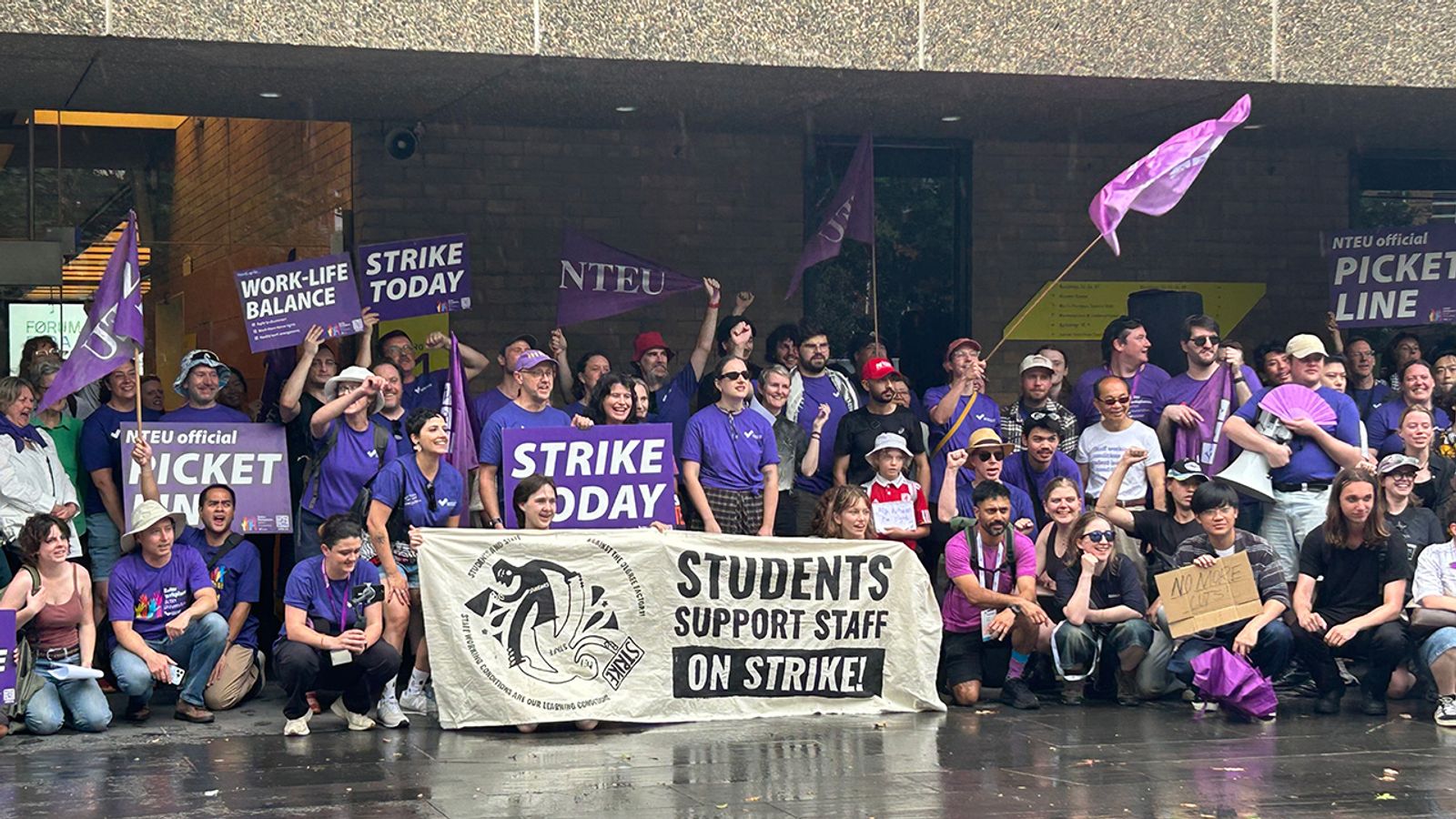
About 150 staff members from the University of Technology Sydney (UTS) staged a four-hour work stoppage last Wednesday, rallying outside the campus in central Sydney. The action, called by the National Tertiary Education Union (NTEU), comes amid ongoing enterprise bargaining negotiations with university management.
The protest focused on UTS management’s plans, announced earlier this year, to cut $100 million from the university’s budget by 2027, eliminating approximately 400 jobs—roughly 10 percent of the workforce. The restructuring also includes halting new enrollments for nearly 20 percent of the university’s courses, particularly in international studies, social sciences, education and public health.
This situation at UTS mirrors a troubling national trend affecting Australian higher education. At least 19 of Australia’s 39 public universities have announced similar restructuring plans in 2025, with proposed job cuts exceeding 3,500 nationwide.
At the rally, NTEU NSW division secretary Vince Caughley struck an optimistic tone, telling participants: “We are winning.” He highlighted a no-confidence petition against UTS vice-chancellor Andrew Parfitt that had garnered over a thousand signatures, suggesting the union’s campaign to expose management’s “lack of accountability” would “turn the tables” on the proposed cuts.
NTEU speakers claimed that an “Academic Change” proposal update circulated by Parfitt on the day of the rally contained “significant concessions.” The following day, an article in the Sydney Morning Herald reported that management had “backflipped on plans for mass redundancies and course cuts,” citing Caughley’s positive reception of the revised plan.
However, a closer examination of Parfitt’s update reveals that the majority of job cuts and course closures remain in the pipeline. The document states that “the majority of academic staff reductions are likely to be met through voluntary separation” and that changes to some courses “will result in slightly fewer staffing reductions.” Forced redundancies have not been ruled out.
The update outlines plans to “redesign” the international studies degree and “streamline” teaching degrees rather than eliminate them completely. While the law faculty and business school would no longer be merged, they would still share some services and governance arrangements. Undergraduate public health courses would remain suspended, though most postgraduate public health studies would continue.
Importantly, these modifications are subject to “the final change implementation plan,” which won’t be announced until February 2026. Meanwhile, staff report that cuts are already proceeding, with employees being pressured to accept them.
One academic who attended the rally told reporters that staff had developed an alternative model for international studies courses that could result in losing half the positions rather than eliminating the program entirely. Another staff member in international studies expressed relief that current students could complete their courses but remained uncertain about her own job security.
Critics argue that the NTEU is effectively facilitating slightly modified versions of the job losses and course cuts rather than preventing them. The union’s approach focuses on “prohibiting forced redundancies and strengthening provisions for redeployment,” but such clauses have historically offered little protection against restructuring. The NTEU has frequently assisted university management in achieving job cuts through “voluntary” redundancies.
For the past year, both the NTEU and the Community and Public Service Union (CPSU) have resisted calls from rank-and-file committees at several universities for unified national action against the cuts and the underlying policies of the Labor government.
The Albanese government has been applying financial pressure to universities, including through restrictions on international student enrollments, to force restructuring in accordance with its Universities Accord. This initiative demands that both teaching and research be aligned with “national priorities,” which critics say increasingly includes military research connected to the AUKUS security pact and preparations for potential conflicts with China.
At Wednesday’s rally, NTEU general secretary Damien Cahill blamed “widespread financial mismanagement” for the job losses at UTS, calling them “completely unnecessary.” However, critics argue that the union leadership is attempting to isolate protests to individual universities and particular vice-chancellors rather than addressing the systemic issues driven by government policy.
Some staff members have expressed concern about universities’ growing ties to defense industries. One lecturer at the rally noted: “It does concern me that the university derives a substantial chunk of its revenue from the military industrial complex.” The same educator criticized cuts to international student numbers as “unnecessary,” suggesting that foreign students were being “scapegoated for a housing crisis caused by a decade or so of government inaction.”
As the situation continues to unfold, some educators are calling for the formation of independent rank-and-file committees at universities across Australia to develop a unified response to job cuts, course closures, and what they see as corporate-driven restructuring in higher education.
Fact Checker
Verify the accuracy of this article using The Disinformation Commission analysis and real-time sources.

5 Comments
It’s concerning to see the significant job and course cuts being considered at UTS. Maintaining the quality and diversity of Australia’s higher education system is crucial. I hope the university can find a balanced solution that protects both jobs and academic programs.
Agreed. With the broader challenges facing Australian universities, it’s important that institutions like UTS engage transparently with staff and students to find the best path forward.
The proposed cuts at UTS are quite substantial, and it’s understandable why faculty and staff would be protesting. Trimming 10% of the workforce and 20% of courses is a major restructuring. I’m curious to hear more about the university’s rationale and plans to mitigate the impacts.
You raise a fair point. It would be helpful for UTS to provide more details on the drivers behind these proposed changes and how they aim to preserve core academic programs and services.
The situation at UTS reflects the broader pressures facing Australia’s higher education sector. With multiple universities announcing similar restructuring plans, it’s clear this is a systemic issue that requires a coordinated policy response from the government. Protecting jobs and educational opportunities should be a top priority.