


Listen to the article
Trump Threatens BBC with $1 Billion Lawsuit Over Edited Speech
Donald Trump’s legal team has issued a formal demand for retraction to the BBC, threatening a $1 billion (£760 million) lawsuit over what they claim was deceptive editing of the former president’s January 6, 2021 speech in a recent documentary.
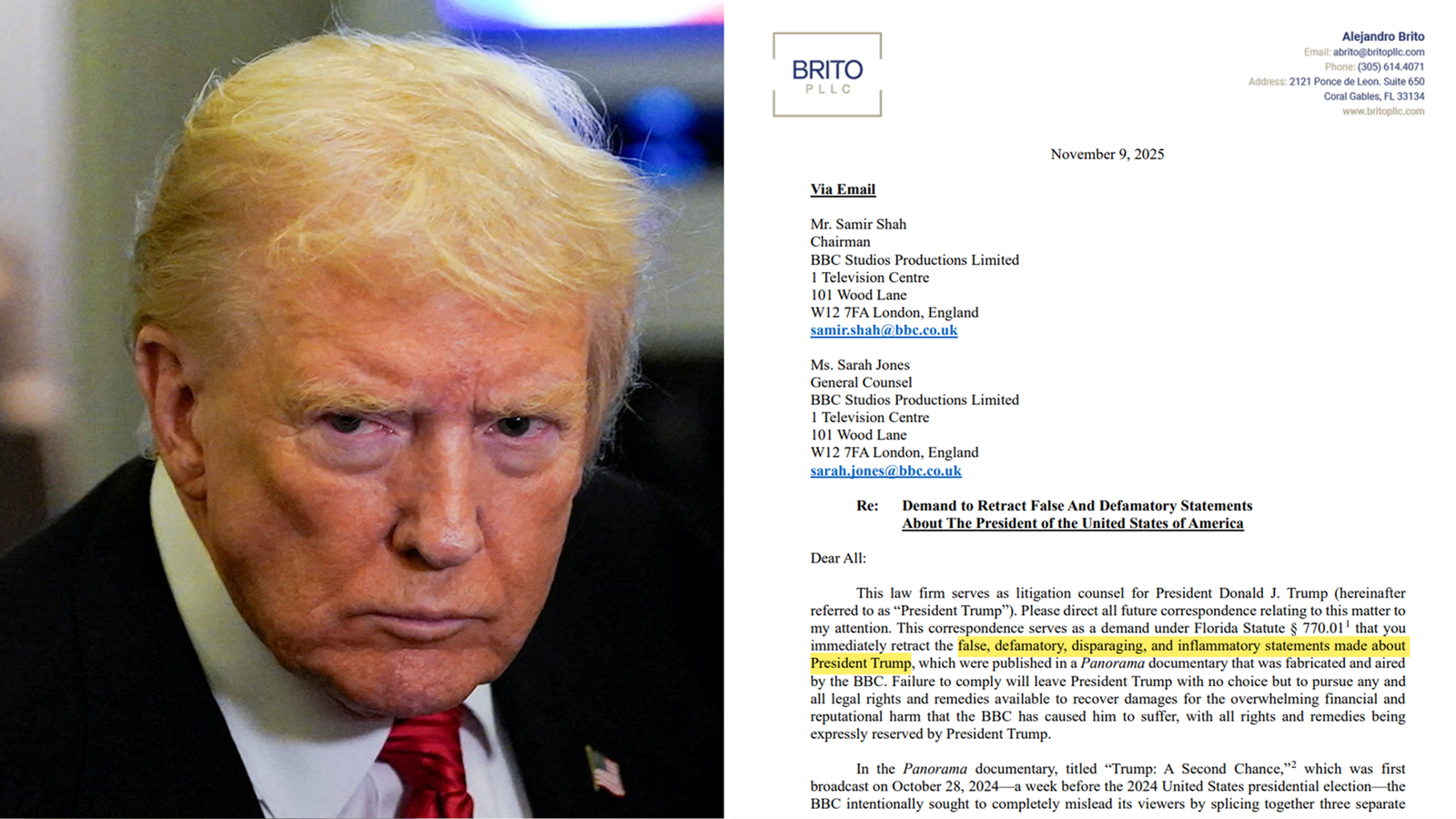
Florida-based attorney Alejandro Brito sent the strongly-worded letter to BBC Chair Samir Shah and BBC lawyer Sarah Jones, accusing the British broadcaster of broadcasting “false, defamatory, disparaging, and inflammatory statements” about Trump.
The dispute centers on the Panorama documentary “Trump: A Second Chance,” which aired on October 28, 2024, just days before the U.S. presidential election. According to Brito, the BBC “intentionally sought to completely mislead its viewers by splicing together three separate parts of President Trump’s speech.”
The documentary showed Trump telling supporters: “We’re gonna walk down to the Capitol and I’ll be there with you and we fight. We fight like hell and if you don’t fight like hell, you’re not going to have a country anymore.”
Brito contends this was a fabricated portrayal, arguing that Trump’s actual remarks were: “We’re going to walk down, and I’ll be there with you, we’re going to walk down, we’re going to walk down any one of you but I think right here, we’re going to walk down to the Capitol and we’re going to cheer on our brave senators and congressman and women.”
The lawyer further alleges that the BBC omitted Trump’s call for protesters to “peacefully and patriotically make your voices heard,” which significantly altered the context of the speech.
BBC Chair Samir Shah has already apologized for what he called an “error of judgment” regarding the editing of Trump’s speech in the documentary. The controversy has already led to internal turmoil at the BBC, with references in the letter to a “whistleblower memorandum” suggesting insider concerns about the editing process.
In his letter, Brito cites Florida defamation law extensively, arguing that words are defamatory when “they tend to subject one to hatred, distrust, ridicule, contempt or disgrace or tend to injure one in one’s business or profession.” He specifically notes that statements can be defamatory if a defendant “juxtaposes a series of facts so as to imply a defamatory connection between them, or creates a defamatory implication by omitting facts.”
The letter demands that the BBC issue a full retraction of the documentary “in as conspicuous a manner as they were originally published,” issue an apology, and “appropriately compensate President Trump for the harm caused.” It also includes detailed preservation demands for evidence related to the documentary.
The Trump legal team has given the BBC until November 14, 2025, at 5:00 p.m. EST to comply with these demands. If the broadcaster fails to do so, Brito warns that Trump “will be left with no alternative but to enforce his legal and equitable rights” by filing legal action seeking “no less than $1,000,000,000 (One Billion Dollars) in damages.”
This legal threat comes amid a broader international media controversy. The timing of the documentary – airing just before the U.S. election – has raised questions about media objectivity during campaign periods, while the subsequent fallout highlights the high-stakes nature of political coverage in today’s polarized media landscape.
The BBC, as a publicly funded broadcaster with a global reputation for journalistic standards, now faces significant scrutiny over its editorial processes. The corporation has not yet issued a public response to the specific demands in Brito’s letter.
Media law experts note that international defamation cases present complex jurisdictional challenges, particularly when involving public figures and political speech. Whether this dispute will result in actual litigation remains to be seen, but it underscores the increasingly contentious relationship between Trump and mainstream media organizations.
Fact Checker
Verify the accuracy of this article using The Disinformation Commission analysis and real-time sources.

10 Comments
This seems like a heavy-handed legal threat from Trump’s team. While the BBC should aim for accuracy, $1 billion is an exorbitant demand. I’m curious to hear more details on the alleged editing and whether it truly misrepresented Trump’s remarks.
I agree, the lawsuit threat seems disproportionate. The BBC should respond transparently and provide the full context of Trump’s speech to clarify any potential misrepresentation.
This is a complex issue with valid concerns on both sides. While the BBC should strive for accuracy, a $1 billion lawsuit seems excessive and could have wider implications for media reporting on political figures. I hope a reasonable resolution can be reached.
Agreed, this requires a nuanced approach. Both parties should engage in good faith to address the concerns, rather than escalating the situation through legal action.
The threat of a massive lawsuit is concerning, as it could have a chilling effect on press freedom and open discourse. However, if the BBC did indeed engage in deceptive editing, they should be held accountable. I hope this can be resolved through transparent dialogue rather than confrontation.
Absolutely, open and transparent dialogue is the best path forward here. Both sides should focus on providing the full context and evidence to address the concerns, rather than resorting to legal threats.
This dispute highlights the ongoing tensions between the media and political figures over how events are portrayed. While fair reporting is essential, it’s concerning to see such aggressive legal action threatened over an edited video clip.
I’m skeptical of the claims of ‘deceptive editing’ without seeing the full context. The BBC should provide a detailed response addressing the specific allegations.
As a viewer, I’m interested in seeing the full, unedited footage to evaluate whether the BBC’s portrayal was indeed misleading. Lawsuits of this magnitude can have a chilling effect on press freedom, so the facts need to be carefully examined.
I agree, transparency from both sides is crucial here. The BBC should release the full footage and Trump’s team should provide evidence of the alleged deception, rather than resorting to heavy-handed legal threats.