


Listen to the article
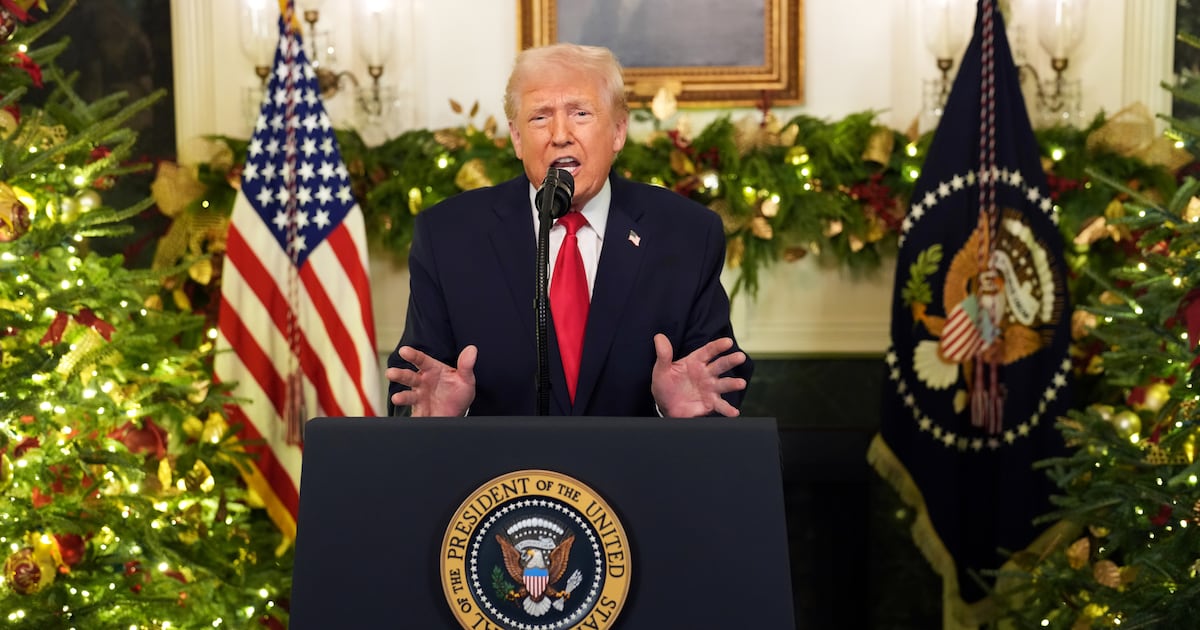
President Trump delivered an 18-minute primetime address from the White House’s Diplomatic Reception Room on Wednesday, focusing heavily on defending his economic policies while making several claims that conflict with official data and economic realities.
During his address, the president insisted he was “fixing” what he characterized as his predecessor’s “mess,” but fact-checkers immediately identified numerous inaccuracies in his statements about energy prices, employment figures, and economic growth.
Trump claimed gasoline was under $2.50 per gallon in much of the country, a statement contradicted by the Energy Information Administration, which reported a national average of $2.90 just last week. He further asserted that prices had reached $1.99 in many states, but according to AAA data, no state currently averages that amount or lower.
The president also made mathematically impossible claims regarding prescription drug prices, stating he had lowered them by as much as 600 percent. While administration officials, including Dr. Mehmet Oz, have attempted to defend this claim, economists note that price reductions cannot mathematically exceed 100 percent.
On manufacturing, Trump credited his tariff policies for what he described as unprecedented factory and plant construction. However, economic data shows factory construction spending actually declined this year after reaching its peak during the final year of the previous administration. Similarly, his claim of attracting $18 trillion in investments contradicts the White House’s own published figure of $9.6 trillion.
The employment picture painted by the president also diverges from Bureau of Labor Statistics data. While Trump stated that “more Americans are working than ever before,” the nation’s unemployment rate reached a four-year high last month. Current figures show approximately 700,000 more Americans were unemployed in November compared to the beginning of Trump’s term.
Addressing the issue of affordability—which he has previously dismissed as a Democratic “hoax”—Trump claimed Thanksgiving turkey prices fell by one-third over the past year. The American Farm Bureau, however, estimated a more modest decrease of about 16 percent at retail. At the wholesale level, prices actually increased due to avian flu outbreaks, according to research from Purdue University.
This follows controversy from last month when the White House promoted lower-priced Walmart Thanksgiving food packages without acknowledging they contained fewer items than the previous year’s offerings.
On inflation, the president declared the problem “stopped,” despite September’s rate standing at three percent—virtually unchanged since January. This persistent inflation rate continues to affect consumer purchasing power across numerous economic sectors.
Immigration claims also featured prominently, with Trump asserting that the Biden administration has seen 25 million border entries. This figure substantially exceeds the under 11 million “encounters” reported by Customs and Border Protection as of last December. Curiously, a newly installed plaque on the White House’s “Walk of Fame” lists the figure at 21 million, creating further confusion about the actual statistics.
The president concluded by repeating his claim of having “settled eight wars,” a statement previously identified by foreign policy experts as hyperbole rather than an accurate assessment of international conflicts resolved during his administration.
Throughout the address, Trump appeared to prioritize presenting a positive economic narrative ahead of upcoming policy initiatives, though the factual discrepancies have prompted immediate scrutiny from economists, energy analysts, and media fact-checkers alike.
Fact Checker
Verify the accuracy of this article using The Disinformation Commission analysis and real-time sources.

9 Comments
Interesting to see the president making dubious claims about energy prices and economic figures. Fact-checking is important to ensure we have accurate information, especially on important policy issues.
I agree, it’s concerning when public officials make statements that don’t align with official data. Transparency and accountability are crucial for maintaining trust in government.
While I appreciate the president’s efforts to promote economic growth, it’s important that he provides reliable data to support his claims. Inaccurate or exaggerated statements can undermine public trust.
Well said. Transparency and accountability should be the top priorities for any leader, regardless of political affiliation.
The president’s statements on energy prices and manufacturing seem to conflict with independent data. I wonder if there are any nuances or context that could help reconcile these discrepancies.
Given the important implications of these economic and policy issues, it’s critical that the public has access to accurate, unbiased information. I hope the media continues to scrutinize these claims thoroughly.
It’s concerning to see such a significant disconnect between the president’s statements and the facts reported by credible sources. Rigorous fact-checking is essential for informed public discourse.
The president’s claims about lowering prescription drug prices by 600% seem mathematically impossible. I wonder what the administration’s justification is for that statistic.
You’re right, that claim doesn’t seem plausible. I’d be curious to hear more details on the methodology and data behind it.