


Listen to the article
Religious Tensions in Sri Lanka Fuel False Claims About Muslim Deputy Minister
Long-simmering religious tensions in Sri Lanka have sparked a wave of misinformation regarding the appointment of Muslim politician Muneer Mulaffer to a government position. False claims circulating widely on social media suggest that Mulaffer has been appointed as deputy minister for Buddhist affairs, when in fact he has been given a broader role handling religious and cultural matters.
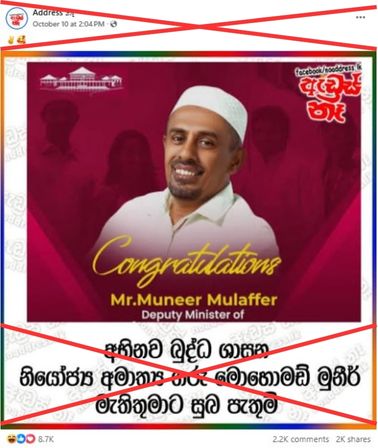
The controversy erupted after President Anura Kumara Dissanayake announced a cabinet reshuffle on October 10, 2025. A Sinhala-language Facebook post, shared more than 2,000 times, congratulated “the honourable new deputy minister of Buddhist Affairs, Mr. Mohammed Muneer,” accompanied by an edited image of Mulaffer wearing a kufi cap with the word “congratulations” superimposed.
Prasanna Perera, a spokesperson for the President’s Media Division, has categorically denied these claims. “Mr. Muneer Mulaffer has been appointed as the Deputy Minister of Religious and Cultural Affairs, while the area of Buddhist Affairs does not fall under his responsibilities,” Perera clarified. “The Subject of Buddhist Affairs is overseen by Mr. Gamagedara Dissanayake, who serves as the Deputy Minister of Buddhasasana, Religious and Cultural Affairs.”
The Ministry of Buddhasasana, Religious and Cultural Affairs was originally established primarily to promote and protect Buddhist teachings, but its functions have since expanded to encompass broader religious and cultural matters throughout the country. This nuance appears to be at the heart of the confusion—or deliberate misrepresentation—in the viral social media posts.
Sri Lanka’s complex religious landscape has been marked by periodic tensions between its Buddhist majority and Muslim minority. The island nation experienced severe ethnic unrest in 1983 during the “Black July” massacre, which precipitated a devastating civil war that claimed approximately 100,000 lives. More recently, clashes between Buddhists and Muslims in 2018 led to a nationwide state of emergency.
The situation worsened following the Easter Sunday attacks on April 21, 2019, which resulted in Muslims increasingly becoming targets of hate speech across social media platforms. The current misinformation campaign appears to be exploiting these underlying tensions.
Comments on the false posts reveal deeply Islamophobic sentiments, suggesting many users were genuinely misled by the claims. “Honestly, how can this be? In this Sinhala-Buddhist country, don’t they have enough brains?” wrote one commenter. Another suggested that Mulaffer would “make the almsgiving to the temples Halal and ban women from coming to the temples. He will make it mandatory to go temples on Fridays.”
Human rights and governance researcher D.M. Dissanayake offered context for Mulaffer’s actual appointment, explaining it as part of the government’s effort to ensure inclusive representation. “As a multi-religious and culturally diverse country, communities with other religious beliefs and cultures felt they were left behind because they had no assigned person to address their issues,” Dissanayake said. “The government, in filling that gap, has appointed a new deputy minister to attend to matters related to Muslims.”
Further investigation revealed that the image shared in the false posts was manipulated. The original photograph was posted on Mulaffer’s official Facebook account on November 22, 2024, congratulating him on his earlier appointment as deputy minister for national integration.
This is not the first instance of misinformation targeting Sri Lankan lawmakers. Fact-checking organization Fact Crescendo has also debunked these claims about Mulaffer’s appointment, highlighting the persistent challenge of combating false information in a society with deep religious divisions.
As Sri Lanka continues to navigate its complex multi-religious identity, the spread of such misinformation risks inflaming tensions in a country still recovering from decades of conflict. The incident underscores the ongoing challenge of fostering religious harmony while combating the spread of divisive falsehoods on social media platforms.
Fact Checker
Verify the accuracy of this article using The Disinformation Commission analysis and real-time sources.

10 Comments
This seems like a misleading claim about the appointment of a Muslim politician in Sri Lanka. It’s important to get the facts straight and not spread misinformation, even if it plays into existing religious tensions.
Agreed, the reported claims about the deputy minister’s role appear to be inaccurate. Responsible reporting is crucial, especially on sensitive issues like this.
While religious tensions are a serious issue in Sri Lanka, this appears to be a case of inaccurate reporting. Fact-checking and clarifying the facts are important to prevent the spread of misinformation.
Absolutely. It’s critical that we rely on authoritative sources and verified information, especially when it comes to sensitive political and religious matters.
While religious tensions are high in Sri Lanka, it’s concerning to see false information circulating about a government appointment. Fact-checking is key to preventing the spread of misinformation.
Absolutely. Verifying the details and correcting the record is the best way to address this kind of misleading claim.
It’s disappointing to see the appointment of a Muslim politician being distorted in this way. Responsible journalism should focus on the facts, not amplify unsubstantiated allegations.
You make a good point. Fact-based reporting is essential, especially on sensitive topics involving religion and politics.
This kind of misinformation about a government appointment is concerning. It’s important for the public to have access to accurate, verified information from reliable sources.
I agree. Spreading false claims can inflame existing tensions and undermine public trust. Responsible reporting is crucial in these situations.