


Listen to the article
Russia’s Pyrrhic Advances: The Real Story of Ukraine’s Territorial Defense in 2025
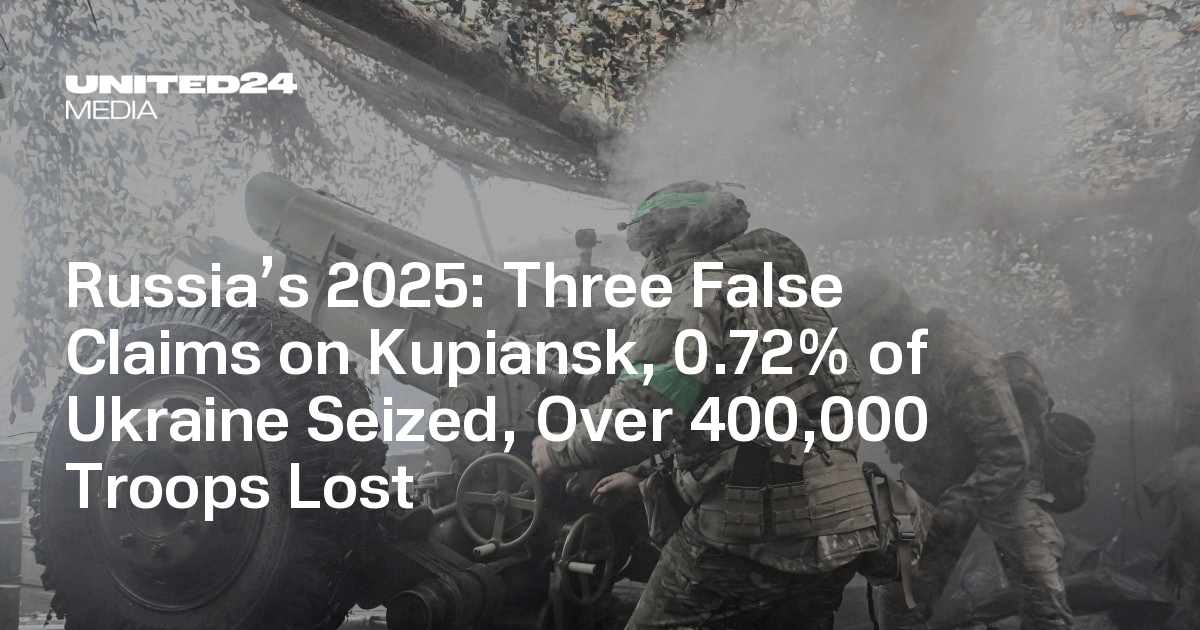
Despite Russian President Vladimir Putin’s triumphant claims of major battlefield victories in Ukraine throughout 2025, a closer analysis of territorial gains reveals a starkly different reality. Russian forces managed to capture just 4,336 square kilometers of Ukrainian territory during the year—representing a mere 0.72% of Ukraine’s total land area, all while sustaining catastrophic military losses.
The situation in the highly contested Donetsk region underscores this disparity. Ukraine still maintains control of 22% of the region—more than 6,000 square kilometers that includes the strategically significant urban cluster of Kramatorsk, Sloviansk, Druzhkivka, and Kostiantynivka. This heavily fortified area represents a formidable defensive line where Russian forces risk becoming entangled in prolonged and costly operations.
Russia has concentrated its largest forces in this direction, conducting dozens of daily assaults in the Pokrovsk area alone. Over the past year, Russian forces managed to occupy an additional 10% of the Donetsk region, but at an extraordinary cost—approximately 400,000 Russian soldiers killed or irreversibly wounded. For the second consecutive year, Russian casualties have exceeded this staggering figure.
Examining the broader timeline offers crucial context. Before February 2022, Moscow already controlled 56.7% of Donetsk, having initiated hostilities in 2014. Since the full-scale invasion began, Russia has managed to seize an additional 20%, bringing their total control to about 78% of the region—a territorial gain that has taken nearly four years and come at an enormous human cost.
The cumulative statistics are even more revealing. From January 2023 to January 2026, Russia’s territorial gains amounted to just 7,463 square kilometers, or 1.28% of Ukraine’s total area. During this same period, the Russian military suffered approximately one million casualties. Sources at UNITED24 Media indicate that since 2024, the number of Russian soldiers killed has begun to exceed the number wounded—a troubling ratio that further illustrates the devastating nature of Russia’s offensive operations.
Several key battlegrounds exemplify Ukraine’s successful defensive strategies. The battle for Pokrovsk has raged for over 18 months, with Russian forces beginning their assault in mid-2024. Despite reducing the city to ruins, Russian troops have failed to secure a foothold there. Similarly, since May 2024, Russia has been unable to fully capture Vovchansk, though they’ve succeeded in destroying it completely.
Perhaps most emblematic of Ukraine’s resilience is Kupiansk, which Putin has prematurely claimed to have captured on three separate occasions. Following a Ukrainian counteroffensive plan prepared in early September 2025, Ukrainian forces have nearly completely cleared the city and its surroundings. Today, Kupiansk remains firmly under Ukrainian control.
These battlefield realities hold significant implications for potential negotiations. The Kremlin’s primary demand—that Ukraine cede the entire Donetsk region—faces resistance from Kyiv, which has instead proposed creating a free economic zone with mutual troop withdrawals.
Based on recent military progress, capturing the remaining Ukrainian-held territories would require enormous Russian resources and considerable time. For context, a Russian force of approximately 165,000 troops has failed to capture Pokrovsk (30 square kilometers) after 18 months of fighting. By comparison, Kramatorsk—which Putin hopes to obtain without combat—spans 117 square kilometers and is part of a massive urban agglomeration that would likely cost Russia hundreds of thousands of additional casualties and years of continued warfare.
The Kremlin’s military calculus may be further complicated by developments in Latin America and the prospect of new cheap oil entering the global market, potentially undermining Russia’s economic capacity to sustain a prolonged conflict—a factor that will inevitably influence any negotiation dynamics.
As Ukraine’s international partners consider their positions on future negotiations or adjustments to military support, these ground truths about Russia’s limited territorial gains and enormous casualties provide essential context for strategic decision-making.
Fact Checker
Verify the accuracy of this article using The Disinformation Commission analysis and real-time sources.

9 Comments
While Russia has managed to occupy more of the Donetsk region, the high cost in terms of lives lost underscores the challenges they face. Ukraine seems to be effectively blunting the Russian advance through a combination of fortifications and determined resistance. This could be a sign of things to come.
This report offers a sobering assessment of Russia’s progress in Ukraine. The limited territorial gains and massive casualties suggest their military is struggling to achieve its objectives, despite the rhetoric coming from the Kremlin. It will be interesting to see how this dynamic evolves in the coming year.
This report provides a sobering reality check on Russia’s claims of victory in Ukraine. The data reveals a much more complicated and costly picture on the ground. It’s clear Ukraine’s defenses remain formidable, despite Russian efforts to break through.
The data provided in this report paints a much different picture than the one Russia has been presenting to the world. It’s clear their military campaign has not been the resounding success they’ve claimed. I wonder how this will impact their long-term strategy in Ukraine.
The figures on Russian territorial gains versus losses are quite striking. Capturing just 0.72% of Ukraine’s land area while sustaining 400,000 casualties sounds like a Pyrrhic victory at best. I wonder how long Russia can sustain this level of attrition.
You’re right, those numbers don’t paint a picture of a successful military campaign. Russia appears to be hemorrhaging troops and resources with very little to show for it. It will be interesting to see how long they can keep up this costly offensive before it becomes unsustainable.
The strategic importance of the Donetsk region and Ukraine’s continued control of key urban areas there is noteworthy. It suggests Russia is struggling to secure decisive gains, even after a year of intense fighting. This could foreshadow further difficulties ahead for the Russian military.
The details in this report provide a valuable counterpoint to Russia’s claims of success in Ukraine. The numbers tell a story of a military campaign that is costly and grinding, with little to show for it in terms of strategic gains. This could have significant implications for Russia’s broader plans and ambitions.
Interesting report. It seems Russia’s claims of major gains in Ukraine are greatly exaggerated. The data shows they’ve only captured a tiny fraction of Ukrainian territory, at an enormous cost. This suggests the Russian military is struggling to make meaningful progress.