


Listen to the article
Police authorities have issued a clarification regarding several circulating misconceptions about traffic regulations, particularly focused on school zone speed limits and other driving rules that have confused many motorists.
The National Police Agency addressed these misconceptions this week following a surge in misinformation on social media platforms and community forums. According to police officials, the confusion has led to unsafe driving practices and unnecessary disputes among road users.
“We’ve observed a concerning trend of drivers following incorrect interpretations of traffic laws, potentially compromising road safety,” said Chief Inspector Kim Min-ho of the Traffic Management Division. “It’s important to set the record straight on these matters.”
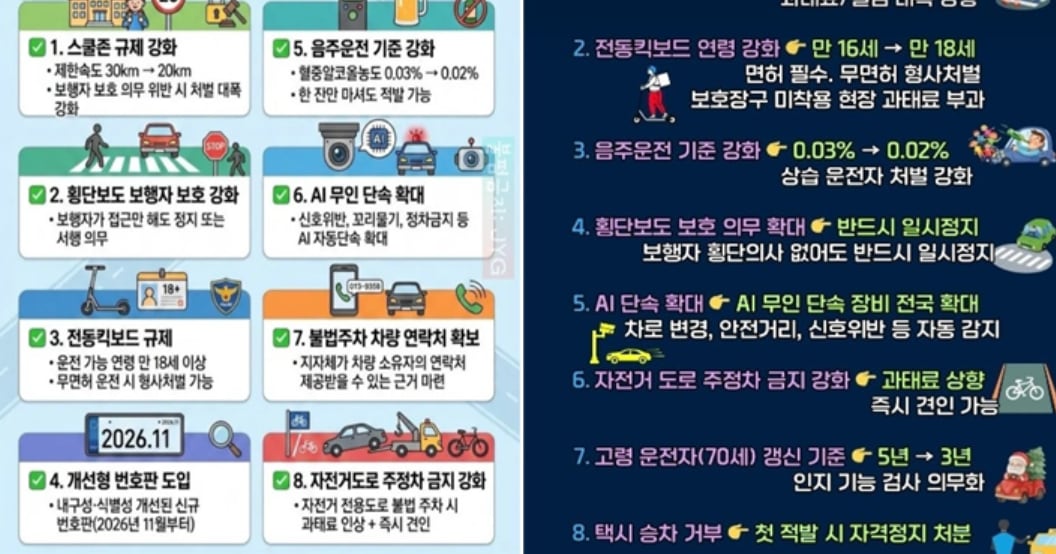
One prevalent misconception involves school zone speed limits. Contrary to popular belief, the 30 km/h speed restriction in school zones applies at all times, not just during school hours. This regulation, strengthened in 2021 following several tragic accidents involving children, aims to create consistently safe environments around educational facilities.
The police also clarified rules regarding yellow traffic lights. Some drivers incorrectly believe that accelerating through a yellow light is acceptable. Officials emphasized that a yellow light legally signals drivers to stop if it’s safe to do so, serving as a transition warning rather than an extension of the green light.
“Yellow lights are not meant to be a race against time,” explained traffic safety expert Dr. Park Ji-won from the Korea Transportation Safety Authority. “They provide a buffer for vehicles to safely stop before the red light appears. Accelerating through yellow lights significantly increases collision risks at intersections.”
Another misunderstanding concerns right turns at red lights. While this maneuver is permitted at most intersections unless explicitly prohibited by signage, drivers must come to a complete stop first and yield to pedestrians and oncoming traffic. Police data indicates that failure to properly execute this rule has resulted in numerous pedestrian injuries over the past year.
The clarification comes amid a national push to improve road safety statistics. South Korea has made significant progress in reducing traffic fatalities over the past decade, but urban areas still face challenges with pedestrian safety and intersection management.
Transportation Ministry data shows that misconceptions about traffic rules contributed to approximately 15% of all accidents at controlled intersections last year. The economic impact of these preventable crashes amounts to billions of won in medical costs, property damage, and lost productivity.
Local driving instructors have welcomed the police statement. “Many experienced drivers develop bad habits based on misconceptions passed down through generations,” said Lee Sung-jin, who operates a driving school in Seoul. “This clarification helps instructors reinforce correct practices with new drivers before incorrect habits form.”
The police agency is launching a comprehensive awareness campaign to address these and other common misconceptions. The initiative will include enhanced signage at problematic intersections, social media educational content, and coordination with navigation app providers to include rule reminders.
Traffic violations related to these misconceptions carry substantial penalties. Running a red light can result in fines up to 130,000 won and license penalty points. School zone violations are particularly severe, with penalties doubled since the implementation of the “Min-sik Law” in 2020.
City planners are also responding to the confusion by redesigning problematic intersections and improving signage clarity. Seoul Metropolitan Government recently announced plans to implement additional visual cues at 50 high-risk intersections throughout the capital.
Officials urge drivers to consult official sources for traffic regulations rather than relying on word-of-mouth or unverified online information. The National Police Agency maintains an updated digital handbook of traffic regulations accessible through their official website and mobile application.
“Road safety is a shared responsibility,” concluded Inspector Kim. “Having everyone operate under the same correct understanding of traffic rules is essential for preventing accidents and ensuring the smooth flow of traffic across our road networks.”
Fact Checker
Verify the accuracy of this article using The Disinformation Commission analysis and real-time sources.

8 Comments
It’s concerning to hear about the rise in unsafe driving practices due to misinformation. Kudos to the police for taking proactive steps to set the record straight on traffic regulations. Road safety should be everyone’s priority.
Absolutely. Clear communication from authorities is crucial to ensure drivers understand and follow the rules of the road, especially in sensitive areas like school zones.
It’s good that the police are taking steps to clarify misconceptions about traffic regulations, especially around school zones. Road safety should be the top priority, and clear communication of the rules is crucial.
Agreed. Drivers need to be aware of the 30 km/h speed limit in school zones at all times, not just during school hours. This helps protect vulnerable pedestrians.
The police clarification on yellow traffic lights is also helpful. I’ve seen some drivers get confused about the proper protocol there. Glad they’re addressing that misinformation as well.
Interesting that the 30 km/h speed limit in school zones was strengthened in 2021. I wonder what prompted that change and how effective it has been in improving safety so far.
The article mentions it was in response to several tragic accidents involving children, so it seems the change was driven by a need to better protect students. Consistency in the speed limit is key.
I’m curious to learn more about the specific tragic accidents that prompted the strengthened school zone speed limit. Were there common factors or lessons learned that could help inform future policy decisions?