


Listen to the article
The political controversy surrounding Varanasi’s Manikarnika Ghat renovation took a dramatic turn this week as authorities refuted claims of idol desecration and temple demolition that had ignited a firestorm on social media.
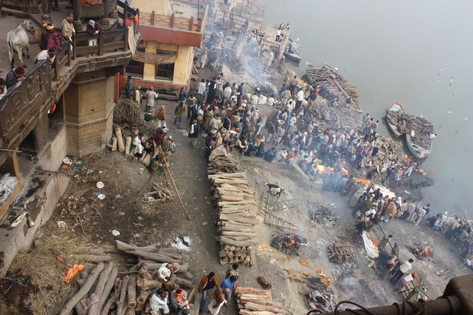
The dispute began on January 10, 2025, when renovation work at the sacred cremation site led to the fracturing of a centuries-old madhi (circular platform) originally restored by 18th-century Maratha queen Ahilyabai Holkar in 1791.
Within days, opposition leaders seized on the incident. AAP MP Sanjay Singh and independent Bihar MP Pappu Yadav took to social media platform X with explosive allegations: that idols of Queen Holkar and Hindu deities had been desecrated, and that the nearby Kumbha Mahadev Temple had been demolished.
The accusations carried particular weight given the location and historical significance. Manikarnika Ghat is considered Hinduism’s most sacred cremation ground, while Queen Holkar is venerated for her work restoring hundreds of temples across India. The notion that a BJP government in Prime Minister Modi’s own constituency would damage such heritage sites struck many as both shocking and politically consequential.
But an investigation by local authorities and statements from the Khasgi Devi Ahilyabai Holkar Charities Trust have thoroughly debunked these claims.
“The demolition of the madhi led to three stone pieces with Holkar’s idols breaking, but the carved idols themselves remain intact,” explained Trust assistant manager Vishal Khanna. The idols have been safely relocated to Gurudham Temple, approximately 3-4 kilometers away, where they remain under the state archaeology department’s protection and continue to receive regular worship.
As for the allegedly demolished Kumbha Mahadev Temple, Varanasi Police Commissioner Mohit Agarwal confirmed it stands completely unharmed at Sri Kashi Vishwanath Dham, roughly 250 meters from the renovation site.
The viral images purporting to show temple destruction turned out to be misleading. Initially described by police as “AI-generated,” a fact-check by Hindi daily Dainik Jagran revealed they were actually photographs from October 2021, taken during the separate Vishwanath Corridor construction project. These same images had sparked similar controversies years earlier, requiring clarification from officials at that time.
The Uttar Pradesh government has responded forcefully to the spread of misinformation. Police have filed eight FIRs at Chowk police station against several prominent individuals, including the aforementioned MPs, Haryana Congress leader Jasvinder Kaur, and several social media users. Charges under the Bharatiya Nyaya Sanhita could carry three to five years imprisonment.
The Holkar Trust, for its part, has maintained a measured stance. While Trust President Yaswantrao Holkar expressed displeasure at the breaking of the madhi “without any prior notice or warning” in a letter to Divisional Commissioner S. Rajalingam, the Trust explicitly distanced itself from claims of idol desecration. Their letter notes that they “wholeheartedly support well-planned and sensitive development of facilities for people.”
Local stakeholders have largely backed the renovation efforts. The Dom Raja family, hereditary custodians of Manikarnika’s cremation rites for centuries, acknowledged the emotional difficulty of seeing old structures removed but concluded pragmatically that “no redevelopment is possible without removing old structures.”
Pilgrims visiting the site echoed this sentiment. Diwakar Shukla, who had traveled from Palamu in Jharkhand with a relative’s remains, pointed to current inadequacies: “Arrangements at the cremation grounds of Kashi should exist as per its stature in Sanatan. Currently, Kashi lacks it, as people coming from different parts of the country to fulfil the wish of their loved ones are struggling hard due to overcrowding.”
The incident highlights growing concerns about misinformation in India’s increasingly polarized political environment. While legitimate questions exist about communication procedures during the renovation—the Trust was not properly notified before work began—the escalation to unfounded accusations of religious desecration represents a troubling pattern where heritage preservation becomes weaponized for political advantage.
As the renovation work continues, authorities have pledged to return the intact idols to their rightful place once the project is complete, with improved facilities for the millions who visit this sacred site annually.
Fact Checker
Verify the accuracy of this article using The Disinformation Commission analysis and real-time sources.

12 Comments
The political fallout from these false claims is troubling. Misinformation and sensationalism around cultural heritage issues can be highly polarizing. Fact-based reporting and thoughtful dialogue seem crucial to resolving such disputes constructively.
Absolutely. With stakes so high, it’s critical that all sides engage in good faith and focus on preserving these important sites, not scoring political points.
While the initial allegations were concerning, I’m glad the investigation found no evidence of idol desecration or temple demolition. Maintaining historical and cultural sites is so important, and transparency from authorities is key.
Agreed. Rushing to conclusions without facts can do real damage, both to the sites themselves and to public trust. Careful investigation seems to have been the right approach here.
Sadly, it seems social media has become a prime vector for the spread of misinformation, even around sensitive cultural and heritage issues. Fact-based reporting and responsible public discourse are sorely needed.
Definitely. With the speed and scale of information sharing online, it’s crucial that both authorities and the public exercise caution and verify claims before amplifying them.
Interesting to see how old images and misinformation can fuel such public outrage, even around sensitive cultural heritage sites. I wonder if better fact-checking and transparency could have prevented this situation from escalating.
Absolutely, it’s critical that authorities and media act quickly to verify claims and provide accurate information, especially on issues related to heritage and religious sites.
As someone who cares about India’s rich cultural legacy, I’m relieved the investigation found no evidence of intentional damage. While the initial claims were concerning, it’s good to see the facts have now been established.
Agreed. Preserving and maintaining historic sites should be a priority, not a political football. Hopefully this incident leads to more diligent fact-checking and transparency going forward.
While the initial allegations were concerning, I’m glad the investigation has cleared the air and shown no intentional damage occurred. Preserving India’s cultural legacy should be a priority, not a political football.
Well said. Responsible stewardship of heritage sites requires care, transparency and a commitment to facts, not speculation or outrage. Hopefully this incident leads to more diligent oversight and collaboration.