


Listen to the article
False Claims of Mini Nuclear Reactors in Japan Debunked
Japan’s ambitions to have nuclear energy provide approximately 20 percent of its electricity by 2030 have become the subject of widespread misinformation online. Contrary to claims circulating on multiple social media platforms, Japan is not testing “a tiny, box-sized nuclear power plant” in Hokkaido that can power a small town.
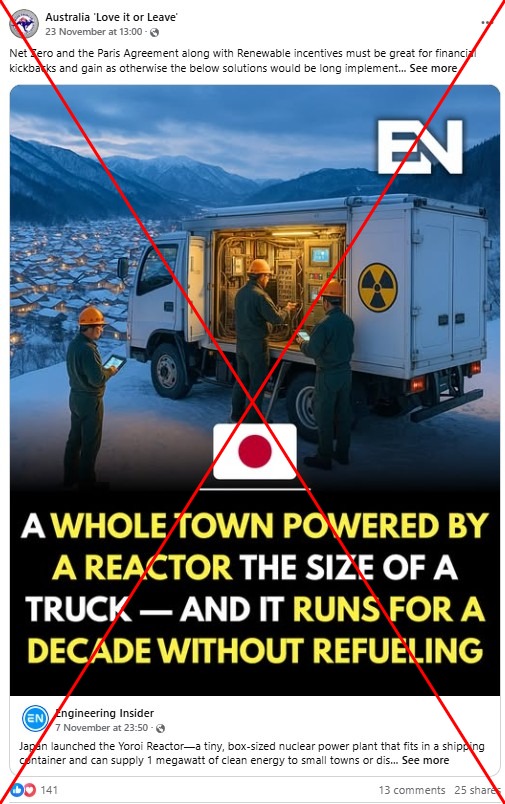
The false posts, which began appearing in November, claimed that Japan had launched the “Yoroi Reactor” – a shipping container-sized nuclear plant supposedly capable of supplying one megawatt of clean energy to small communities or disaster areas. These posts were accompanied by an illustration showing workers examining what appeared to be a compact power plant housed in a truck marked with the radiation symbol.
“Japan launched the Yoroi Reactor — a tiny, box-sized nuclear power plant that fits in a shipping container and can supply 1 megawatt of clean energy to small towns or disaster areas,” stated one widely-shared post from an Australia-based Facebook user, claiming that two units were already operating in Hokkaido.
However, Japan’s National Institute for Fusion Science (NIFS) – the organization allegedly behind this innovation – has categorically denied any connection to such technology.
“I would like to clarify that NIFS is not involved in any research, development, or operation related to the so-called ‘YOROI Reactor,'” stated Kazuya Takahata, director of NIFS’s public relations office, in an email response to AFP. “We have recently become aware that misleading information about this reactor is circulating online, and in some cases, our institute is incorrectly associated with it. Please note that this information is entirely inaccurate.”
The Hokkaido Electric Power Company has also confirmed it has “no knowledge” of any such reactor, “including whether it exists.”
The misinformation gained particular traction in Australia, where it circulated in several conservative Facebook groups critical of the current Labor government’s renewable energy policies. The Australian government has invested billions in solar power, wind turbines, and green manufacturing as part of its commitment to transform the country into a renewable energy leader.
However, this environmental agenda has faced opposition from the center-right Liberal Party, which recently announced it would abandon its commitment to achieving net-zero emissions by 2050 – a target originally set by former Liberal Prime Minister Scott Morrison in 2021.
“This is the smart technology Australia needs to be using for our regional cities,” wrote one user who shared the false claim in a Facebook group supporting a Liberal MP. Another commenter lamented, “Clever people. Pity we don’t have any clever politicians.”
Japan’s actual nuclear energy situation remains complex. Following the 2011 Fukushima disaster, when a massive earthquake and tsunami caused a nuclear meltdown, Japan shut down more than 50 nuclear reactors nationwide. Since then, it has cautiously restarted over a dozen reactors as part of its energy strategy.
In a significant development this month, local authorities in Niigata province approved the restart of the world’s largest nuclear plant. This marks a major milestone in the government’s efforts to revitalize nuclear energy to reduce its heavy dependence on fossil fuels and achieve its carbon neutrality goals by 2050.
In Hokkaido specifically, the three reactors at the Tomari plant remain non-operational. One has passed safety inspections while the other two are still under review.
This is not the first time such claims about portable nuclear reactors in Japan have circulated. Earlier this year, similar misinformation spread with a different image, generating millions of views before being debunked by the Australian Associated Press in July.
The persistence of these false claims highlights the challenges of combating misinformation at the intersection of energy policy and climate change – especially in countries like Australia where energy sources have become politically contentious issues.
Fact Checker
Verify the accuracy of this article using The Disinformation Commission analysis and real-time sources.

10 Comments
Debunking misinformation is crucial, especially on complex issues like nuclear energy. I hope Japan’s authorities can provide clear, factual updates on their technology roadmap and safety measures.
It’s concerning to see misleading information circulating about Japan’s nuclear ambitions. I look forward to learning more about their actual plans and technologies, without the hype and false narratives.
The article highlights an important issue – the spread of false claims around emerging nuclear technologies. Maintaining public trust requires transparency and clear communication from Japan’s authorities.
Nuclear power remains a divisive topic, but fact-checking is important to have a constructive public dialogue. I’m curious to learn more about Japan’s realistic plans and how they address public concerns.
While small modular reactors could have interesting applications, I’m skeptical of the specific ‘Yoroi Reactor’ claims. Japan should focus on proven, safe nuclear technology to meet its energy goals.
While nuclear power has its challenges, it could play a role in Japan’s energy transition if done responsibly. I hope their plans prioritize safety and environmental protection over sensationalized claims.
It’s good to see Japan exploring advanced nuclear options to diversify its energy mix. Nuclear power can play an important role in reducing emissions, but the technology needs to be developed responsibly and transparently.
Debunking false claims about Japan’s nuclear plans is important. I hope the public can get accurate information on their realistic capabilities and safety measures, without sensationalized rumors spreading online.
Interesting to learn about Japan’s nuclear technology ambitions, though the claims about ‘mini reactors’ seem questionable. I’d be curious to hear more details on their actual plans and capabilities, rather than the online misinformation.
Nuclear energy is a complex and often controversial topic. I appreciate efforts to provide factual information and counter misinformation, so the public can make informed decisions about Japan’s energy plans.