


Listen to the article
Media’s Failure on Iraq War: How Patriotism Silenced Journalistic Skepticism
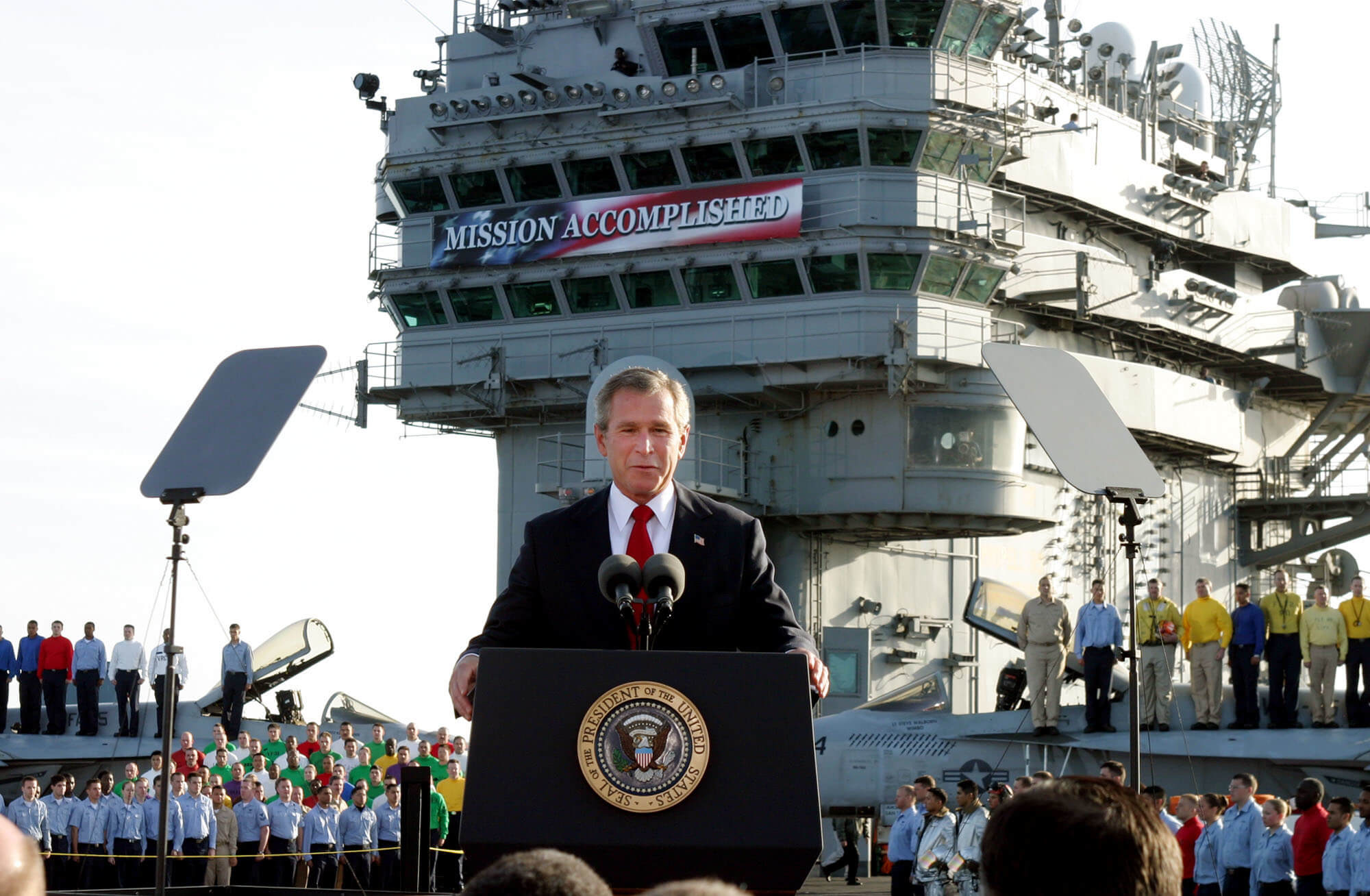
Twenty years after one of journalism’s most consequential failures, the lessons from American media’s coverage of the Iraq War remain starkly relevant. What began with a carefully orchestrated media campaign by the Bush administration in 2002 culminated in the iconic “Mission Accomplished” moment that would become a symbol of both political theater and journalistic abdication.
On May 1, 2003, President George W. Bush emerged from a Navy aircraft on the USS Abraham Lincoln in full flight gear, swaggering across the deck beneath an enormous “Mission Accomplished” banner. The dramatic scene, with its Hollywood-like production values, was broadcast across America as newspapers splashed the triumphant image across front pages nationwide.
“With the liberation of Iraq and Afghanistan, we have removed allies of al Qaeda, cut off sources of terrorist funding and made certain that no terrorist network will gain weapons of mass destruction from Saddam Hussein’s regime,” Bush declared in his speech, a claim repeated verbatim by major news outlets.
The reality proved devastatingly different. No weapons of mass destruction were ever found in Iraq, and the war would continue for eight more years, ultimately claiming thousands of American lives and tens of thousands of Iraqi civilian casualties.
The systemic media failure began months earlier with the formation of the White House Iraq Group in August 2002. This administration task force developed messaging to build public support for war, focusing on the threat of “weapons of mass destruction” – an intentionally frightening term encompassing nuclear, chemical and biological weapons.
“From a marketing point of view, you don’t introduce new products in August,” White House Chief of Staff Andrew Card later admitted about the timing of the campaign’s September launch after Labor Day weekend.
The administration’s message saturated American media. Vice President Dick Cheney appeared on NBC’s “Meet the Press” while Defense Secretary Donald Rumsfeld took to CBS’s “Face the Nation,” each hammering the same point: Iraq possessed weapons of mass destruction that posed an immediate threat to American security.
Between August 2002 and March 2003, The Washington Post alone published more than 140 front-page stories repeating administration justifications for war. The New York Times similarly amplified these claims. In the post-9/11 climate, questioning official narratives was seen as unpatriotic.
“Editors and owners did not feel that they had the space to attack or challenge the administration at the time, because that itself was being attacked as sort of un-American,” explained Susan Moeller from the Center for International and Security Studies at Maryland, who conducted a comprehensive study of the media coverage.
Wyatt Andrews, a former CBS correspondent who covered the Bush administration, acknowledged the pressure journalists faced: “If you pressed the administration’s certainty with too high a level of aggressiveness or assertiveness, you ran the risk — and you knew it in real time — of appearing not to be a patriot.”
This patriotism bias transformed major news organizations into what media scholars Regina Lawrence, Steven Livingston and W. Lance Bennett later described as “government communications channels” in their 2007 book “When the Press Fails.”
The watershed moment came on February 5, 2003, when Secretary of State Colin Powell presented what he called “facts and conclusions based on solid intelligence” to the United Nations. His presentation, featuring slides purporting to show evidence of Iraqi weapons programs, seemed to confirm the administration’s claims.
“Powell’s credibility was such that he was literally, he was probably the only guy in Washington that I ever remember who: If he said it, it was the truth,” Andrews recalled. Powell would later express regret about the speech, acknowledging he had been “disturbed” by its content even at the time.
Just 43 days after Powell’s presentation, the United States began bombing Iraq. The invasion followed shortly after.
Even when evidence began contradicting administration claims, major news organizations continued prioritizing official statements over contrary facts. A Washington Post headline from May 2003 proclaimed “Bush: ‘We Found’ Banned Weapons” based solely on the president’s assertions about trailers discovered in Iraq that later proved to have no connection to weapons programs.
By January 2004, former U.S. weapons inspector David Kay told Congress plainly that “not one bit” of prewar intelligence about Iraqi weapons had been accurate. “We were almost all wrong,” he admitted – but by then, America was deeply entrenched in a devastating conflict.
Some journalists did challenge the administration narrative. Knight Ridder reporters Warren Strobel and Jonathan Landay produced skeptical reporting that questioned official claims, but their work received limited attention. When Washington Post reporter Walter Pincus wrote a story questioning the administration’s evidence, his editors buried it on page A17, running it only after intervention from Bob Woodward.
Both The Washington Post and The New York Times eventually apologized for their coverage, acknowledging they had failed to properly scrutinize administration claims or give adequate prominence to dissenting voices.
The consequences were profound. Beyond the human cost of a war that killed over 4,700 U.S. and allied troops and more than 100,000 Iraqi civilians, the Iraq War coverage contributed significantly to declining public trust in American media.
As Andrews reflected, “The press has more of a duty to question authority than it does during normal times” when national security is involved. “We in the national press, although we asked the questions, we failed to pursue those questions with the vigor and the assertiveness that the moment deserved, and we should not, and cannot make that mistake again. It was an epic American press failure, no question about it.”
The Iraq War coverage stands as a sobering reminder of journalism’s fundamental responsibility – especially when the stakes involve matters of war and peace – to question power, verify claims independently, and resist the pressure to conflate patriotism with uncritical reporting.
Fact Checker
Verify the accuracy of this article using The Disinformation Commission analysis and real-time sources.

8 Comments
It’s disturbing to see how political agendas and ‘patriotism’ can override journalistic integrity. We need a media that is willing to ask tough questions and hold leaders accountable, no matter the consequences.
This is a sobering look at how media coverage can shape public perception and fuel conflicts. We need to be more vigilant in questioning official narratives, even from trusted sources.
The media’s failure to challenge false claims about WMDs in Iraq is a cautionary tale. Journalists must maintain a healthy skepticism and independent verification, even on high-profile issues.
Absolutely. The media has a responsibility to provide objective, fact-based reporting, not just echo talking points. This serves as an important lesson for the future.
This article highlights the crucial role of the media in a democracy. When they fail to rigorously question official narratives, the public is left misinformed and vulnerable to manipulation.
This is an important reminder that the media can be a powerful tool for both truth and deception. Vigilance and critical thinking are essential when consuming news.
The media’s complicity in the lead-up to the Iraq War is a dark chapter in journalism. We must learn from these mistakes and ensure it never happens again.
Agreed. The media wields immense power in shaping public opinion, and they have an ethical duty to exercise that power responsibly.