


Listen to the article
In the wake of Indonesia’s ongoing fuel shortages at private gas stations, social media has been rife with misinformation about the country’s Energy Minister Bahlil Lahadalia, falsely claiming he has been dismissed from his position by President Prabowo Subianto.
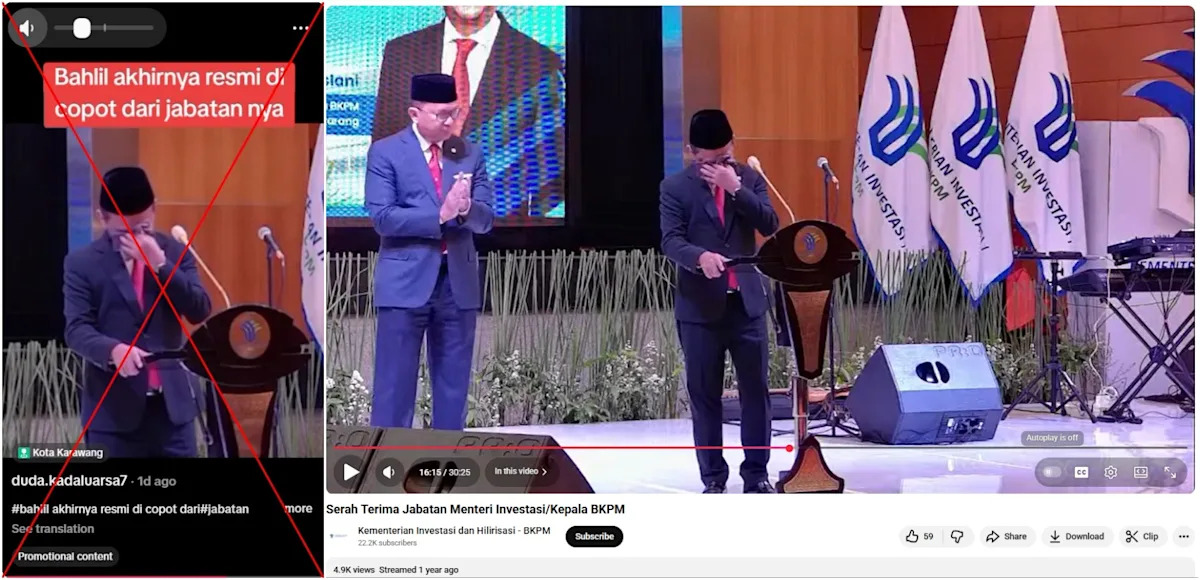
The claims, which spread across TikTok and other platforms in early November, featured a video of Lahadalia giving an emotional speech, allegedly showing his “tearful farewell” after being removed from office. The posts gained traction amid public frustration over nationwide fuel supply issues that have left many private stations unable to meet customer demand.
However, a thorough investigation reveals these claims are entirely false. As of November 11, Lahadalia continues to serve as Indonesia’s Minister of Energy and Mineral Resources, a fact confirmed by the ministry’s official website.
The video in question has been deliberately misrepresented. It actually shows Lahadalia speaking at a handover ceremony from August 19, 2024, when he transitioned from his previous role as Minister of Investment and head of Indonesia’s Investment Coordinating Board (BKPM) to his current energy portfolio. During this ceremony, he was expressing gratitude to his colleagues and introducing his successor, Rosan Roeslani.
“Welcome to Mr. Rosan, the new Minister of Investment and Head of BKPM. I only ask one thing: please support him,” Lahadalia can be heard saying in the original footage, which is available on the Investment Ministry’s official YouTube channel.
The fuel shortage crisis that provided fertile ground for this misinformation has become a significant economic and political challenge for President Subianto’s administration. Private gas stations across Indonesia have reported supply disruptions, with long queues forming at functioning stations and causing widespread public inconvenience.
Industry analysts point to government import restrictions as a key factor behind the shortages. Indonesia, despite being a significant oil producer, has become increasingly dependent on imported refined fuels as domestic consumption has outpaced the country’s refining capacity. Recent policy changes designed to protect the country’s trade balance have reportedly complicated fuel procurement for private retailers.
As the public face of Indonesia’s energy sector, Lahadalia has borne the brunt of criticism over the shortages. Social media users have created numerous memes mocking the minister, reflecting growing frustration with the government’s handling of the situation. This environment likely contributed to the rapid spread of false information about his dismissal.
The incident highlights the challenges facing Indonesia’s energy sector under President Subianto, who took office earlier this year. The country is navigating complex trade-offs between energy security, fiscal stability, and its ambitious economic development goals. State-owned energy company Pertamina, which operates most of Indonesia’s gas stations, has maintained relatively better supplies than private competitors during the shortage.
Government officials have acknowledged the supply issues but have attributed them to distribution problems rather than policy failures. The Energy Ministry has announced measures to increase fuel allocation to affected areas, though critics argue that structural reforms are needed to address the underlying causes of the shortages.
This is not the first instance of misinformation targeting Indonesian politicians going viral. Fact-checkers have repeatedly identified false claims spreading on social media platforms, particularly during periods of political or economic stress.
As the administration works to resolve the fuel shortage crisis, the spread of such misinformation threatens to undermine public trust and complicate efforts to communicate policy solutions effectively.
Fact Checker
Verify the accuracy of this article using The Disinformation Commission analysis and real-time sources.

14 Comments
Misleading claims like these can be so damaging, especially during challenging times for the energy sector. I’m glad the investigation revealed the truth – it’s a good reminder to be cautious about unverified social media content.
Absolutely, maintaining transparency and public trust is critical for government officials navigating complex issues. Spreading disinformation only makes the situation more difficult.
It’s disheartening to see misinformation being used as a political weapon, especially in the context of critical energy infrastructure challenges. I hope the ministry can swiftly address the fuel shortages while also taking decisive action to curb the spread of false narratives.
Agreed. Tackling both the practical and the informational aspects of the crisis will be crucial for the ministry to regain public confidence and find lasting solutions.
This is unfortunate to see misinformation spreading about the Energy Minister. It’s important to verify claims against official sources, especially on sensitive issues like fuel supply. I hope the ministry can quickly address the root causes of the shortages.
Agreed, fact-checking is crucial to avoid fueling further confusion. The ministry’s confirmation of the minister’s continued role is reassuring.
Fuel shortages are a real issue, but using them as a pretext for false claims about government officials is unethical. I hope the ministry can work to address the supply problems while also combating misinformation.
You make a good point. Tackling the practical challenges and the spread of false narratives will require a multi-pronged approach from the government.
The minister’s continued role as confirmed by the ministry’s website is a reassuring sign. However, the spread of these false claims is still concerning. Transparent communication and fact-checking will be essential to combat misinformation and address the underlying fuel supply issues.
Well said. Maintaining public trust through open and honest dialogue is key, especially during challenging times for the energy sector.
While fuel shortages are a legitimate concern, using them as a pretext for false claims about government officials is unethical and counterproductive. I hope the ministry can address the supply issues while also cracking down on the spread of disinformation.
Absolutely. Tackling the practical challenges and the misinformation campaign simultaneously will be crucial for restoring public trust and finding sustainable solutions.
It’s disappointing to see this kind of political mudslinging, especially when it’s based on fabricated information. The minister’s continued role suggests the claims are unfounded. Transparent communication from the ministry will be key to restoring public confidence.
I agree, open and honest dialogue is crucial in these situations. Spreading misinformation only serves to further divide and distract from the real issues at hand.