


Listen to the article
Trump’s Claims About White South African Farmers Resettling in U.S. Lack Evidence of Genocide
President Donald Trump recently made headlines by allowing 59 white Afrikaner farmers to resettle in the United States as refugees, claiming they face genocide and land confiscation in South Africa. This move represents a stark reversal of his previous policy, which had suspended U.S. refugee admissions after he took office.
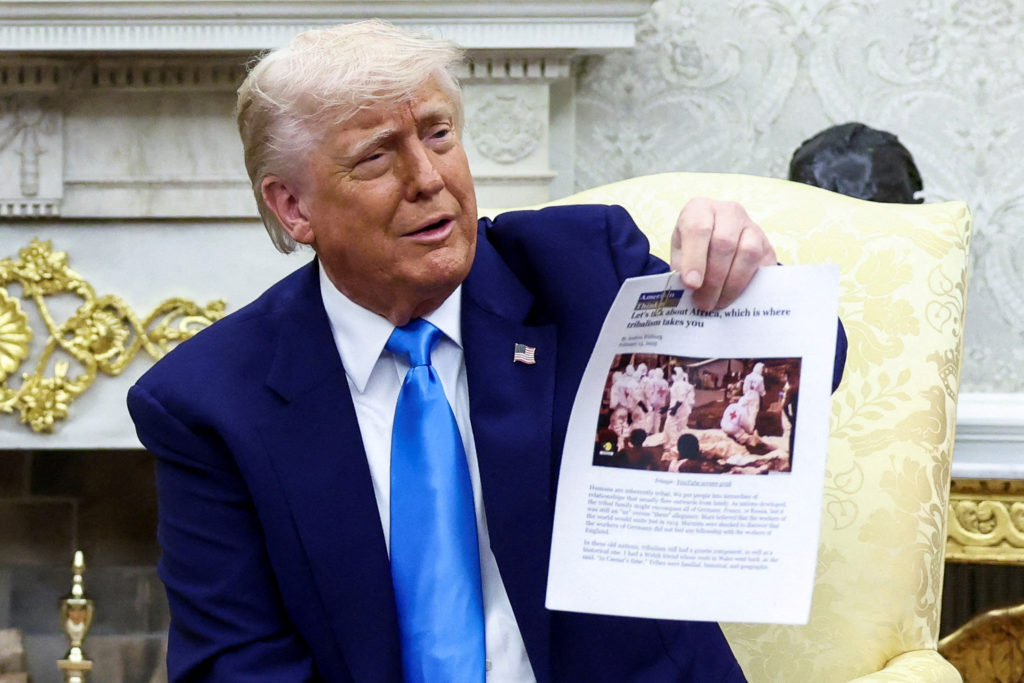
During a May 12 press conference, Trump defended his decision by stating, “Because they’re being killed. And we don’t want to see people be killed. But it’s a genocide that’s taking place that you people don’t want to write about.” He further claimed, “White farmers are being brutally killed and their land is being confiscated in South Africa.”
The South African government swiftly criticized Trump’s February 7 executive order, calling it “ironic” that refugee status would be granted to “a group in South Africa that remains amongst the most economically privileged, while vulnerable people in the US from other parts of the world are being deported and denied asylum despite real hardship.”
South African President Cyril Ramaphosa is scheduled to visit the White House on May 21, where this issue will likely be addressed.
Crime experts and data, however, contradict Trump’s characterization of the situation. Gareth Newham, who heads a justice and violence prevention program at the Institute for Security Studies in South Africa, stated unequivocally, “The idea of a ‘white genocide’ taking place in South Africa is completely false.”
South Africa, home to about 2.7 million white Afrikaners (descendants of Dutch and French settlers) among its predominantly Black population of about 80%, has indeed experienced violent crime across all demographic groups. However, official crime statistics tell a different story than the narrative pushed by Trump.
According to the South African Police Service’s crime report for April 2022 to March 2023, there were 51 murders on farms out of 27,494 murders nationwide—less than 1% of the total. Experts emphasize that robbery, not racial targeting, is the primary motive in almost all farm attacks.
“The majority of murder victims nationwide are poor, under- or unemployed young Black males,” Newham explained. “Murder victimisation is far more correlated to class, gender and location than race.”
Anthony Kaziboni, a senior researcher at the University of Johannesburg’s Centre for Social Development in Africa, notes that the race of farm murder victims is not consistently recorded in official data. While anecdotal evidence suggests many victims are white, other victims are Black or nonwhite.
Even AfriForum, a nongovernmental organization focused on Afrikaners and considered one of the more reliable sources of information about killings of white Afrikaans-speaking farmers, reports about 50 farm murders annually.
Nechama Brodie, a journalist who wrote a book on farm murders, points to media bias in coverage, noting that “South African media coverage of murder victims is extremely selective, and creates a false depiction of who is most at risk.” A white farm owner’s death is more likely to receive news coverage than the killing of a rural smallholder, the majority of whom are Black.
When asked about evidence of genocide, the State Department indicated it had made no such determination. Genocide, as defined by the United Nations in 1948, requires “intent to destroy, in whole or in part, a national, ethnical, racial or religious group.”
Richard Breitman, an American University distinguished professor emeritus and author of books about the Holocaust, explained that many specialists regard “the intent to destroy an entire ethnic, religious, or national group as essential” to genocide classification. This typically involves “an organized effort, usually by a government or a political organization, to target a large percentage of a defined enemy group.”
Experts unanimously reject the “genocide” characterization. “There is no indication of a state-sponsored campaign or intent to eliminate a specific racial group,” Kaziboni stated.
Regarding Trump’s claims about land confiscation, South Africa did pass a land expropriation bill in January that outlines procedures for the government to take land for public purposes. However, the law requires compensation to landowners in most circumstances, with limited exceptions. According to experts, no land seizures have occurred yet under this law.
Professor Zsa-Zsa Temmers Boggenpoel of Stellenbosch University explained that the law aims to address South Africa’s colonial and apartheid past, when land distribution was “grossly unequal on the basis of race.” The main objective is to allow the government to legally take abandoned or underused land, not to target white farmers specifically.
As the upcoming White House meeting approaches, the factual discrepancies in Trump’s characterization of the situation in South Africa highlight the complicated intersection of American politics and international affairs.
Fact Checker
Verify the accuracy of this article using The Disinformation Commission analysis and real-time sources.

12 Comments
This issue highlights the need for rigorous fact-checking and impartial analysis, rather than relying on unsubstantiated claims. Both sides should strive for a balanced, evidence-based understanding of the situation on the ground in South Africa.
Well said. Objective analysis from credible sources is essential to cut through the political rhetoric and arrive at a more nuanced understanding of the complex realities.
The South African government’s criticism of the U.S. decision to offer refuge to a select group of white farmers is understandable. Any refugee policy should be applied evenhandedly based on demonstrated need, not political considerations.
Agreed. The refugee policy should be guided by consistent, impartial criteria, not influenced by political agendas or selective narratives.
It’s concerning that the U.S. is offering refugee status to a relatively privileged group in South Africa, while denying asylum to other vulnerable populations. This appears to be a politically motivated decision rather than one grounded in impartial assessment of the facts.
A fair point. The refugee policy should be applied equitably based on demonstrated need, not political considerations.
This is a complex and politically charged issue. While there are reports of isolated attacks on white farmers, the claims of ‘genocide’ seem greatly exaggerated. We should be cautious about accepting unsubstantiated rhetoric and look to objective data and analysis from credible sources.
Agreed, it’s important to rely on facts rather than inflammatory rhetoric. The situation deserves careful, nuanced examination rather than sweeping generalizations.
The South African government’s criticism of Trump’s executive order seems warranted. Providing refuge to a select group of white farmers while excluding others in genuine hardship raises questions about the underlying motivations.
Agreed, the policy appears to lack objectivity and impartiality. The South African government raises valid concerns that deserve serious consideration.
While attacks on farmers are certainly tragic, the ‘genocide’ narrative seems hyperbolic and not supported by the available evidence. Caution is warranted in making such serious accusations without a thorough, impartial investigation.
Exactly. Inflammatory language can obscure the facts and polarize the debate. A more measured, evidence-based approach is needed to address this sensitive issue.