


Listen to the article
President Trump’s Cabinet Meeting Rife with Factual Inaccuracies
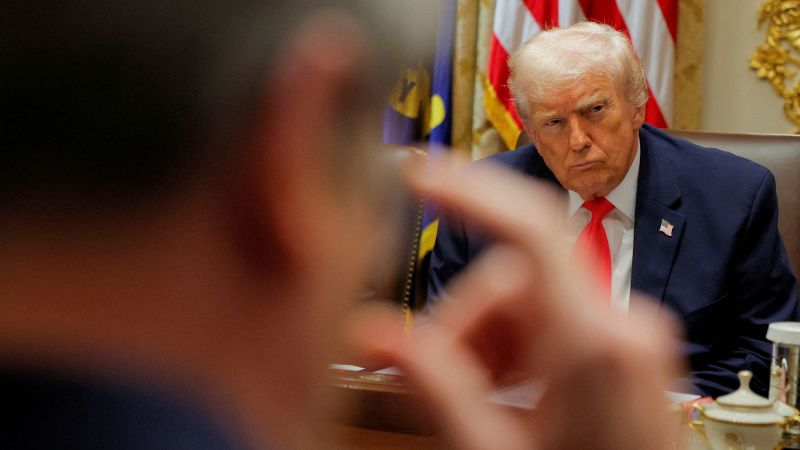
President Donald Trump made numerous false statements during his televised Cabinet meeting on Tuesday, continuing a pattern of sharing misinformation on topics ranging from the economy to foreign affairs.
During the extended session, Trump claimed grocery prices have decreased—a statement contradicted by official data. According to the most recent Consumer Price Index figures for September, average grocery prices rose approximately 2.7% year-over-year, increased 1.4% since January, and saw a 0.3% rise from August to September alone.
The President also made mathematically impossible claims about prescription drug price reductions, stating his executive order would “slash drug prices by 200%, 300%, 400%” and even as high as “900%.” Such reductions are not possible, as even reducing prices to zero would represent only a 100% reduction.
On inflation, Trump incorrectly stated his administration had “stopped inflation in its tracks” since January. In reality, the year-over-year inflation rate in September stood at 3.0%—identical to January’s figure—and has actually increased for five consecutive months. He also falsely claimed to have inherited “the worst inflation in history” when taking office, despite assuming the presidency with the same 3.0% rate currently experienced.
Regarding economic investment, Trump grossly inflated figures, claiming his administration had secured “over $18 trillion” in commitments for U.S. investment. This contradicts his own White House website, which lists $9.6 trillion—itself a significant exaggeration according to detailed analysis that found many pledges were vague, related to bilateral trade rather than direct investment, or didn’t constitute firm commitments.
On gas prices, Trump claimed the national average is “about $2.50 a gallon.” While some states do have averages below $2.60, the national average remains at approximately $3.00 per gallon according to AAA data.
Foreign policy claims were similarly problematic. Trump dramatically overstated U.S. aid to Ukraine, saying “Biden gave away $350 billion.” Official figures from the government inspector general show approximately $94 billion disbursed through June 2025, while the German think tank tracking Ukraine aid reports about $133 billion allocated through August.
The President also repeated his assertion of having “ended eight wars” and “settled eight wars”—claims that don’t withstand scrutiny. His list includes conflicts that weren’t actually wars (like the Egypt-Ethiopia dam dispute), wars that didn’t occur during his presidency (Serbia-Kosovo), and ongoing conflicts despite peace agreements (Democratic Republic of Congo and Rwanda).
Trump’s claim about military strikes on alleged drug boats saving “25,000 lives” per vessel was called “absurd” by public health experts. The total number of U.S. overdose deaths from all drugs in 2024 was approximately 82,000, making the per-boat figure implausible. Additionally, the administration has not provided public evidence that the targeted boats in the Caribbean—not a major fentanyl smuggling route—carried deadly narcotics.
On domestic issues, Trump falsely claimed Washington, D.C. now has “no murders” following National Guard deployment, despite documented homicides occurring throughout recent months. He also mischaracterized his signature domestic policy legislation, incorrectly stating it eliminates taxes on Social Security when it merely provides a temporary additional deduction for recipients 65 and older.
The President also repeated his thoroughly debunked claim that the 2020 election was “fake” and “rigged,” despite overwhelming evidence that he legitimately lost a free and fair election to Joe Biden.
These false statements continue a well-documented pattern of presidential misinformation, often recycling previously debunked claims across multiple appearances and platforms.
Fact Checker
Verify the accuracy of this article using The Disinformation Commission analysis and real-time sources.

10 Comments
It’s concerning to see the continued pattern of inaccurate statements from the President, particularly on issues like inflation and drug pricing that directly impact people’s lives. Fact-checking and accountability are crucial for upholding democratic norms.
Disappointing to see the President making false claims about the economy and drug prices. Fact-checking is crucial to counter misinformation, especially from those in positions of power. I hope the administration will be more mindful of accuracy going forward.
Agreed, it’s concerning when public figures spread inaccurate information. Transparency and accountability are essential for maintaining trust in institutions and policymaking.
The reported factual inaccuracies during the Cabinet meeting are troubling. As a leader, providing the public with truthful information should be a top priority, regardless of political affiliation. Fact-checking is an important safeguard for maintaining trust in government.
Absolutely right. Fact-based dialogue and transparency are essential for effective policymaking and maintaining the integrity of our democratic institutions.
This is a concerning pattern of the President making statements contradicted by official data. As a leader, it’s critical to provide the public with factual information, not misleading claims. Fact-checking holds our officials accountable.
Absolutely right. Factual accuracy should be the top priority, especially on consequential economic and policy issues. The public deserves truth from their elected representatives.
The reported inaccuracies around inflation, drug prices, and grocery costs are troubling. It’s vital that the administration relies on verifiable data, not unfounded assertions. Fact-checking is an important safeguard for democratic discourse.
While I appreciate the President’s efforts to promote his administration’s economic record, making false claims undermines public trust. Responsible leaders should strive for transparency and acknowledge both successes and shortcomings based on objective evidence.
Agreed. Fact-based dialogue, even on politically sensitive topics, is essential for informed decision-making and maintaining the integrity of our institutions.