


Listen to the article
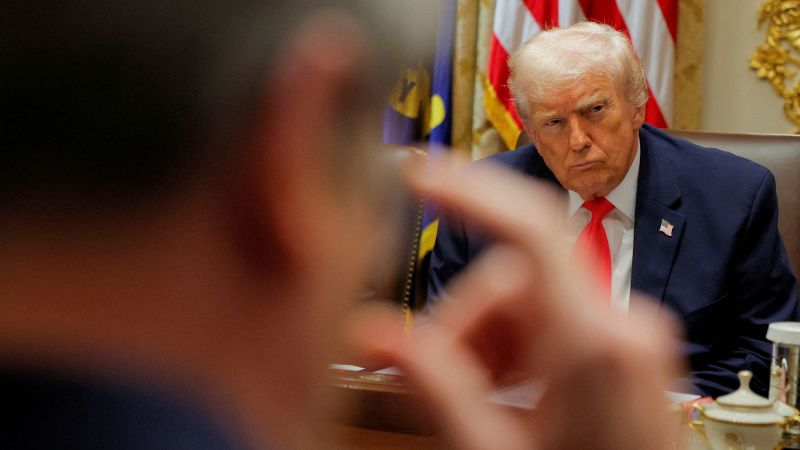
In a Cabinet meeting Tuesday, President Donald Trump made numerous false statements on topics ranging from the economy to foreign policy, continuing a pattern of repeating previously debunked claims.
The meeting, which was televised, featured the president making inaccurate assertions about inflation rates, grocery prices, and prescription drug costs, among other issues. These statements contradicted official government data and economic realities.
On the economy, Trump falsely claimed that “grocery prices are down.” Current Consumer Price Index figures show grocery prices have actually increased approximately 2.7% since September 2024, with a 1.4% rise since January 2025 when Trump returned to office. Most recently, prices grew 0.3% from August to September.
The president also made mathematically impossible claims about prescription drug prices, stating his executive order would “slash drug prices by 200%, 300%, 400%” and even up to “900%.” Such reductions are not possible, as even reducing prices to zero would represent only a 100% reduction.
Regarding inflation, Trump incorrectly stated that his administration had “stopped inflation in its tracks” since January. The year-over-year inflation rate in September was 3.0%, identical to January’s rate, and September marked the fifth consecutive month of increases in the year-over-year rate.
Trump’s claim that he “inherited the worst inflation in history” is demonstrably false. He inherited a 3.0% inflation rate – far below the all-time record of 23.7% set in 1920 or even the 9.1% peak during President Biden’s term in June 2022.
The president significantly inflated figures regarding investment in the United States, claiming to have “secured commitments of over $18 trillion.” Even the White House website listed the figure at $9.6 trillion, which a CNN investigation found to be greatly exaggerated, including vague pledges and statements that don’t constitute actual investment commitments.
On foreign policy, Trump falsely stated that “Biden gave away $350 billion” in aid to Ukraine. The actual figure, according to the federal inspector general overseeing Ukraine assistance, is approximately $94 billion disbursed through June 2025, with about $93 billion more appropriated. A German think tank tracking aid to Ukraine puts the total US allocation at about $133 billion through August.
The president’s claim to have “ended eight wars” and “settled eight wars” is an exaggeration. Several conflicts on his list weren’t actually wars or remain unresolved, including a diplomatic dispute between Egypt and Ethiopia over a dam project, and ongoing fighting in the Democratic Republic of Congo despite a peace agreement.
Trump made additional false claims regarding national security, asserting that military strikes on alleged drug boats in international waters each saved “25,000 lives.” This figure lacks evidence and is inconsistent with the total number of U.S. overdose deaths from all drugs in 2024, which was approximately 82,000.
On energy policy, Trump incorrectly stated that “China doesn’t have gasoline.” China produced more than four million barrels of crude oil daily in 2024, according to the U.S. Energy Information Administration, though significantly less than U.S. production of over 13 million barrels per day.
The president also falsely claimed that under Biden administration policies, “everybody had to own an electric car by 2030.” Biden’s emissions rules aimed to have electric vehicles comprise 35% to 56% of new vehicles sold by 2032, with no mandate for individual ownership or replacement of existing vehicles.
Trump repeated his false claim that the 2020 election was “fake” and “rigged,” despite having legitimately lost to Biden in an election widely recognized as free and fair.
The pattern of repeating debunked claims highlights ongoing concerns about the accuracy of information shared during official White House communications, raising questions about transparency and accountability in government messaging.
Fact Checker
Verify the accuracy of this article using The Disinformation Commission analysis and real-time sources.

8 Comments
Curious to see how this story unfolds and whether the president’s statements will face further scrutiny. Maintaining economic stability and consumer confidence should be a top priority, so accuracy in public messaging is essential.
It’s concerning to see the president making inaccurate statements about inflation and grocery prices. Fact-checking is crucial to ensure the public has access to reliable economic information, especially on important issues like the cost of living.
I agree, it’s important for leaders to be held accountable for the accuracy of their public statements. Fact-checking helps provide a reality check and maintain trust in government.
It’s disappointing to see the president make false statements about the economy, especially on issues that directly impact people’s daily lives. Reliable information from trusted sources is key during challenging economic times.
The president’s statements on inflation and grocery prices seem to be at odds with the data. I hope this leads to a deeper discussion on the complexities of the economy and the importance of evidence-based decision-making.
Interesting to see the president making such questionable economic claims. I wonder how the public will react to these statements that seem to contradict official data. Could be a sign of more partisan rhetoric ahead of the upcoming election.
While I appreciate the president’s efforts to address economic concerns, making claims that contradict official data is concerning. Fact-based policymaking and clear communication are vital for effective governance.
These false claims about prescription drug price reductions seem mathematically impossible. I wonder if the president is trying to oversell the impact of his executive orders. Transparency and honesty from elected officials is critical.