


Listen to the article
The longstanding assumption that economic growth depends on fossil fuels is facing robust challenges as renewable energy continues to transform global economies. Climate expert and former U.S. climate negotiator Lia Newman has stepped forward to address what she calls an “outdated and misleading” narrative promoted by fossil fuel advocates.
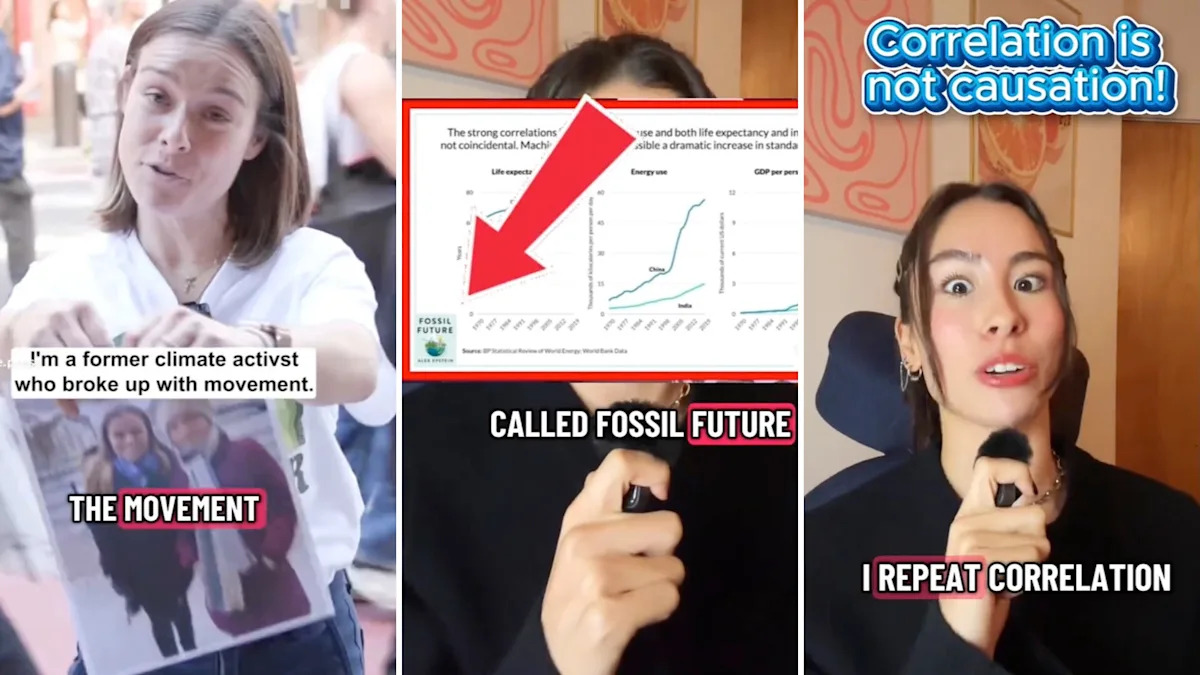
Newman recently confronted claims made in a video by The Free Press featuring former climate activist Lucy Biggers. The video presented graphs suggesting a direct correlation between fossil fuel usage and economic prosperity. Newman pointed out that these graphics originated from fossil fuel advocate Alex Epstein, raising questions about the objectivity of the presentation.
“This ‘fossil [fuels] equals development’ myth is outdated and misleading,” Newman stated in her TikTok response. She emphasized a fundamental scientific principle often overlooked in energy debates: “Correlation is not causation.”
Newman clarified that economic improvements in developing regions aren’t directly caused by fossil fuels themselves. Rather, the correlation exists because fossil fuel usage has historically accompanied industrial development, manufacturing expansion, and job creation. However, this traditional relationship is now being disrupted by the rise of renewable energy technologies.
Global economic data increasingly shows that countries can achieve robust economic growth while simultaneously reducing their reliance on high-emission energy sources. China and India, often cited as examples of fossil-fuel-dependent growth, are actually experiencing some of the world’s most dramatic renewable energy expansions. Both nations are making significant investments in solar, wind, and other clean technologies while continuing their economic advancement.
A key metric Newman highlighted is emissions intensity—the amount of pollution generated per unit of GDP. This figure has been steadily declining globally, demonstrating that economies are becoming more efficient, producing greater economic value while generating less pollution.
“This shows a decoupling that, although GDP can rise, emissions or emission intensity can drop,” Newman explained.
This decoupling is already evident in several regions. The United States, European Union, Japan, South Korea, Australia, and New Zealand have all demonstrated continued economic growth while reducing overall emissions. Even more notably, emerging economies in China, India, Africa, and Latin America are beginning to show similar divergence between GDP growth and emissions increases.
The economic impact of renewable energy extends beyond environmental benefits. The sector has become a major job creator, with employment in solar, wind, and other clean energy technologies growing significantly faster than traditional energy sectors in many markets. According to the International Renewable Energy Agency, renewable energy employment reached 12.7 million globally in 2022, with continued strong growth projected.
The investment landscape reflects this shift as well, with global investment in renewable energy capacity reaching $472 billion in 2022, outpacing fossil fuel investments in many regions. Major financial institutions have increasingly redirected capital from fossil fuels toward clean energy projects, recognizing both the environmental imperatives and economic opportunities.
“This video presents a false choice—development or tackling emissions—which is just not true,” Newman said in reference to The Free Press video. “Don’t be fooled by these points promoted by the fossil fuel industry.”
The debate comes at a critical time as countries worldwide navigate energy transitions while addressing economic development goals. The evidence Newman presents suggests that the traditional fossil fuel pathway to prosperity is no longer the only—or even the most economically advantageous—option for nations seeking growth.
In an information landscape where energy economics can be misrepresented, Newman’s fact-checking resonated with many viewers seeking clarity on these complex relationships. As one commenter noted approvingly, “Correlation is not causation is my anthem.”
Fact Checker
Verify the accuracy of this article using The Disinformation Commission analysis and real-time sources.

8 Comments
Fascinating to see the expert push back against the selective use of data to support a specific agenda. Careful analysis of the full context is crucial when evaluating complex energy and economic issues.
Yes, the expert rightly points out that correlation does not equal causation. A more holistic, evidence-based approach is needed to understand the dynamics at play.
This highlights the importance of scrutinizing claims, even from those presented as ‘experts.’ An objective, fact-based perspective is essential when it comes to such impactful policy debates.
Agreed. The expert’s willingness to challenge misleading narratives, regardless of the source, is commendable. Rigorous analysis is key to informing sound energy and economic policies.
This expert’s response demonstrates the value of critical thinking and fact-checking, even when confronting claims from influential sources. Nuance and objectivity are essential in these important policy debates.
It’s encouraging to see an expert confront outdated assumptions and promote a more nuanced understanding of the complex relationship between energy, climate, and economic development.
This expert’s response helps clarify the complex relationship between energy sources and economic development. It’s important to look beyond simplistic correlations and understand the nuanced factors at play.
Agreed, the ‘fossil fuels = development’ narrative is overly reductive. Renewable energy is increasingly driving economic growth, and the evidence suggests fossil fuels are not strictly necessary for development.