


Listen to the article
Russian Disinformation Campaigns Target Côte d’Ivoire’s Democratic Stability
As Côte d’Ivoire approaches its October presidential election, the West African democracy has become the target of sophisticated disinformation operations linked to Russia and neighboring military-ruled states. Security experts believe these campaigns aim to destabilize one of the region’s few remaining democratic strongholds.
In August, social media accounts with tens of thousands of followers disseminated false reports of violent unrest in Abidjan during peaceful protests against President Alassane Ouattara. According to Côte d’Ivoire’s National Agency for Information System Security, these accounts “attempted to show there had been an insurrection to incite unrest.” The agency’s investigation traced the disinformation campaign to accounts “mainly identified as having links to Burkina Faso and its supporters.”
One Burkinabe group with over 116,000 followers falsely claimed that “gunshots were reportedly heard in the west of the city and dozens of people were killed,” despite no evidence of such violence.
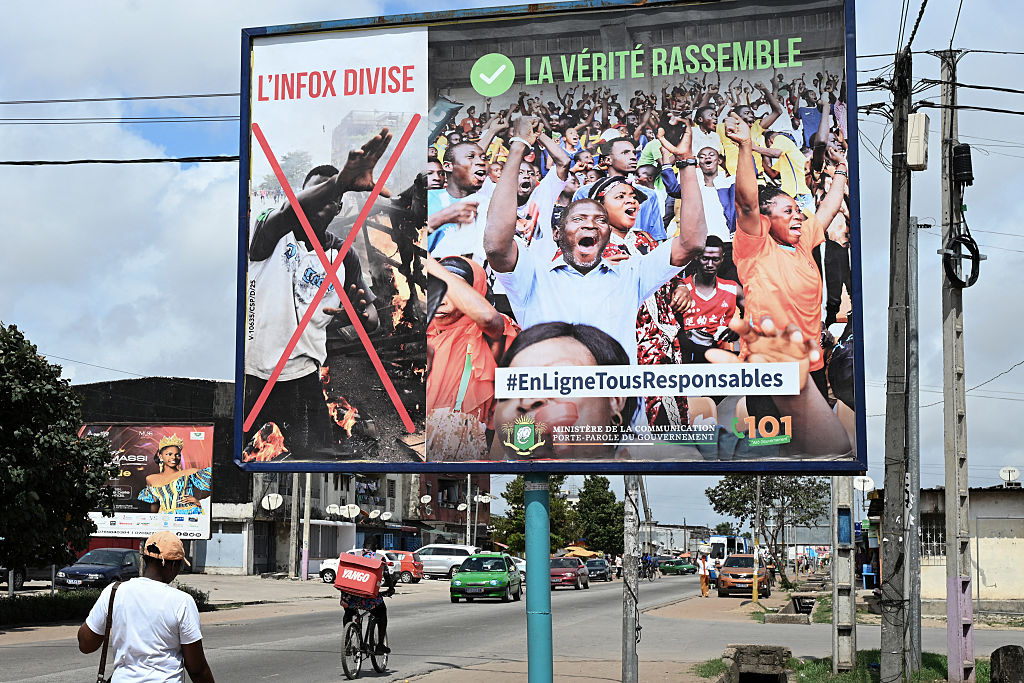
This incident follows a pattern of targeted disinformation against Côte d’Ivoire. In March, a campaign falsely reported President Ouattara’s death, while in May, another spread fabricated claims that he had been captured in a coup. Ivoirian Communications Minister Amadou Coulibaly told the BBC that cybersecurity investigations traced these false narratives to “neighboring countries.”
The campaigns appear politically motivated. Ouattara has been a vocal opponent of the military coups that brought juntas to power in Burkina Faso, Mali, and Niger. These three countries subsequently withdrew from the Economic Community of West African States (ECOWAS) to form the Alliance of Sahel States, which maintains close ties with Russia.
Security analysts see these operations as part of Russia’s broader information warfare strategy in the region. The Kremlin’s disinformation campaigns helped destabilize the Sahel well before Russian mercenaries arrived in these countries. In February 2023, networks connected to the Wagner Group spread rumors of a coup in Niger. By July, the military had overthrown the democratically elected president, and within a month, the junta had requested Wagner’s assistance.
“They are in the eye of the storm,” a West African official told the European Council on Foreign Relations regarding Côte d’Ivoire’s position.
Will Brown, a researcher for the Council, noted in an October 2025 policy brief that “Russia and Russia-trained Burkinabè teams were aiming much of their resources at Ivory Coast ahead of the presidential election.” Brown added that “Moscow has developed a powerful propaganda machine that taps into existing antipathy towards Europe, particularly France, to push African governments closer to its foreign policy objectives.”
The Rapid Intervention Communication Battalion (BIR-C), a group sharing the Burkinabe military junta’s propaganda, plays a significant role in these operations. A Sahel-based security analyst told Agence France-Presse that independent investigations have linked these accounts to military juntas, “including individuals directly linked to the Burkinabè junta, such as the two brothers of Captain Ibrahim Traore,” Burkina Faso’s junta leader.
Traore’s younger brother, Kassoum, manages the junta leader’s social media communications and is suspected of running the BIR-C alongside older brother Inoussa, who serves as Traore’s special advisor for digital economy.
Jeremy Cauden, co-director of Afriques Connectees, an Abidjan-based online reputation management company, explained that accounts supporting the military leaders of Burkina Faso, Mali, and Niger actively share critiques of President Ouattara. “The key to the success of the BIR-C is their ability to seize on current events, turn them into distorted and manipulated content and spread this via very active accounts with a huge audience in a coordinated and rapid manner,” Cauden told AFP.
Beverly Ochieng, an analyst at Control Risks consulting company, predicts these disinformation efforts will persist. “Destabilizing the Ivoirian electoral process allows juntas to divert attention from their own [promised political] transitions and justify them continuing to hold onto power by discrediting neighboring democratic alternatives,” she explained.
As Côte d’Ivoire’s October election approaches, the country faces not only domestic political challenges but also an intensifying information war aimed at undermining its democratic institutions and regional leadership position.
Fact Checker
Verify the accuracy of this article using The Disinformation Commission analysis and real-time sources.

11 Comments
It’s troubling to see social media accounts with large followings being used to spread disinformation. Côte d’Ivoire’s authorities must stay vigilant and quickly debunk any false claims to prevent them from gaining traction.
It’s worrying to see this type of cross-border disinformation targeting Côte d’Ivoire. The authorities will need to be proactive in monitoring social media and swiftly countering any false claims that could undermine the democratic process.
This is a concerning trend. Disinformation campaigns aimed at destabilizing democratic governments are a serious threat to regional stability. I hope the authorities in Côte d’Ivoire can effectively counter these malicious efforts.
Agreed. Vigilance and proactive public education are key to combating such cross-border propaganda. Maintaining strong democratic institutions will be crucial during this election period.
Targeting a relatively stable democracy like Côte d’Ivoire with false claims of unrest is a worrying tactic. I wonder what the motivations are behind these disinformation campaigns originating from neighboring countries.
Exporting instability and undermining democratic legitimacy could be the goal. Côte d’Ivoire will need to work closely with regional partners to identify and shut down the sources of these malicious narratives.
Sophisticated disinformation campaigns targeting fragile democracies are a growing global concern. I hope the international community can provide support to Côte d’Ivoire as they work to safeguard their electoral process.
Agreed. Strengthening cybersecurity, media literacy, and regional cooperation will all be crucial in this fight against malign foreign interference.
Disinformation campaigns that try to incite unrest and violence are a serious threat to democracy. Côte d’Ivoire will need to work closely with social media platforms and international partners to quickly identify and debunk these false narratives.
Absolutely. Maintaining public trust in electoral processes and democratic institutions will be crucial in the face of these malign influence operations.
This is a concerning pattern of behavior from Russia and its allies in the region. Undermining democratic stability in Côte d’Ivoire could have broader implications for West Africa. Vigilance is needed to counter these divisive tactics.