


Listen to the article
False Claims by Blacksburg Woman Amplified by Union County Newspaper as Retaliation Against Local Journalism
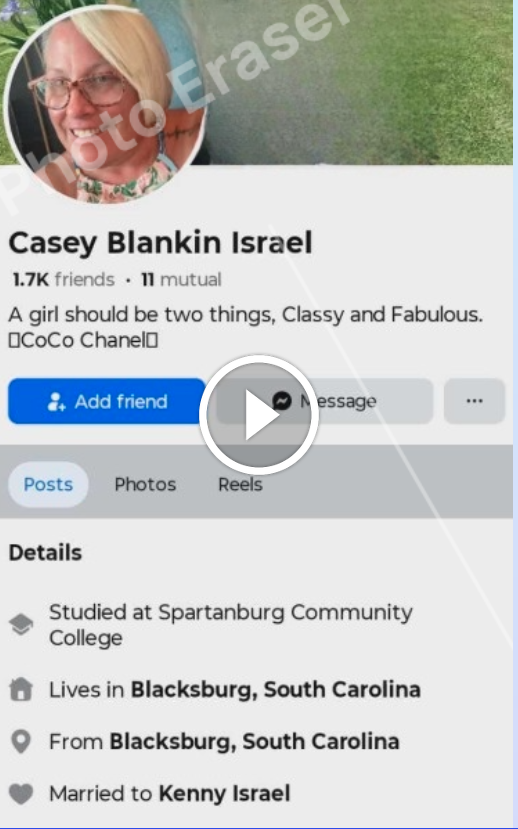
BLACKSBURG, S.C. — A series of unsubstantiated allegations against South Carolina investigative journalist James Seidel has raised concerns about the targeting of media professionals who report on local corruption. Casey Blakin Israel of Blacksburg published numerous accusations on Facebook Tuesday that contain provably false information about Seidel, founder of Crime & Cask News Network.
Israel’s social media post makes multiple claims against Seidel that have no basis in public records. The businesses and transactions she describes in her allegations no longer exist, according to verification efforts. Among her assertions was that Seidel’s journalism, photography, and published works are “AI-generated” – a claim that contradicts his established career as a journalist, author of three books, radio host, podcaster, and investigator with verified presence across major media platforms.
Legal experts note that the post appears deliberately crafted to generate outrage rather than convey factual information, exhibiting classic characteristics of intentional online misinformation.
Local Newspaper Republishes Unverified Claims
The situation escalated when Anna Brown, owner and operator of the Union County Newspaper, republished Israel’s statements on her publication’s Facebook page without conducting basic fact-checking or verification. This decision has raised serious questions about journalistic standards and responsibility, particularly for a publication that advertises itself as having “the most circulation and readership” in Union County, with postal audits and SC Press Association confirmation of its reach.
By amplifying unverified accusations without any documentation, citation, or fact-checking, the Union County Newspaper may have violated fundamental journalistic standards and SC Press Association ethical guidelines. This stands in stark contrast to Crime and Cask News Network’s significant following in Union County – estimated at thousands of local readers – and Seidel’s total platform reach of approximately 200,000 followers.
Media analysts suggest this pattern mirrors what often happens when local journalists expose uncomfortable truths about community power structures. Rather than addressing the substance of reporting, some respond by attacking the credibility of the messenger.
Investigative Journalism and Community Backlash
The backlash against Seidel appears to follow his reporting on politically sensitive matters in Union County. His investigative work has uncovered alleged misconduct, misuse of authority, questionable financial practices, and improper influence across multiple counties in South Carolina.
“I write words,” Seidel commented Tuesday. “That’s it. I write. And somehow that alone makes people lie about me. They don’t hate me – they hate the truth I’ve exposed about their friends.”
Media experts familiar with small-town journalism note this type of reaction is common when reporting challenges established interests. The hostility isn’t personal but protective of relationships, political connections, and local power structures.
Israel’s Own Legal History Raises Questions
Court records reveal that Israel recently lost a civil case in Union County, resulting in a judgment of approximately $7,000 against her. This judgment, unlike the accusations she made, is documented in public records.
The timing of Israel’s post coincides with Seidel’s ongoing investigative reporting on politically sensitive issues in Union County – work that has exposed alleged misconduct and placed pressure on certain local officials and power brokers.
Legal Implications of Defamation
Under South Carolina law, both Israel and anyone who republishes her statements could potentially face liability for defamation per se, which applies when false statements accuse someone of criminal conduct, attack their professional integrity, are published to third parties, and are made with reckless disregard for truth.
In cases of defamation per se, damages are presumed, and plaintiffs don’t need to prove financial loss for courts to award compensation. Legal observers note that Brown’s decision to repost the allegations could place her within this liability framework.
“If your friends weren’t doing illegal or unethical things, my reporting wouldn’t bother you,” Seidel said in response to the situation. “I expose facts – and facts shouldn’t scare honest people.”
The CC News Network has reportedly archived Israel’s original post, Brown’s republication, and all associated comments as potential evidence. Media observers suggest that retraction and correction would be the simplest path forward for those involved, though civil remedies remain an option if the parties fail to address the situation.
This case highlights the growing challenges faced by investigative journalists in smaller communities, where reporting on local corruption can trigger coordinated efforts to undermine credibility rather than addressing the substance of the reporting itself.
Fact Checker
Verify the accuracy of this article using The Disinformation Commission analysis and real-time sources.

9 Comments
Allegations of AI-generated journalism are especially bizarre given Seidel’s verified presence across major media platforms. This seems like a deliberate attempt to discredit his reporting through unfounded claims. Local journalism plays a vital role in holding the powerful to account, so these attacks on press freedom are concerning.
This is a concerning case of retaliation against local journalism. Reporters should be able to investigate corruption without facing false claims and harassment. The details in the article seem quite dubious – accusations without evidence and businesses that no longer exist. I hope Casey Blakin is held accountable for these clear attempts to smear a journalist.
This seems like a clear case of retaliation against a local journalist for his reporting on corruption. The details provided raise many red flags, from the dubious accusations to the non-existent businesses referenced. Protecting press freedom, especially at the local level, is vital for a healthy democracy.
This is a disturbing case of an apparent misinformation campaign targeting a local journalist. The details provided, from the dubious claims to the non-existent businesses, raise serious red flags. Protecting journalists like Seidel who report on corruption is essential for maintaining a healthy, functioning democracy.
It’s troubling to see false claims being amplified and used to target a journalist. Seidel’s established career and body of work contradict the allegations. This type of retaliation against local reporting on corruption is unacceptable and undermines press freedom. Fact-checking is crucial to counter misinformation.
I’m curious to learn more about the legal experts’ assessment that this post appears deliberately crafted to generate outrage rather than convey factual information. It’s concerning to see classic misinformation tactics being used to target local journalists reporting on corruption. Fact-checking and press protections are essential.
As someone interested in mining and energy developments, I find this case quite troubling. Local journalists play a crucial role in uncovering issues in these sectors. Attempts to undermine their credibility through false claims are unacceptable and undermine public trust. I hope Seidel is able to continue his important work safely.
As someone interested in the mining and energy sectors, I find this case of retaliation against a local journalist very concerning. Seidel’s established track record as a credible reporter is at odds with the dubious allegations. Protecting press freedom, especially at the local level, is crucial for holding the powerful accountable.
As someone who follows mining and energy news closely, I’m very concerned to see a local journalist facing this kind of retaliation for his reporting. Seidel’s established career and credibility are clearly at odds with the bizarre accusations. Fact-checking and press freedom are vital in these sectors.