


Listen to the article
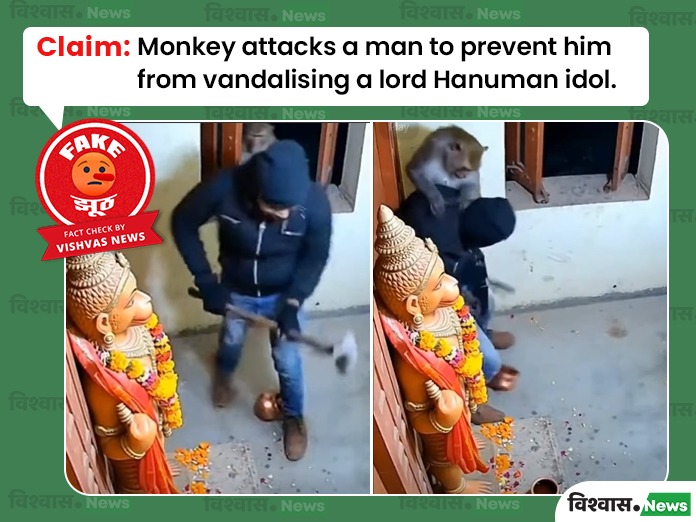
The viral video claiming to show a monkey defending a Hanuman idol from vandalism has been conclusively debunked as an AI-generated fabrication, according to an investigation by fact-checking organization Vishvas News.
The 10-second clip, which circulated widely on social media platforms, purportedly showed a man attempting to damage a statue of the Hindu deity Hanuman before being attacked by a monkey. Many viewers interpreted this as divine intervention, with Facebook user Ramendra Jha sharing it on February 10 with the caption: “A fanatic ignorant person came to vandalise the idol of Bajrangbali, but Bajrangbali’s messenger taught him such a lesson that everyone was stunned.”
However, digital forensic analysis revealed multiple inconsistencies typical of AI-generated content. Most notably, investigators identified what experts call “digital hallucinations” – visual anomalies where objects unnaturally change shape or appearance. In this case, the hammer used in the supposed vandalism visibly morphs throughout the video.
To verify these initial observations, Vishvas News employed multiple AI detection tools. The Hive moderation system flagged the video with 99% certainty as an artificial creation, while a second analysis using SightEngine’s detection technology confirmed an 80% probability of AI manipulation.
“If you look closely at the top of the hammer in the video, it appears to melt and form into various shapes,” noted AI expert Azahar Machwe, who was consulted during the investigation. These telltale distortions are consistent with limitations in current AI video generation technology, which often struggles to maintain consistent physical properties of objects.
The Facebook account that originally shared the video belongs to a user followed by over 8,000 people. Created in May 2022, the account appears to have substantial reach, potentially allowing the fabricated content to spread rapidly across social networks.
The debunking of this video comes amid growing concerns about the potential for AI-generated content to inflame religious tensions. Religious imagery and alleged desecration are particularly sensitive topics in India, where communal harmony can be fragile. False claims of temple vandalism have previously triggered real-world violence and unrest.
This incident highlights the increasing sophistication of AI video generation tools and their potential for misuse in creating divisive content. As these technologies become more accessible, the challenge for fact-checkers and media literacy advocates grows proportionally.
Tech companies and digital platforms are under mounting pressure to develop and deploy more effective detection systems that can automatically flag synthetic media. However, as AI generation capabilities improve, distinguishing between authentic and fabricated content becomes increasingly difficult.
Media experts recommend that viewers exercise heightened skepticism when encountering emotionally charged videos online, particularly those depicting controversial or potentially inflammatory events. Telltale signs of AI generation include unnatural movements, objects that change shape, inconsistent lighting, and unusual visual artifacts.
Vishvas News has conclusively rated the viral claim as “False” in their fact-check review system, emphasizing that no such incident of vandalizing a Hanuman idol, as depicted in the video, actually occurred.
Fact Checker
Verify the accuracy of this article using The Disinformation Commission analysis and real-time sources.

14 Comments
This is a good reminder of the need for increased digital media literacy, especially as AI-generated content becomes more sophisticated and harder to distinguish from the real thing. Kudos to the fact-checkers for taking the time to thoroughly investigate and expose this fabrication.
Absolutely. As AI capabilities continue advancing, being able to critically assess the authenticity of online content will be an increasingly essential skill. Fact-checking organizations play a vital role in maintaining trust and transparency.
I’m glad the truth about this viral video was uncovered, but it’s concerning to think about the broader implications of AI-generated content being used to spread misinformation. Fact-checking efforts like this play a vital role in maintaining accountability and preserving the integrity of online discourse.
You’re right. As AI becomes more advanced and accessible, the potential for misuse will only grow. Robust fact-checking and public education will be essential to combat the spread of fabricated media and maintain trust in digital information.
Fascinating to see how advanced AI has become in generating realistic-looking video content. While this ‘monkey video’ may have seemed convincing at first glance, it’s good that fact-checkers were able to conclusively debunk it as a fabrication. Transparency around AI-generated media will be crucial going forward.
You’re right, these AI-generated fakes can be quite deceptive. It’s a good thing experts were able to identify the inconsistencies and digital anomalies that gave it away as non-authentic.
I’m curious to know more about the technical details behind how the fact-checkers were able to detect this as AI-generated content. What specific tools and methods did they use to verify the inauthenticity of the video?
That’s a great question. The article mentions they used ‘multiple AI detection tools’, including the Hive moderation system, which flagged it with 99% certainty as an artificial creation. I’d be interested to learn more about the specific algorithms and techniques they employed as well.
It’s concerning to see how easily manipulated and misled the public can be by these types of AI-generated videos. The technical expertise required to detect the digital anomalies and inauthenticity highlights the need for greater transparency and education around emerging media technologies.
I agree. As AI continues advancing, we’ll likely see more and more attempts to spread misinformation through fabricated visual content. Strengthening digital media literacy will be crucial to empower people to critically evaluate what they see online.
While the viral video may have been intended to spread misinformation, I’m glad the truth was ultimately uncovered. Identifying and addressing the use of AI for the creation of deceptive media content is an important issue that deserves ongoing attention.
Well said. Combating the proliferation of AI-generated disinformation is crucial, especially when it involves sensitive topics like religious iconography and potential vandalism. Rigorous fact-checking is key to upholding factual integrity online.
This story serves as an important reminder of the potential for AI to be misused to create deceptive media. While the technology holds immense promise, robust safeguards and fact-checking processes are essential to prevent the spread of misinformation and maintain public trust.
Absolutely. Responsible development and deployment of AI will require ongoing collaboration between technologists, fact-checkers, and the public to ensure these powerful tools are not exploited for nefarious purposes.