


Listen to the article
U.S. Military Operation in Venezuela Raises Legal Questions on Multiple Fronts
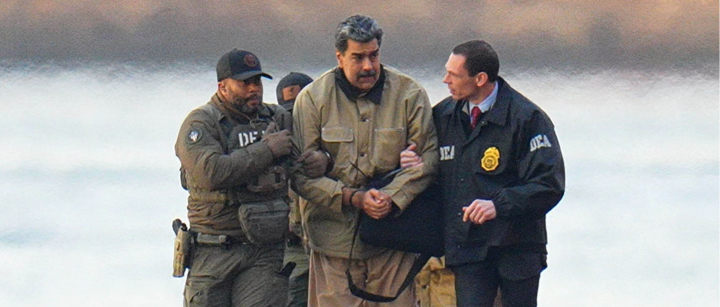
The Trump administration’s January 3 military operation that captured Venezuelan President Nicolás Maduro and his wife, Cilia Flores, has ignited intense debate among legal experts and lawmakers about its legality under both international and U.S. domestic law.
Several Democratic legislators have publicly denounced the operation as a violation of the United Nations Charter and U.S. constitutional requirements. The unfolding controversy highlights longstanding tensions regarding presidential war powers and the role of Congress in authorizing military action abroad.
“It’s clearly illegal under international law, right? Full stop. U.N. charter. No question there,” said Rep. Jim Himes, the top Democrat on the House Intelligence Committee, during a CBS “Face the Nation” appearance on January 4.
Rep. Adam Smith, the ranking Democrat on the House Armed Services Committee, echoed this sentiment, calling the action “blatantly illegal” and noting that “the U.N. Charter is clear” about prohibiting violations of sovereign territory, even to apprehend someone under indictment.
International law experts broadly agree with this assessment. Article 2(4) of the U.N. Charter explicitly prohibits member states from using force against “the territorial integrity or political independence of any state.” This foundational principle has been a cornerstone of the international order since the U.N.’s establishment.
University of Pennsylvania law professor Bill Burke-White characterized the operation as “illegal under international law in every imaginable way,” explaining that force is only justified in two specific circumstances: authorization by the U.N. Security Council or self-defense against an armed attack. Neither condition applied in this case, according to Burke-White and other experts.
U.N. Secretary-General Antonio Guterres expressed “deep concern” that international law rules were not respected and warned about the dangerous precedent this could establish in state relations.
The Trump administration has mounted a defense based on Article 51 of the U.N. Charter, which preserves a nation’s “inherent right of self-defense.” U.N. Ambassador Mike Waltz and Secretary of State Marco Rubio have portrayed Maduro as a “drug kingpin” whose regime represents a direct threat to U.S. security.
“We can’t have a country where the people in charge of its military and in charge of its police department are openly cooperating with drug trafficking organizations,” Rubio stated on NBC’s “Meet the Press.”
However, legal experts dispute this interpretation. Stanford Law School professor Tom Dannenbaum noted that “drug trafficking does not satisfy that threshold” of what constitutes an armed attack, explaining that the concept of “armed attack” refers to “the ‘most grave’ forms of the use of armed force” with direct injurious consequences.
The administration has also pointed to a 1989 legal opinion authored by Bill Barr (who later served as Trump’s attorney general) and the U.S. invasion of Panama as precedent. Critics counter that the Panama situation differed significantly, as the U.S. claimed to be acting by invitation of the rightful head of state after Panama had declared war on America and Panamanian forces had killed and wounded American servicemembers.
On the domestic front, several Democratic lawmakers have argued that the operation violated U.S. law by proceeding without congressional authorization. Senate Minority Leader Chuck Schumer told ABC that “it’s a violation of the law to do what they did without getting the authorization of Congress.”
Republican lawmakers, including House Speaker Mike Johnson, maintain that the action fell within the president’s Article II powers as commander-in-chief and required only notification of Congress, not prior approval.
Constitutional scholars note significant disagreement over the proper interpretation of war powers. While the Constitution assigns Congress the power to declare war, presidents have increasingly conducted military operations without explicit congressional authorization. The 1973 War Powers Resolution requires presidents to report military actions to Congress within 48 hours, but many legal experts believe this doesn’t override the constitutional requirement for prior authorization.
Harvard Law professor Jack Goldsmith suggests that these legal debates are “largely meaningless” without congressional willingness to assert its authority. “The issue is, why has Congress given the president this massive military force without constraints? Why does it continue to acquiesce in the president’s use of force?” Goldsmith asked.
Democratic senators Tim Kaine, Adam Schiff, and Chuck Schumer, along with Republican senator Rand Paul, have announced plans to force a Senate vote on a war powers resolution that would require congressional approval for any further military action in Venezuela.
Meanwhile, Maduro and his wife have been brought to New York and indicted on cocaine-trafficking conspiracy charges, as the political and legal fallout from this extraordinary operation continues to unfold.
Fact Checker
Verify the accuracy of this article using The Disinformation Commission analysis and real-time sources.

15 Comments
The legality of this operation is murky. On one hand, Maduro is an authoritarian leader accused of atrocities. On the other, unilateral military action by the U.S. against a sovereign nation raises significant concerns over national sovereignty and international law.
This is a murky legal situation. While the U.S. may have legitimate grievances against Maduro, unilateral military action against a sovereign nation appears to breach international law. The legal and diplomatic fallout could be significant.
You’re right, this could set a dangerous precedent if not handled carefully. The legal implications need to be thoroughly examined.
This is a tricky situation. While the U.S. may have legitimate grievances against Maduro, the military strike seems to violate international law. It will be important for legal experts to carefully examine the specifics and implications.
This is a complex legal issue with valid arguments on both sides. The U.S. operation raises serious questions about national sovereignty and the role of international law. It will be interesting to see how this plays out diplomatically and in the courts.
The legality of this U.S. military operation in Venezuela is highly questionable. Even if the intent was to apprehend an authoritarian leader, unilateral action that violates a nation’s sovereignty appears to conflict with the UN Charter. This will likely spark intense debate over presidential war powers and the role of international law.
Interesting development, though the legal questions are quite concerning. I can see valid arguments on both sides, but ultimately the U.S. action appears to run afoul of the UN Charter’s prohibitions on violations of sovereign territory. Curious to see how this plays out.
You make a good point. The legal ambiguity here is troubling and could set a dangerous precedent if not handled carefully.
This is a complex issue with valid concerns on both sides. While the goal of removing an authoritarian leader may have merit, the unilateral military action by the U.S. appears to violate international law. The legal fallout could be significant.
Agreed. The legality of this operation is highly questionable and could have far-reaching diplomatic and legal consequences.
Capturing Maduro may have been the goal, but the U.S. military action in Venezuela raises serious legal questions. Violating national sovereignty, even for a leader accused of abuses, seems to conflict with the UN Charter. This will likely spark intense debate over presidential war powers and international law.
While capturing a leader accused of human rights abuses may seem justified, the legality of the U.S. military action is highly questionable. It appears to violate the UN Charter and could set a dangerous precedent for future interventions.
The legal issues around this U.S. operation in Venezuela are quite concerning. Even if the intent was to apprehend a leader accused of human rights abuses, the violation of national sovereignty is problematic from an international law perspective. This will likely spark intense debate.
While the intent behind this U.S. operation may have been to apprehend an authoritarian leader, the legal issues are quite concerning. Unilateral military action against a sovereign nation appears to contravene international law, and the diplomatic and legal fallout could be significant.
This is a complex legal situation with valid arguments on both sides. Capturing a leader accused of human rights abuses may seem justified, but the U.S. military action in Venezuela raises serious questions about national sovereignty and international law. The legal implications will be important to watch.